







Question: The full case will be found online since it is too long IBM Brand Equity Restoration and Advertising Evolution IBM This case was written by
The full case will be found online since it is too long 
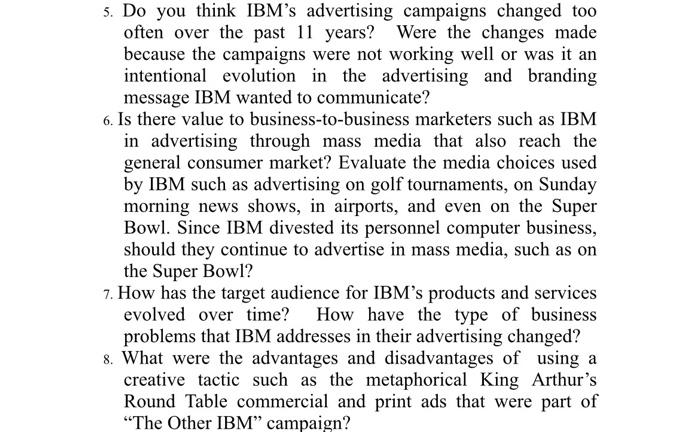
IBM Brand Equity Restoration and Advertising Evolution IBM This case was written by Professor Michele Greenwald, Visiting Professor of Marketing at HEC Paris, for use with Advertising and Promotion: An Integrated Marketing Communications Perspective - 7 edition by George E. Belch and Michael A. Belch. It is intended to be used as the basis for class discussion rather than to illustrate either effective or ineffective handling of a management situation The case was compiled from published sources and interviews with executives at IBM and Ogilvy & Mather: Introduction During the 1970s and 80s, IBM was one of the most successful companies in the world. The company had experienced strong growth in both revenue and profits and had a virtual stranglehold on the market for mainframe computers. In fact the company was often referred to as "Big Blue," a nickname derived from its massive blue mainframe computers For four consecutive years in the 1980s, IBM held the top spot in Fortune magazine's annual list of the most admired companies in the United States. However, by 1993 the quintessential "Blue Chip" company had reached its nadir. Over the three previous years, IBM had lost a total of $15 billion and its stock price was at an 18-year low. The brand had fallen below number 250 in Interbrand's annual survey of the most valued brands with a brand value, estimated at a negative $50 million dollars. The explosive growth of personal computer networks threatened IBM's lucrative mainframe and minicomputer business and the company was struggling to turn the situation around In the late 1980's and early 90's, the drivers of innovation and change in information technology were smaller, nimble companies like Microsoft Compaq, Dell, Oracle and others who offered less expensive systems than IBM that could basically accomplish the same tasks. IBM had fallen behind in technology as its top management stubbornly clung to the notion that traditional mainframes, which had been the company's primary strength, would maintain their dominant position in the marketplace. Compounding the problem was the fact that IBM had become a bloated and inefficient hver the unens und hul 5. Do you think IBM's advertising campaigns changed too often over the past 11 years? Were the changes made because the campaigns were not working well or was it an intentional evolution in the advertising and branding message IBM wanted to communicate? 6. Is there value to business-to-business marketers such as IBM in advertising through mass media that also reach the general consumer market? Evaluate the media choices used by IBM such as advertising on golf tournaments, on Sunday morning news shows, in airports, and even on the Super Bowl. Since IBM divested its personnel computer business, should they continue to advertise in mass media, such as on the Super Bowl? 7. How has the target audience for IBM's products and services evolved over time? How have the type of business problems that IBM addresses in their advertising changed? 8. What were the advantages and disadvantages of using a creative tactic such as the metaphorical King Arthur's Round Table commercial and print ads that were part of "The Other IBM campaign
Step by Step Solution
There are 3 Steps involved in it
1 Expert Approved Answer
Step: 1 Unlock

Question Has Been Solved by an Expert!
Get step-by-step solutions from verified subject matter experts
Step: 2 Unlock
Step: 3 Unlock
 Study Help