







Question: The gain when the system crossing the imaginary axis is. b. The angle of departure are and c. The angle of arrival are . and
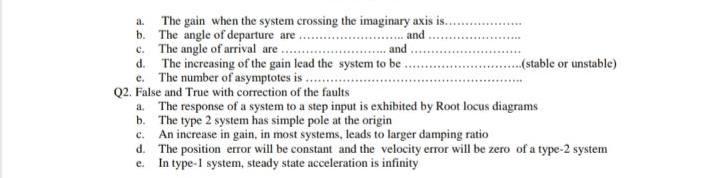
The gain when the system crossing the imaginary axis is. b. The angle of departure are and c. The angle of arrival are . and d. The increasing of the gain lead the system to be ...(stable or unstable) c. The number of asymptotes is Q2. False and True with correction of the faults a. The response of a system to a step input is exhibited by Root locus diagrams b. The type 2 system has simple pole at the origin c. An increase in gain, in most systems, leads to larger damping ratio d. The position error will be constant and the velocity error will be zero of a type-2 system e. In type-1 system, steady state acceleration is infinity The gain when the system crossing the imaginary axis is. b. The angle of departure are and c. The angle of arrival are . and d. The increasing of the gain lead the system to be ...(stable or unstable) c. The number of asymptotes is Q2. False and True with correction of the faults a. The response of a system to a step input is exhibited by Root locus diagrams b. The type 2 system has simple pole at the origin c. An increase in gain, in most systems, leads to larger damping ratio d. The position error will be constant and the velocity error will be zero of a type-2 system e. In type-1 system, steady state acceleration is infinity
Step by Step Solution
There are 3 Steps involved in it

Get step-by-step solutions from verified subject matter experts
 Study Help