





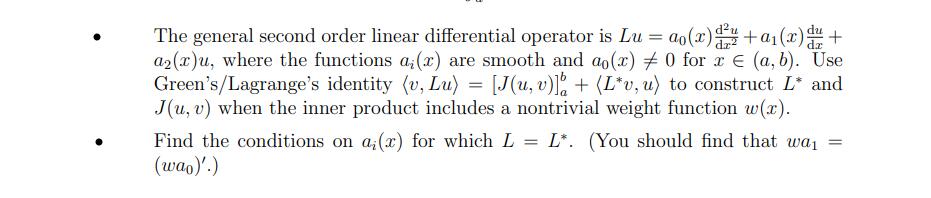
Question: The general second order linear differential operator is Lu = do(x) dzu - daz +ai(x) di + a2(r)u, where the functions as(x) are smooth and
The general second order linear differentialThe general second order linear differential
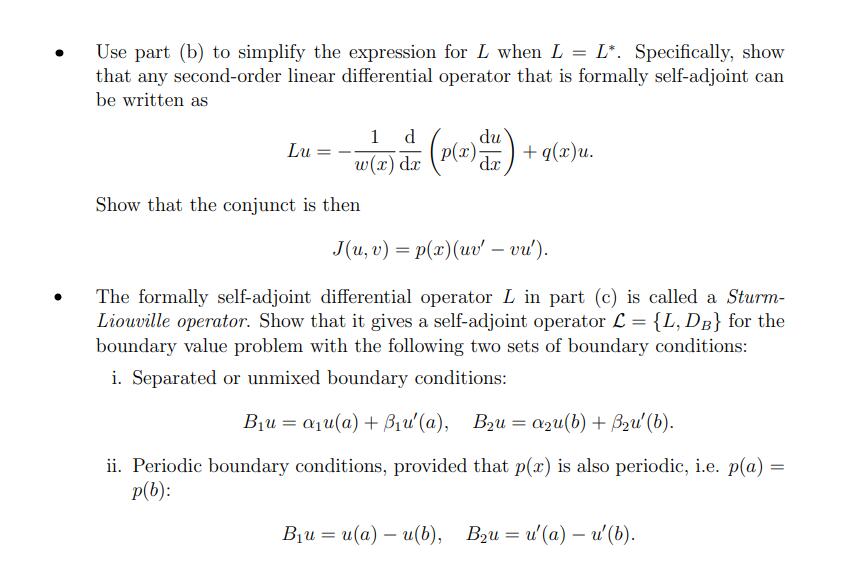
The general second order linear differential operator is Lu = do(x) dzu - daz +ai(x) di + a2(r)u, where the functions as(x) are smooth and do(x) / 0 for r E (a, b). Use Green's/Lagrange's identity (v, Lu) = [J(u, v)], + (L*v, u) to construct L* and J(u, v) when the inner product includes a nontrivial weight function w(x). Find the conditions on a;(x) for which L = L*. (You should find that wal = (wan)'.)Use part (b) to simplify the expression for L when L = *. Specifically, show that any second-order linear differential operator that is formally self-adjoint can be written as 1 d du Lu = w(r) dx (P(x) da + q(x)u. Show that the conjunct is then J(u, v) = p(x)(uv' - vu'). The formally self-adjoint differential operator L in part (c) is called a Sturm- Liouville operator. Show that it gives a self-adjoint operator C = {L, DB} for the boundary value problem with the following two sets of boundary conditions: i. Separated or unmixed boundary conditions: Blu = ju(a) + Blu'(a), Bzu = azu(b) + Bzu'(b). ii. Periodic boundary conditions, provided that p(x) is also periodic, i.e. p(a) = p(b): Biu = u(a) - u(b), Bou = u'(a) - u'(b)

Step by Step Solution

There are 3 Steps involved in it

1 Expert Approved Answer
Step: 1 Unlock blur-text-image

Question Has Been Solved by an Expert!

Get step-by-step solutions from verified subject matter experts

Step: 2 Unlock
Step: 3 Unlock

Students Have Also Explored These Related Mathematics Questions!