


Question: The German Credit data set contains observations on 30 variables for 1000 past applicants for credit. Each applicant was rated as good credit (700 cases)
The German Credit data set contains observations
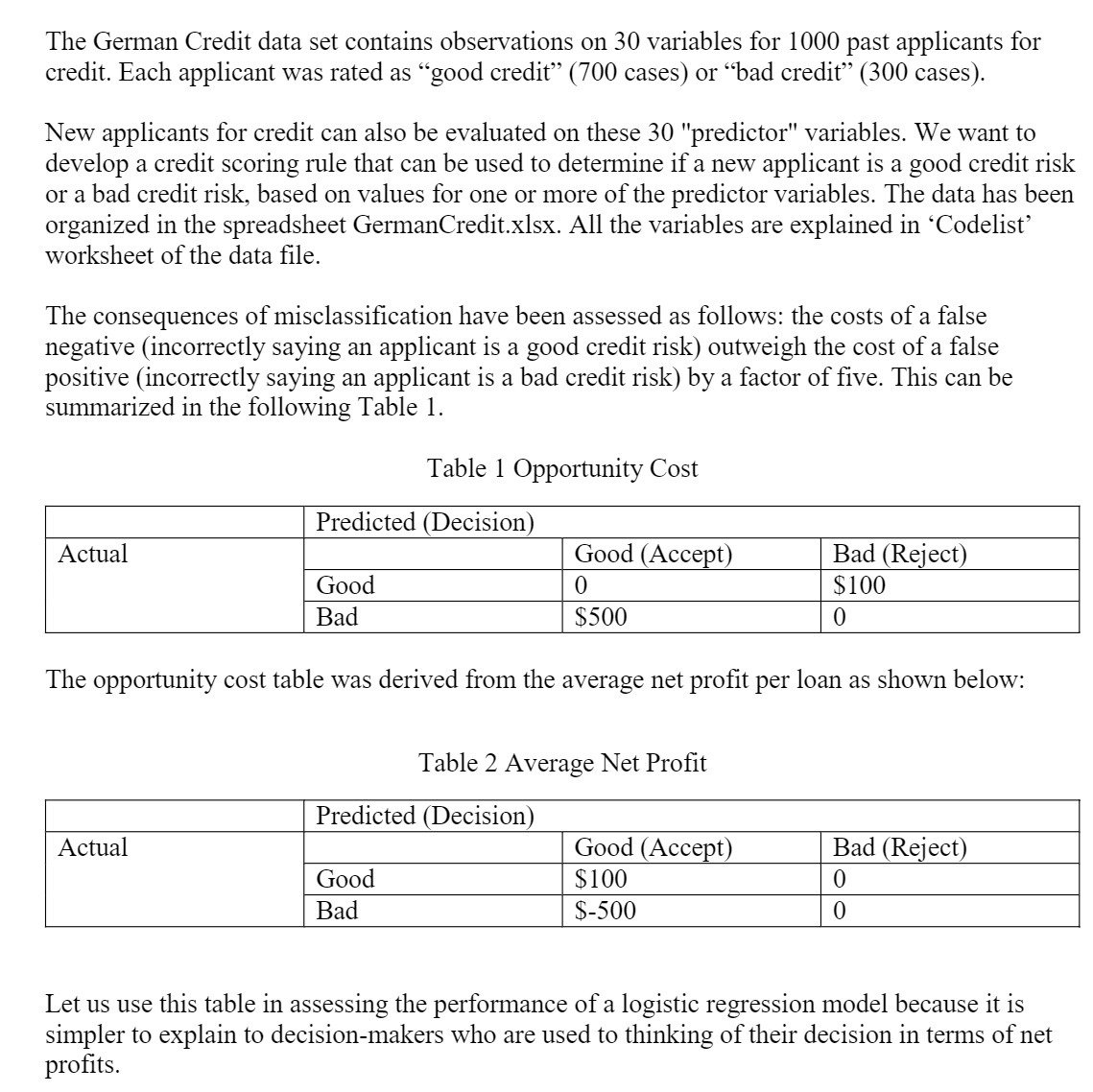
The German Credit data set contains observations on 30 variables for 1000 past applicants for credit. Each applicant was rated as \"good credit\" (700 cases) or \"bad credit\" (300 cases). New applicants for credit can also be evaluated on these 30 "predictor\" variables. We want to develop a credit scoring rule that can be used to determine if a new applicant is a good credit risk or a bad credit risk, based on values for one or more of the predictor variables. The data has been organized in the spreadsheet GennanCredit.Xlsx. All the variables are explained in 'Codelist' worksheet of the data le. The consequences of misclassication have been assessed as follows: the costs of a false negative (incorrectly saying an applicant is a good credit risk) outweigh the cost of a false positive (incorrectly saying an applicant is a bad credit risk) by a factor of five. This can be summarized in the following Table 1. Table l Opportunity Cost Predicted (Decision) Actual Good (Accept) l Bad (Reject) Good 0 l $100 Bad $500 l 0 The opportunity cost table was derived from the average net prot per loan as shown below: Table 2 Average Net Prot Predicted (Decision) Good (Accept) Bad (Reject) $100 55-500 Let us use this table in assessing the performance of a logistic regression model because it is simpler to explain to decision-makers who are used to thinking of their decision in terms of net prots

Step by Step Solution

There are 3 Steps involved in it

1 Expert Approved Answer
Step: 1 Unlock blur-text-image

Question Has Been Solved by an Expert!

Get step-by-step solutions from verified subject matter experts

Step: 2 Unlock
Step: 3 Unlock

Students Have Also Explored These Related Accounting Questions!