







Question: The grey is the answer. Please thoroughly explain why. Thanks! 13.2 The Rate Law 4) See Example 13.3 and Problem 13.79: You are an organic
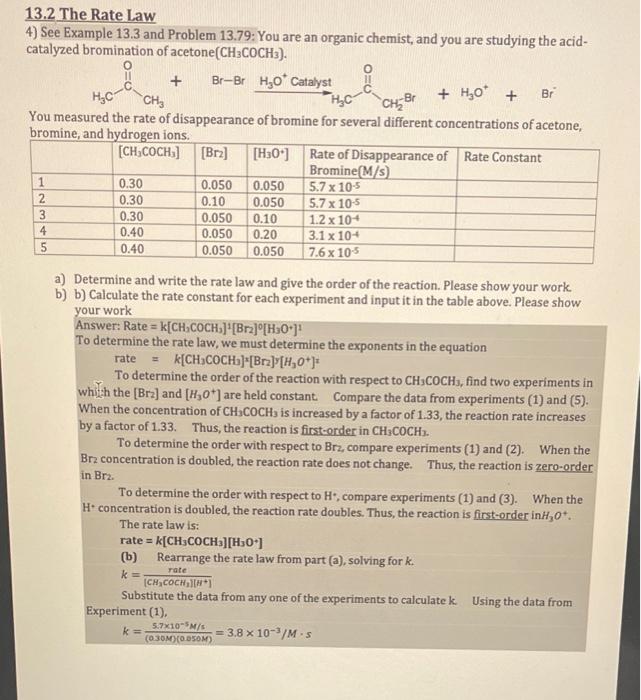
13.2 The Rate Law 4) See Example 13.3 and Problem 13.79: You are an organic chemist, and you are studying the acidcatalyzed bromination of acetone (CH3COCH3). You measured the rate of disappearance of bromine for several different concentrations of acetone, bromine. and hvdrogen ione a) Determine and write the rate law and give the order of the reaction. Please show your work b) b) Calculate the rate constant for each experiment and input it in the table above. Please show your work Answer: Rate =k[CH2COCH3]2[Br2]0[H3O+]1 To determine the rate law, we must determine the exponents in the equation rate =k[CH3COCH3][Br2][H3O+]= To determine the order of the reaction with respect to CH3COCH3, find two experiments in whith the [Br2] and [H3O+]are held constant. Compare the data from experiments (1) and (5). When the concentration of CH3COCH3 is increased by a factor of 1.33, the reaction rate increases by a factor of 1.33. Thus, the reaction is first-order in CH3COCH3. To determine the order with respect to Br, compare experiments (1) and (2). When the Br2 concentration is doubled, the reaction rate does not change. Thus, the reaction is zero-order in Br. To determine the order with respect to H* compare experiments (1) and (3). When the H. concentration is doubled, the reaction rate doubles. Thus, the reaction is first-order in H3O+. The rate law is: rate=k[CH3COCH3][H3O] (b) Rearrange the rate law from part (a), solving for k. k=[(CH2COCH,][H+]rate Substitute the data from any one of the experiments to calculate k Using the data from Experiment (1), k=(030M)5.7105M/s=3.8103/Ms
Step by Step Solution
There are 3 Steps involved in it

Get step-by-step solutions from verified subject matter experts
 Study Help