







Question: The grey is the answer. Please thoroughly explain why. Thanks! 13.3 Relation between Reactant Concentration and Time 6) Example 13.4 and Problem 13.27 The rate
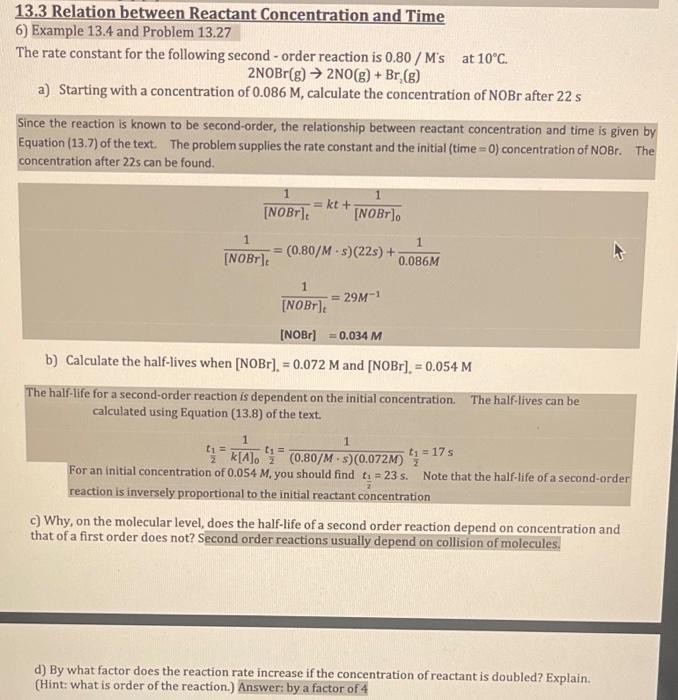
13.3 Relation between Reactant Concentration and Time 6) Example 13.4 and Problem 13.27 The rate constant for the following second - order reaction is 0.80/Ms s at 10C. 2NOBr(g)2NO(g)+Br2(g) a) Starting with a concentration of 0.086M, calculate the concentration of NOBr after 22s Since the reaction is known to be second-order, the relationship between reactant concentration and time is given by Equation (13.7) of the text. The problem supplies the rate constant and the initial (time =0 ) concentration of NOBr. The concentration after 22 s can be found. [NOBr]t1=kt+[NOBr]01[NOBr]t1=(0.80/Ms)(22s)+0.086M1[NOBr]t1=29M1[NOBr]=0.034M b) Calculate the half-lives when [NOBr]=0.072M and [NOBr], =0.054M The half-life for a second-order reaction is dependent on the initial concentration. The half-lives can be calculated using Equation (13.8) of the text. t1=k[A]01t1=(0.80/Ms)(0.072M)1t12=17s For an initial concentration of 0.054M, you should find t21=23s. Note that the half-life of a second-order reaction is inversely proportional to the initial reactant concentration c) Why, on the molecular level, does the half-life of a second order reaction depend on concentration and that of a first order does not? Second order reactions usually depend on collision of molecules. d) By what factor does the reaction rate increase if the concentration of reactant is doubled? Explain. (Hint: what is order of the reaction.) Answer: by a factor of 4
Step by Step Solution
There are 3 Steps involved in it

Get step-by-step solutions from verified subject matter experts
 Study Help