







Question: The Hard Rock Mining Company is developing cost formulas for management planning and decision-making purposes. The company's cost analyst has concluded that utilities cost is
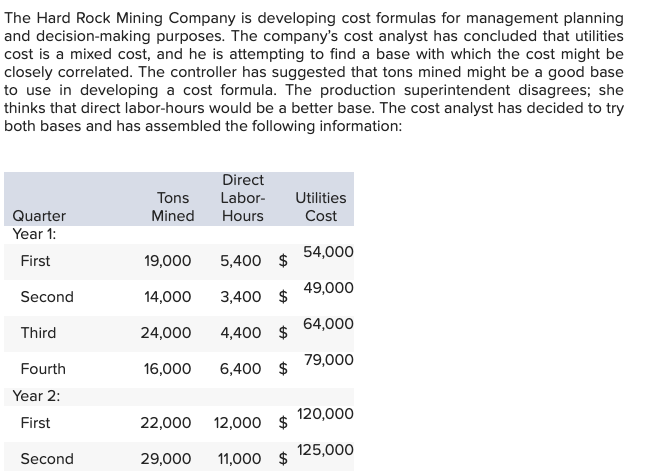
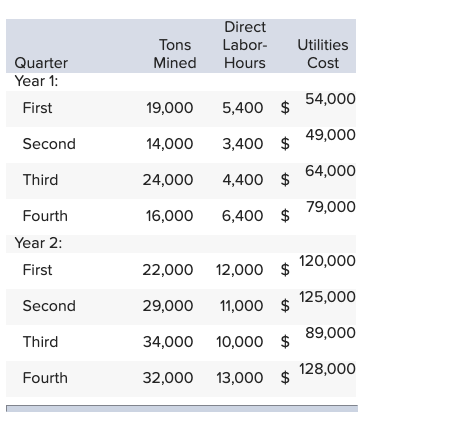
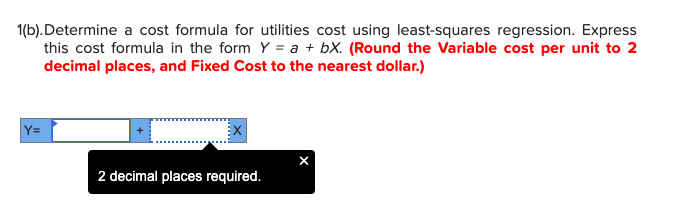
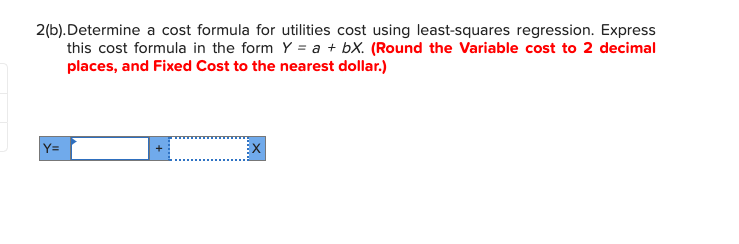
The Hard Rock Mining Company is developing cost formulas for management planning and decision-making purposes. The company's cost analyst has concluded that utilities cost is a mixed cost, and he is attempting to find a base with which the cost might be closely correlated. The controller has suggested that tons mined might be a good base to use in developing a cost formula. The production superintendent disagrees; she thinks that direct labor-hours would be a better base. The cost analyst has decided to try both bases and has assembled the following information: Tons Mined Direct Labor- Hours Utilities Cost Quarter Year 1: First 54,000 19,000 5,400 $ 49,000 Second 14,000 3,400 $ 64,000 Third 24,000 4,400 $ 79,000 Fourth 16,000 6,400 $ Year 2: 120,000 First 22,000 12,000 $ 125,000 Second 29,000 11,000 $ Tons Mined Direct Labor- Hours Utilities Cost Quarter Year 1: First 54,000 19,000 5,400 $ 49,000 Second 14,000 3,400 $ 64,000 Third 24,000 4,400 $ 79,000 16,000 6,400 $ Fourth Year 2: First 120,000 22,000 12,000 125,000 Second 29,000 11,000 89,000 Third 34,000 10,000 $ 128,000 Fourth 32,000 13,000 1(b).Determine a cost formula for utilities cost using least-squares regression. Express this cost formula in the form Y = a + bx. (Round the Variable cost per unit to 2 decimal places, and Fixed Cost to the nearest dollar.) Y= X 2 decimal places required. 2(b).Determine a cost formula for utilities cost using least-squares regression. Express this cost formula in the form Y = a + bx. (Round the Variable cost to 2 decimal places, and Fixed Cost to the nearest dollar.) EX The Hard Rock Mining Company is developing cost formulas for management planning and decision-making purposes. The company's cost analyst has concluded that utilities cost is a mixed cost, and he is attempting to find a base with which the cost might be closely correlated. The controller has suggested that tons mined might be a good base to use in developing a cost formula. The production superintendent disagrees; she thinks that direct labor-hours would be a better base. The cost analyst has decided to try both bases and has assembled the following information: Tons Mined Direct Labor- Hours Utilities Cost Quarter Year 1: First 54,000 19,000 5,400 $ 49,000 Second 14,000 3,400 $ 64,000 Third 24,000 4,400 $ 79,000 Fourth 16,000 6,400 $ Year 2: 120,000 First 22,000 12,000 $ 125,000 Second 29,000 11,000 $ Tons Mined Direct Labor- Hours Utilities Cost Quarter Year 1: First 54,000 19,000 5,400 $ 49,000 Second 14,000 3,400 $ 64,000 Third 24,000 4,400 $ 79,000 16,000 6,400 $ Fourth Year 2: First 120,000 22,000 12,000 125,000 Second 29,000 11,000 89,000 Third 34,000 10,000 $ 128,000 Fourth 32,000 13,000 1(b).Determine a cost formula for utilities cost using least-squares regression. Express this cost formula in the form Y = a + bx. (Round the Variable cost per unit to 2 decimal places, and Fixed Cost to the nearest dollar.) Y= X 2 decimal places required. 2(b).Determine a cost formula for utilities cost using least-squares regression. Express this cost formula in the form Y = a + bx. (Round the Variable cost to 2 decimal places, and Fixed Cost to the nearest dollar.) EX
Step by Step Solution
There are 3 Steps involved in it

Get step-by-step solutions from verified subject matter experts
 Study Help