







Question: THE IEEE STANDARD FOR FLOATING-POINT (TEEE 754) A technical standard for floating-point computation established in 1985 by the Institute of Electical and Electronics Engineers EE).
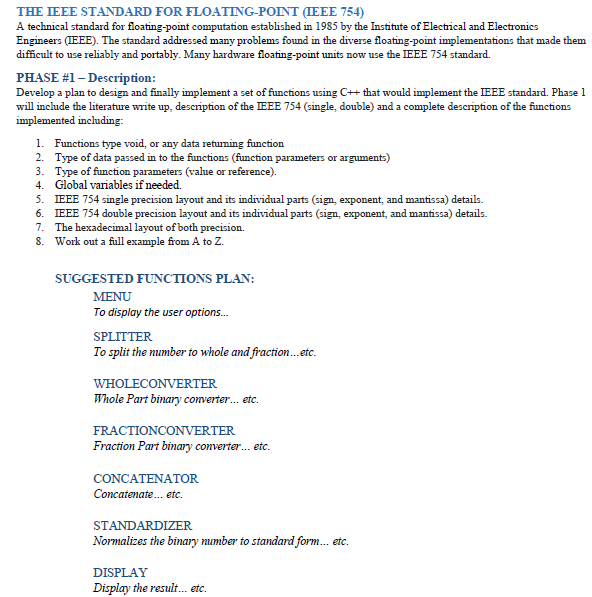
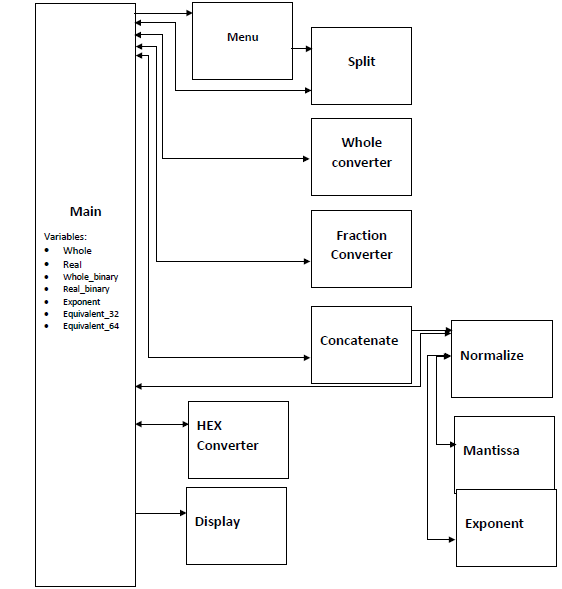

THE IEEE STANDARD FOR FLOATING-POINT (TEEE 754) A technical standard for floating-point computation established in 1985 by the Institute of Electical and Electronics Engineers EE). The standard addressed many problems found n the diverse floating-point implementations that made them difficult to use reliably and portably. Many hardware floating-point units now use the IEEE 754 standard. PHASE #1-Description Develop a plan to design and finally implement a set of functions using C++that would implement the IEEE standard. Phase 1 will include the literature write up, description of the IEEE 754 (single, double) and a complete description of the functions 1. Functions type void, or any data retuning function 2. Type of data passed in to the functions (function parameters or arguments) 3. Type of function parameters (value or reference) 4. Global variables if needed. 5 IEEE 754 single precision layout and its individual parts (sign, exponent, and mantissa) details. 6. EEE 754 double precision layout and its individual parts (sign, exponent, and mantissa) details 7 The hexadecimal layout of both precision. 8. Work out a full example firom A to Z. SUGGESTED FUNCTIONS PLAN: MENU To display the user options... SPLITTER To split the number to whole and fraction .. etc. WHOLECONVERTER Whole Part binary converter... etc. FRACTIONCONVERTER Fraction Part binary converter.. CONCATENATOR Concatenate... etc. STANDARDIZER Normalizes the binary umber to standard form... etc. DISPLAY Display the result... etc. THE IEEE STANDARD FOR FLOATING-POINT (TEEE 754) A technical standard for floating-point computation established in 1985 by the Institute of Electical and Electronics Engineers EE). The standard addressed many problems found n the diverse floating-point implementations that made them difficult to use reliably and portably. Many hardware floating-point units now use the IEEE 754 standard. PHASE #1-Description Develop a plan to design and finally implement a set of functions using C++that would implement the IEEE standard. Phase 1 will include the literature write up, description of the IEEE 754 (single, double) and a complete description of the functions 1. Functions type void, or any data retuning function 2. Type of data passed in to the functions (function parameters or arguments) 3. Type of function parameters (value or reference) 4. Global variables if needed. 5 IEEE 754 single precision layout and its individual parts (sign, exponent, and mantissa) details. 6. EEE 754 double precision layout and its individual parts (sign, exponent, and mantissa) details 7 The hexadecimal layout of both precision. 8. Work out a full example firom A to Z. SUGGESTED FUNCTIONS PLAN: MENU To display the user options... SPLITTER To split the number to whole and fraction .. etc. WHOLECONVERTER Whole Part binary converter... etc. FRACTIONCONVERTER Fraction Part binary converter.. CONCATENATOR Concatenate... etc. STANDARDIZER Normalizes the binary umber to standard form... etc. DISPLAY Display the result... etc
Step by Step Solution
There are 3 Steps involved in it

Get step-by-step solutions from verified subject matter experts
 Study Help