







Question: The Implicit Function Theorem and the Marginal Rate of Substitution. An important result from multivariable calculus is the implicit function theorem, which states that given
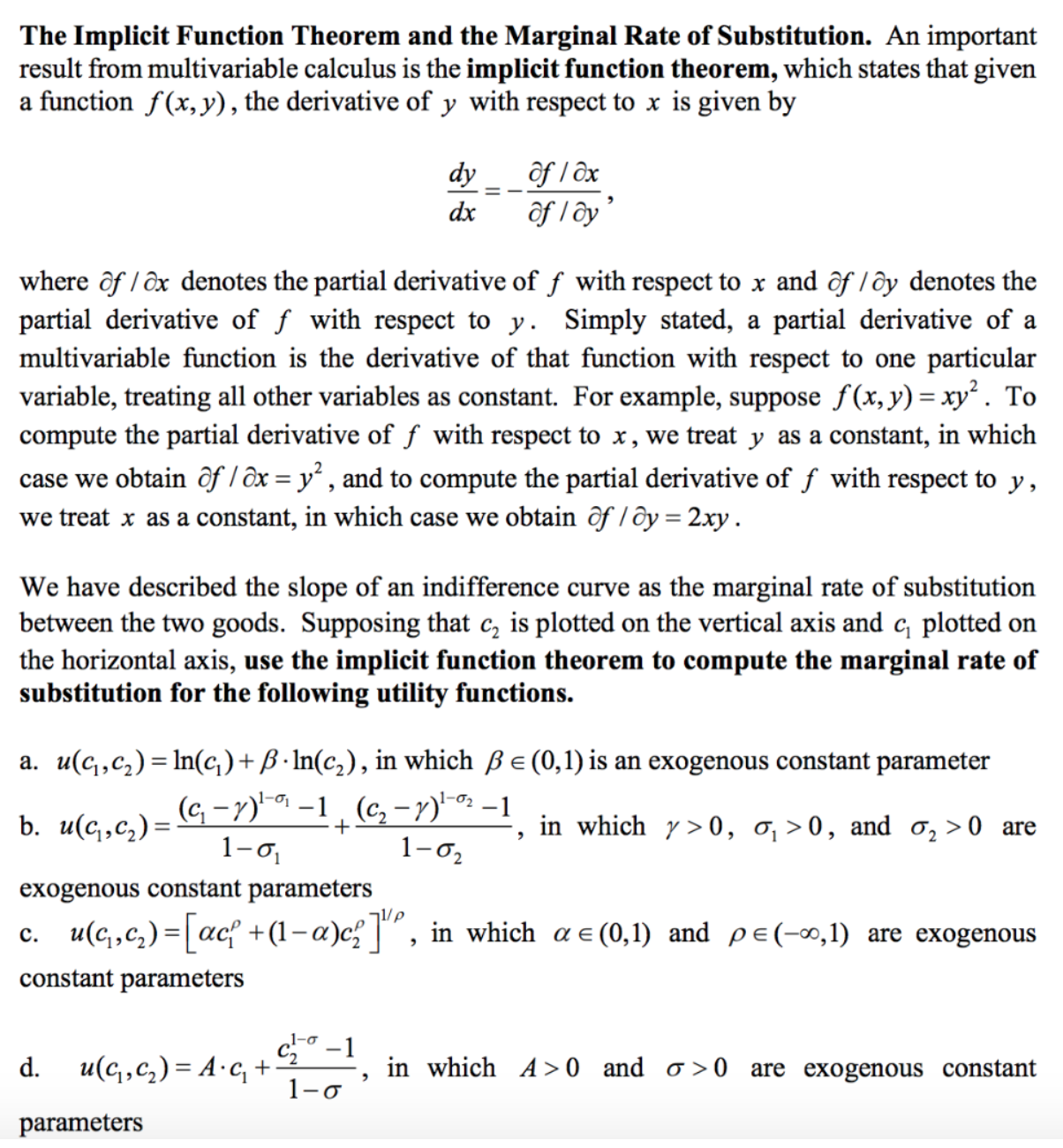
The Implicit Function Theorem and the Marginal Rate of Substitution. An important result from multivariable calculus is the implicit function theorem, which states that given a mction f (x, y) , the derivative of y with respect to x is given by dy__6f/6x dx af/ay' where 63f / 6:: denotes the partial derivative of f with respect to x and 6f lay denotes the partial derivative of f with respect to y. Simply stated, a partial derivative of a multivariable mction is the derivative of that function with respect to one particular variable, treating all other variables as constant. For example, suppose f (x, y) = my2 . To compute the partial derivative of f with respect to x , we treat y as a constant, in which case we obtain 6f 16): = y2 , and to compute the partial derivative of f with respect to y , we treat 1: as a constant, in which case we obtain 6f / 6y = 2xy . We have described the slope of an indifference curve as the marginal rate of substitution between the two goods. Supposing that (32 is plotted on the vertical axis and c1 plotted on the horizontal axis, use the implicit function theorem to compute the marginal rate of substitution for the following utility functions. a. u(c,, :22) = 1n(cl) + if - ln(c,) , in which [3 e (0,1) is an exogenous constant parameter (617)1-GI_1+(62 _7)l-GZ _1 b. uc,c = (I 2) 10", 102 , in which y>0, 0',>0, and 02>0 are exogenous constant parameters 0. u(c1,c,)=[acf' +(l -a)c;' :IW , in which a 6 (0,1) and p e (oo,1) are exogenous constant parameters c;''l 10" d. u(cl,c,)=Ac,+ , in which A>0 and a>0 are exogenous constant parameters
Step by Step Solution
There are 3 Steps involved in it

Get step-by-step solutions from verified subject matter experts
 Study Help