







Question: The industry standard of reporting the yield - to - maturity ( YTM ) of bonds is as follows: Annual coupons: the YTM is an
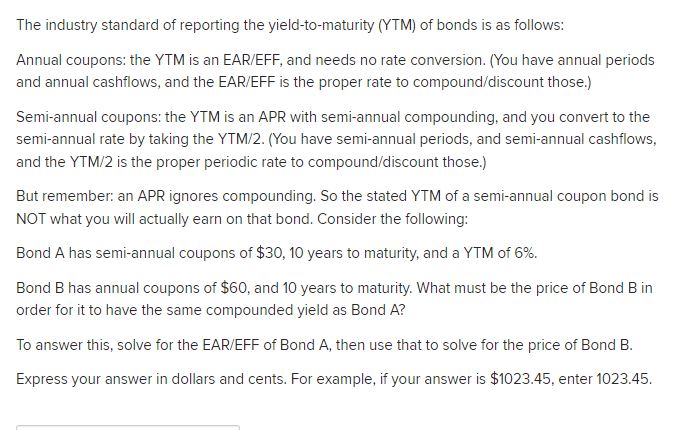
The industry standard of reporting the yieldtomaturity YTM of bonds is as follows:
Annual coupons: the YTM is an EAREFF and needs no rate conversion. You have annual periods
and annual cashflows, and the EAREFF is the proper rate to compounddiscount those.
Semiannual coupons: the YTM is an APR with semiannual compounding, and you convert to the
semiannual rate by taking the YTMYou have semiannual periods, and semiannual cashflows,
and the YTM is the proper periodic rate to compounddiscount those.
But remember: an APR ignores compounding. So the stated YTM of a semiannual coupon bond is
NOT what you will actually earn on that bond. Consider the following:
Bond A has semiannual coupons of $ years to maturity, and a YTM of
Bond has annual coupons of $ and years to maturity. What must be the price of ond in
order for it to have the same compounded yield as Bond A
To answer this, solve for the EAREFF of Bond A then use that to solve for the price of Bond B
Express your answer in dollars and cents. For example, if your answer is $ enter
Step by Step Solution
There are 3 Steps involved in it
1 Expert Approved Answer
Step: 1 Unlock

Question Has Been Solved by an Expert!
Get step-by-step solutions from verified subject matter experts
Step: 2 Unlock
Step: 3 Unlock
 Study Help