







Question: The is a phenomenon in which electrons are ejected from the surface of a metal when light is incident on it. Photoelectric Effect was explained
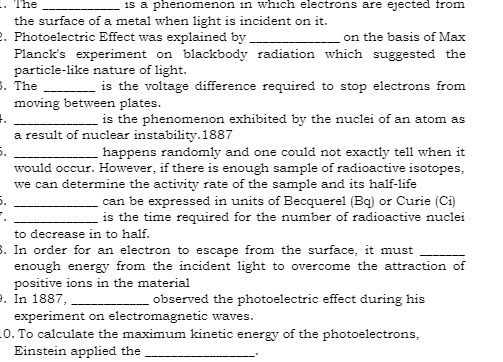
The is a phenomenon in which electrons are ejected from the surface of a metal when light is incident on it. Photoelectric Effect was explained by . on the basis of Max Planck's experiment on blackbody radiation which suggested the particle-like nature of light. The is the voltage difference required to stop electrons from moving between plates. is the phenomenon exhibited by the nuclei of an atom as a result of nuclear instability. 1887 happens randomly and one could not exactly tell when it would occur. However, if there is enough sample of radioactive isotopes, we can determine the activity rate of the sample and its half-life can be expressed in units of Becquerel (Bq) or Curie (Ci) is the time required for the number of radioactive nuclei to decrease in to half. In order for an electron to escape from the surface, it must enough energy from the incident light to overcome the attraction of positive ions in the material In 1887, observed the photoelectric effect during his experiment on electromagnetic waves. 0. To calculate the maximum kinetic energy of the photoelectrons, Einstein applied the
Step by Step Solution
There are 3 Steps involved in it

Get step-by-step solutions from verified subject matter experts
 Study Help