Question: The Kotter article, Leading Change identifies 8 important steps in managing change. Select 3 steps, and for each of these, explain which of the factors
The Kotter article, "Leading Change" identifies 8 important steps in managing change. Select 3 steps, and for each of these, explain which of the factors within the Theory of Planned Behavior is being leveraged.
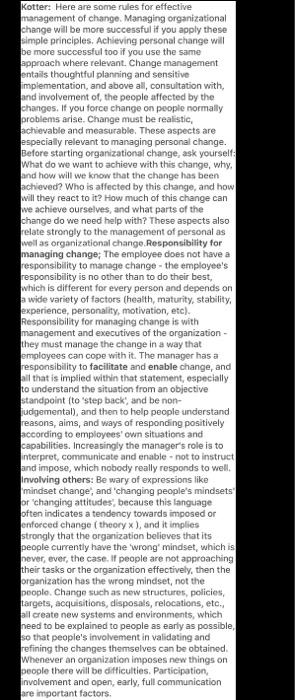
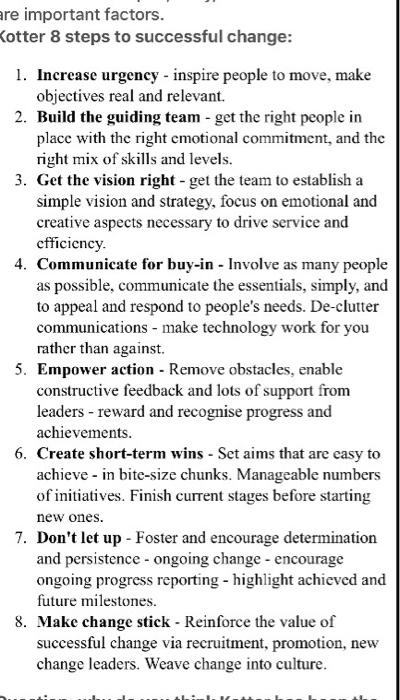
Korter Here are some rules for the management of change Managing organisation range wit be more you apply these le prices. Acho change will mom west you the same proach went Changement Antisthoughtfulaning and sensitive plementation, and above alcomation with and mental the people attected by the est you for curgeon Doodle pomaly problemeCharge must be realisti chievable. There specially to ging personal change for starting to change your What do we want to achieve with change, w how the changes blevet Who called by thing, much of a chanc wachieve ourses, and what parts of the andered how these aspects brongly to the management of personal well as organical change Responsibility managing change the player does not have sponsibility to manage there's responsibility da ne other than to do the best which is not every perpends wide wety of factors that per motion, etc sponsibility for raging changes we management and executives of the organization rey must manage the duge na way that responsibility to facilitate and enable change, and that is led with statement understand the son from active Sandpoint test back and be metall, and then the people understand name and ways of responding post pccording to my own and Increasing the manager's most pret communicate and blenotto pore, which byly sponds to will envolving the way of some mindsetched changing people's minder changing to become this language often indicatesseny towards medor forced change theory and imples ng at the ratio beti people currently have the wrong which is rever, the people are not approaching prerasle or the organication techen the organization has the engine, not the people. Change such as new structures, polici gestions, disposals.com w wydent, which reed to begin to people says. that people invalidating and ratining the changes them can be obtain Whenever now people there will be fica Participation volvement and operar con e important factor otter steps to successful charge 1. www. bliver 2. Middeling the Gelieve levando e pelo prople's De-date come for you ne har Empresa che lo nades per Crew und perch grewporting Make change the change der We Kotter: Here are some rules for effective management of change. Managing organizational change will be more successful if you apply these simple principles. Achieving personal change will be more successful too if you use the same approach where relevant. Change management entails thoughtful planning and sensitive implementation, and above all, consultation with, and involvement of the people affected by the changes. If you force change on people normally problems arise. Change must be realistic, achievable and measurable. These aspects are especially relevant to managing personal change. Before starting organizational change, ask yourself: What do we want to achieve with this change, why, and how will we know that the change has been achieved? Who is affected by this change, and how will they react to it? How much of this change can we achieve ourselves, and what parts of the change do we need help with? These aspects also relate strongly to the management of personal as well as organizational change Responsibility for managing change; The employee does not have a responsibility to manage change - the employee's responsibility is no other than to do their best, which is different for every person and depends on a wide variety of factors (health, maturity, stability, experience, personality, motivation, etc). Responsibility for managing change is with management and executives of the organization they must manage the change in a way that employees can cope with it. The manager has a responsibility to facilitate and enable change, and all that is implied within that statement, especially to understand the situation from an objective standpoint to 'step back, and be non- judgemental), and then to help people understand reasons, aims, and ways of responding positively according to employees' own situations and capabilities. Increasingly the manager's role is to Interpret, communicate and enable - not to instruct and impose, which nobody really responds to well. Involving others: Be wary of expressions like mindset change, and changing people's mindsets or changing attitudes, because this language often indicates a tendency towards imposed or enforced change (theory), and it implies strongly that the organization believes that its people currently have the wrong mindset, which is never, ever, the case. If people are not approaching their tasks or the organization effectively, then the organization has the wrong mindset, not the people. Change such as new structures, policies, targets, acquisitions, disposals, relocations, etc., all create new systems and environments, which need to be explained to people as early as possible, so that people's involvement in validating and refining the changes themselves can be obtained Whenever an organization imposes new things on people there will be difficulties. Participation, involvement and open, early, full communication are important factors. are important factors. Kotter 8 steps to successful change: 1. Increase urgency - inspire people to move, make objectives real and relevant. 2. Build the guiding team - get the right people in place with the right emotional commitment, and the right mix of skills and levels. 3. Get the vision right - get the team to establish a simple vision and strategy, focus on emotional and creative aspects necessary to drive service and cfficiency. 4. Communicate for buy-in - Involve as many people as possible, communicate the essentials, simply, and to appeal and respond to people's needs. De-clutter communications - make technology work for you rather than against 5. Empower action - Remove obstacles, enable constructive feedback and lots of support from leaders - reward and recognise progress and achievements. 6. Create short-term wins - Set aims that are easy to achieve - in bite-size chunks. Manageable numbers of initiatives. Finish current stages before starting new ones. 7. Don't let up - Foster and encourage determination and persistence - ongoing change - encourage ongoing progress reporting - highlight achieved and future milestones 8. Make change stick - Reinforce the value of successful change via recruitment, promotion, new change leaders. Weave change into culture