







Question: The Lagrange function for the representative firm is L(v,nd, 4)= A.f(n)w.np-(1-76). m.v+ [qFIND .v=2D -T > . in which um denotes the Lagrange multiplier on
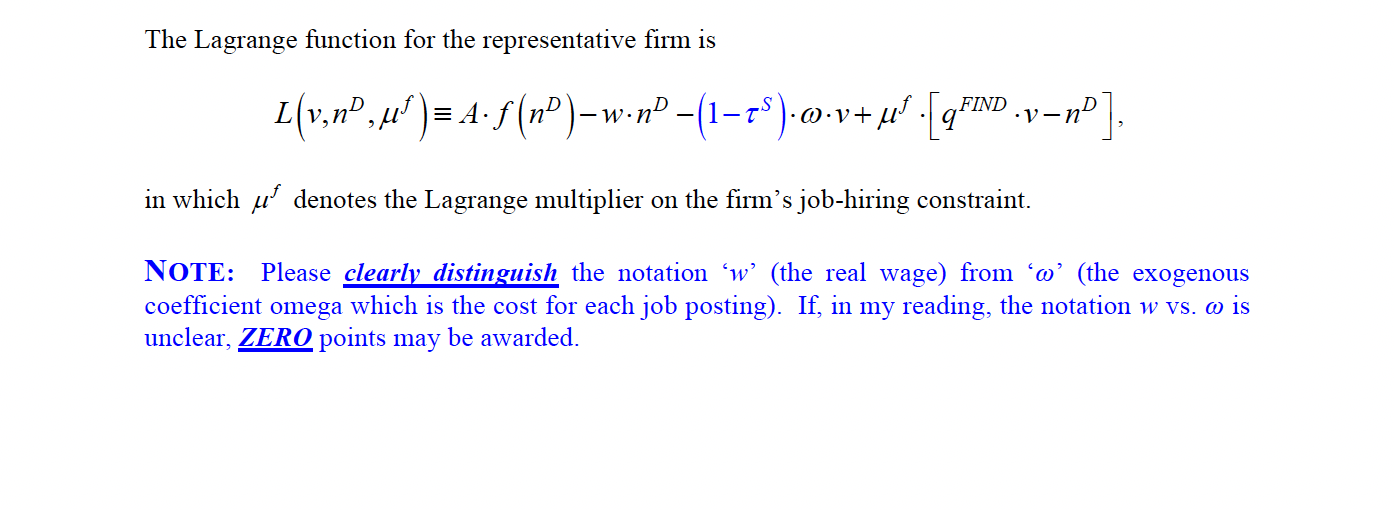
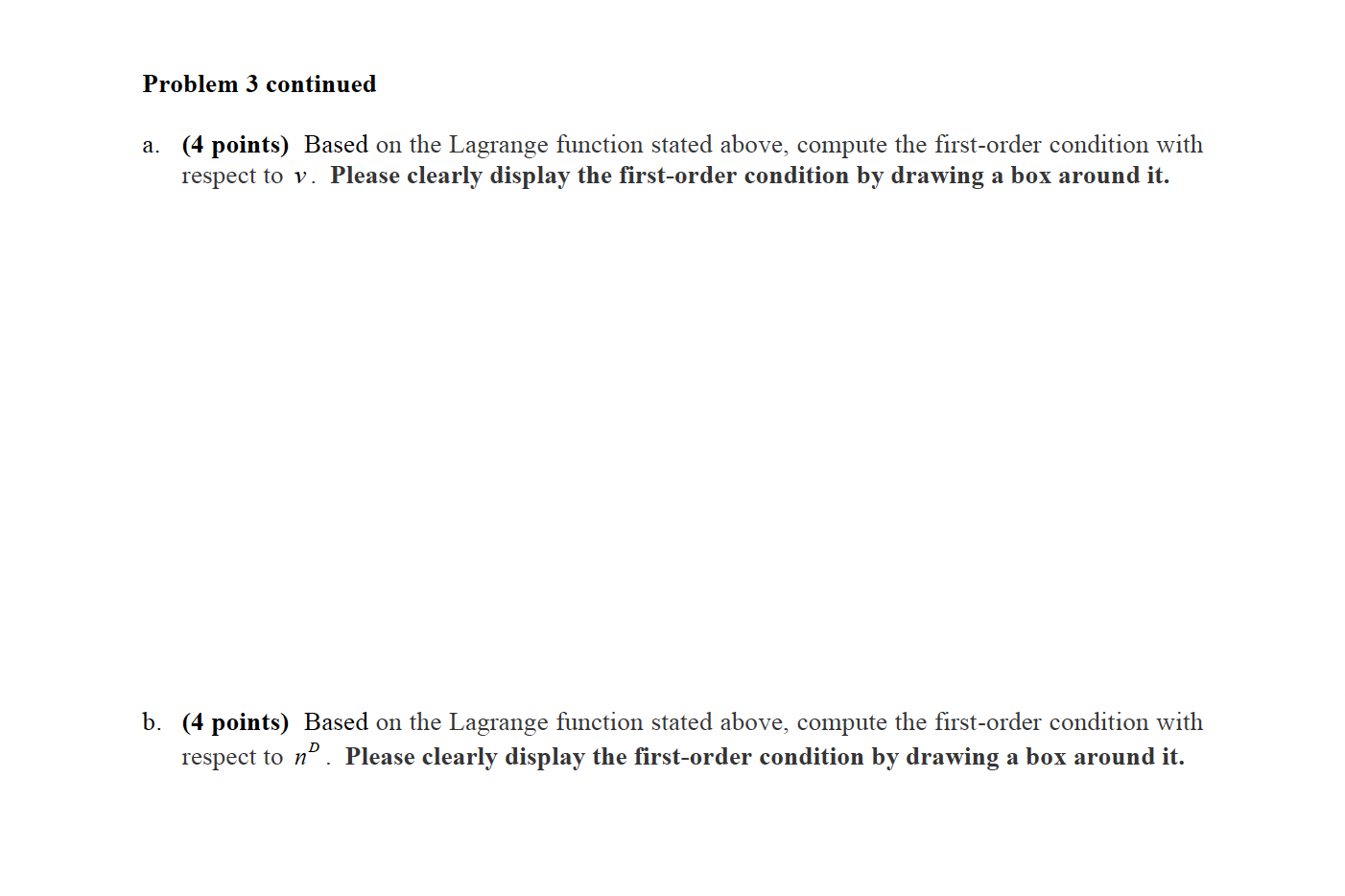
The Lagrange function for the representative firm is L(v,nd, 4")= A.f(n)w.np-(1-76). m.v+" [qFIND .v=2D -T > . in which um denotes the Lagrange multiplier on the firm's job-hiring constraint. NOTE: Please clearly distinguish the notation w' (the real wage) from 'o' (the exogenous coefficient omega which is the cost for each job posting). If, in my reading, the notation w vs. w is unclear, ZERO points may be awarded. Problem 3 continued a. (4 points) Based on the Lagrange function stated above, compute the first-order condition with respect to v. Please clearly display the first-order condition by drawing a box around it. b. (4 points) Based on the Lagrange function stated above, compute the first-order condition with respect to n. Please clearly display the first-order condition by drawing a box around it. The Lagrange function for the representative firm is L(v,nd, 4")= A.f(n)w.np-(1-76). m.v+" [qFIND .v=2D -T > . in which um denotes the Lagrange multiplier on the firm's job-hiring constraint. NOTE: Please clearly distinguish the notation w' (the real wage) from 'o' (the exogenous coefficient omega which is the cost for each job posting). If, in my reading, the notation w vs. w is unclear, ZERO points may be awarded. Problem 3 continued a. (4 points) Based on the Lagrange function stated above, compute the first-order condition with respect to v. Please clearly display the first-order condition by drawing a box around it. b. (4 points) Based on the Lagrange function stated above, compute the first-order condition with respect to n. Please clearly display the first-order condition by drawing a box around it
Step by Step Solution
There are 3 Steps involved in it

Get step-by-step solutions from verified subject matter experts
 Study Help