







Question: The Lagrange point There is a magical point between the Earth and the Moon, called the L_1 Lagrange point, at which a satellite will orbit
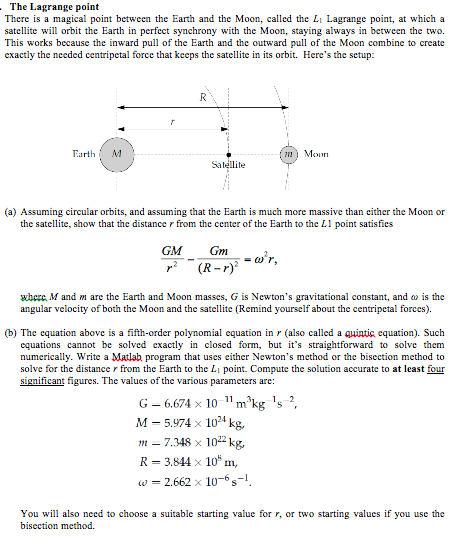
The Lagrange point There is a magical point between the Earth and the Moon, called the L_1 Lagrange point, at which a satellite will orbit the Earth in perfect synchrony with the Moon, staying always in between the two. This works because the inward pull of the Earth and the outward pull of the Moon combine to create exactly the needed centripetal force that keeps the satellite in its orbit. Here's the setup: art Satellite (a) Assuming circular orbits, and assuming that the Earth is much more massive than either the Moon or the satellite, show that the distance r from the center of the Earth to the L_1 point satisfies GM/r^2 - Gm/(R - r)^2 = omega^2 r, where M and m are the Earth and Moon masses, G is Newton's gravitational constant, and omega is the angular velocity of both the Moon and the satellite (Remind yourself about the centripetal forces). (b) The equation above is a fifth-order polynomial equation in r (also called a equation). Such equations cannot be solved exactly in closed form, but it's straightforward to solve them numerically. Write a Matlab program that uses either Newton's method or the bisection method to solve for the distance r from the Earth to the L_1 point. Compute the solution accurate to at least four significant figures. The values of the various parameters are: G = 6, 674 times 10 10^-11m^3 kg^-1 s^- 2, M = 5.974 times 10^24 kg, m = 7.348 times 10^22 kg, R = 3.844 times 10^5 m, omega = 2.662 times 10^-6 s^-1. You will also need to choose a suitable starting value for r, or two starting values if you use the bisection method
Step by Step Solution
There are 3 Steps involved in it

Get step-by-step solutions from verified subject matter experts
 Study Help