







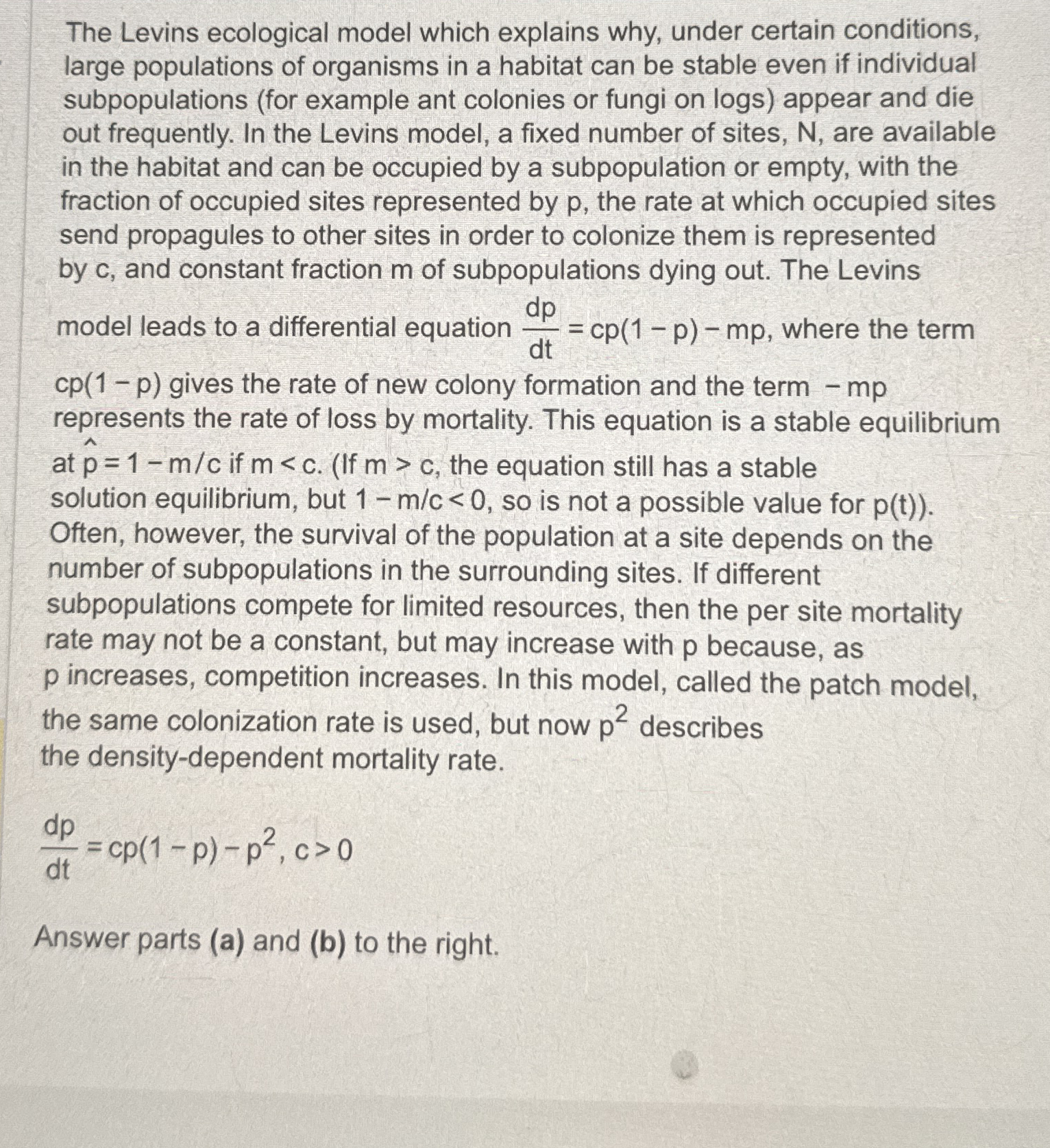
Question: The Levins ecological model which explains why, under certain conditions, large populations of organisms in a habitat can be stable even if individual subpopulations (
The Levins ecological model which explains why, under certain conditions, large populations of organisms in a habitat can be stable even if individual subpopulations for example ant colonies or fungi on logs appear and die out frequently. In the Levins model, a fixed number of sites, N are available in the habitat and can be occupied by a subpopulation or empty, with the fraction of occupied sites represented by the rate at which occupied sites send propagules to other sites in order to colonize them is represented by c and constant fraction m of subpopulations dying out. The Levins model leads to a differential equation where the term gives the rate of new colony formation and the term mp represents the rate of loss by mortality. This equation is a stable equilibrium at hat if the equation still has a stable solution equilibrium, but not a possible value for
Step by Step Solution
There are 3 Steps involved in it
1 Expert Approved Answer
Step: 1 Unlock

Question Has Been Solved by an Expert!
Get step-by-step solutions from verified subject matter experts
Step: 2 Unlock
Step: 3 Unlock
 Study Help