







Question: The linear programming formulation that will maximize the total annual return of the portfolio is as follows. Max 3 U + 5 H Maximize total
The linear programming formulation that will maximize the total annual return of the portfolio is as follows.
Max Maximize total annual return
Funds available
Risk maximum
Oil maximum
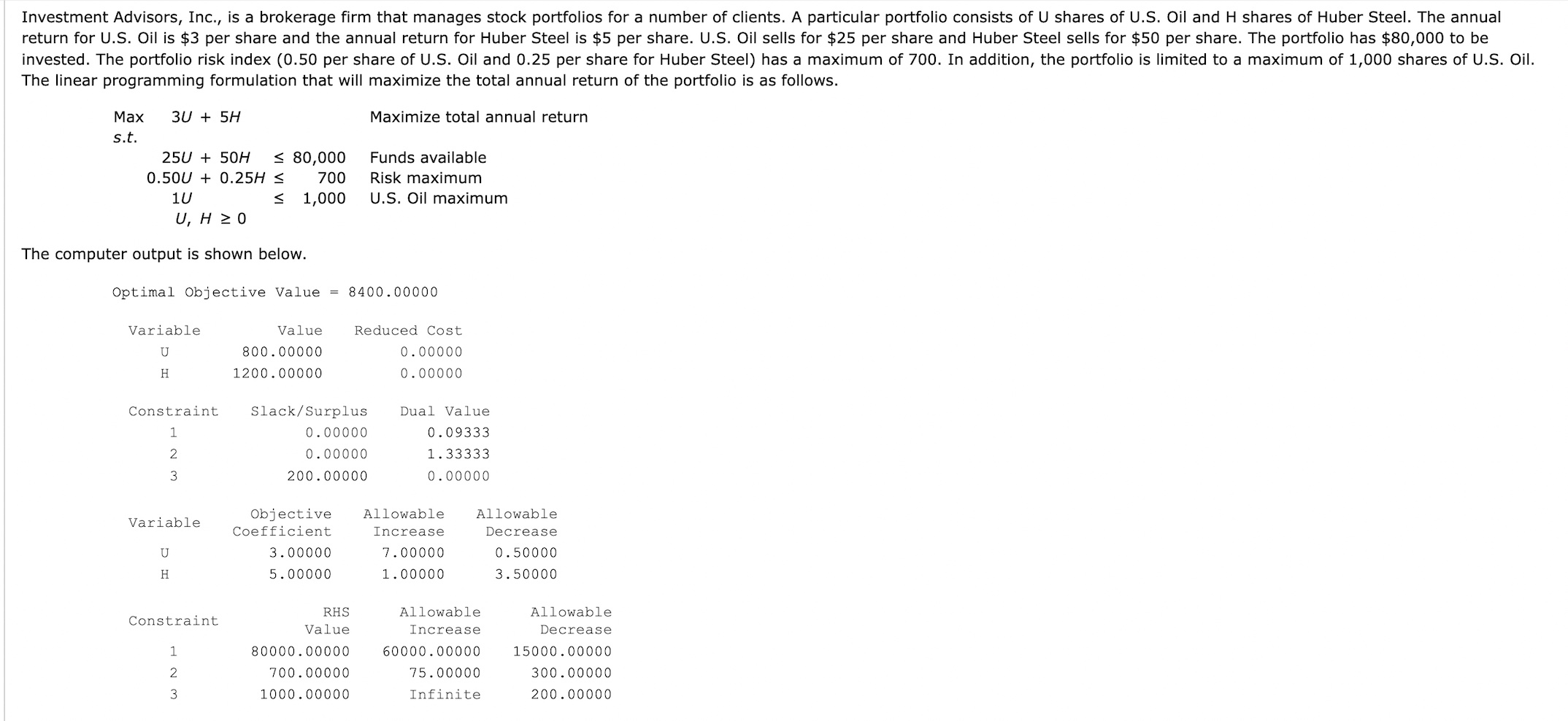
The computer output is shown in picture.
a What is the optimal solution, and what is the value of the total annual return in $
U
H
estimated annual return $
b Which constraints are binding? What is your interpretation of these constraints in terms of the problem? Select all that apply.
a Constraint All funds available are being utilized.
b Constraint The maximum permissible risk is being incurred.
c Constraint All available shares of US Oil are being purchased.
d None of the constraints are binding.
cWhat are the dual values for the constraints? Interpret each. Round your answers to two decimal places.
constraint
a Constraint has a dual value of If an additional dollar is added to the available funds, the total annual return is predicted to increase by $
b Constraint has a dual value of If an additional dollar is added to the available funds, the total annual return is predicted to increase by $
c Constraint has a slack of $ Additional dollars added to the available funds will not improve the total annual return.
d Constraint has a dual value of If an additional dollar is added to the available funds, the total annual return is predicted to increase by $
eConstraint has a dual value of If an additional dollar is added to the available funds, the total annual return is predicted to increase by $
constraint
a Constraint has a dual value of If the risk index is increased by the total annual return is predicted to increase by $
b Constraint has a dual value of If the risk index is increased by the total annual return is predicted to increase by $
c Constraint has a slack of Allowing additional risk will not improve the total annual return.
d Constraint has a dual value of If the risk index is increased by the total annual return is predicted to increase by $
e Constraint has a dual value of If the risk index is increased by the total annual return is predicted to increase by $
constraint
a Constraint has a dual value of If the maximum number of shares of US Oil is increased by the total annual return is predicted to increase by $
b Constraint has a dual value of If the maximum number of shares of US Oil is increased by the total annual return is predicted to increase by $
c Constraint has a slack of shares. Raising the maximum number of shares of US Oil will not improve the total annual return.
d Constraint has a dual value of If the maximum number of shares of US Oil is increased by the total annual return is predicted to increase by $
e Constraint has a dual value of If the maximum number of shares of US Oil is increased by the total annual return is predicted to increase by $
dWould it be beneficial to increase the maximum amount invested in US Oil? Why or why not?
a Yes, each additional share increases the profit by $
b Yes, each additional share increases the profit by $
c Yes, each additional share increases the profit by $
d No increasing the maximum shares does not affect the optimal value.
Step by Step Solution
There are 3 Steps involved in it
1 Expert Approved Answer
Step: 1 Unlock

Question Has Been Solved by an Expert!
Get step-by-step solutions from verified subject matter experts
Step: 2 Unlock
Step: 3 Unlock
 Study Help