







Question: The magnetic field B due to a small current loop (which is placed at the origin) is called a magnetic dipole. Let p = (x
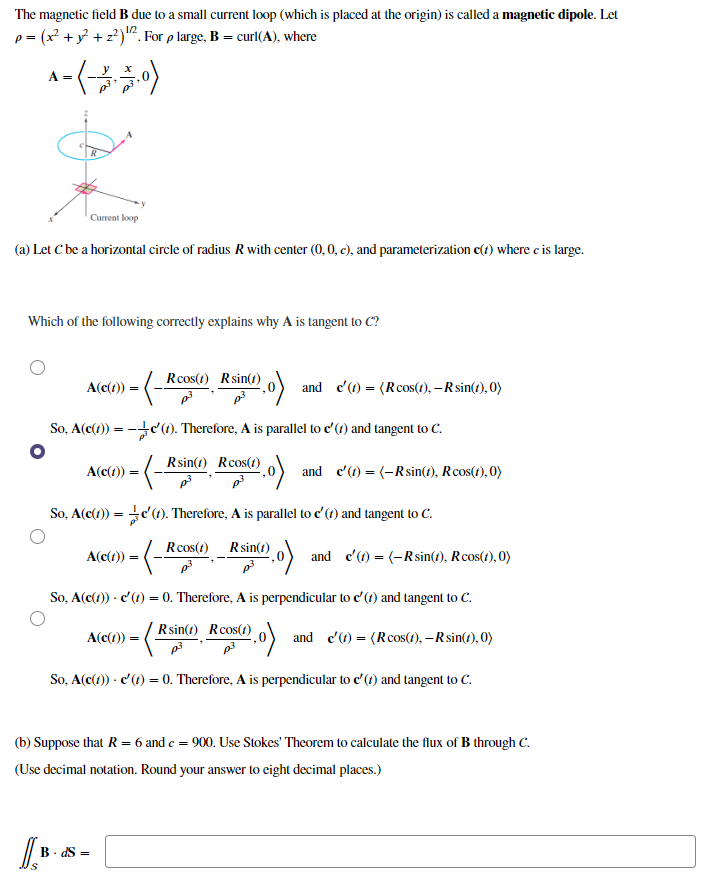
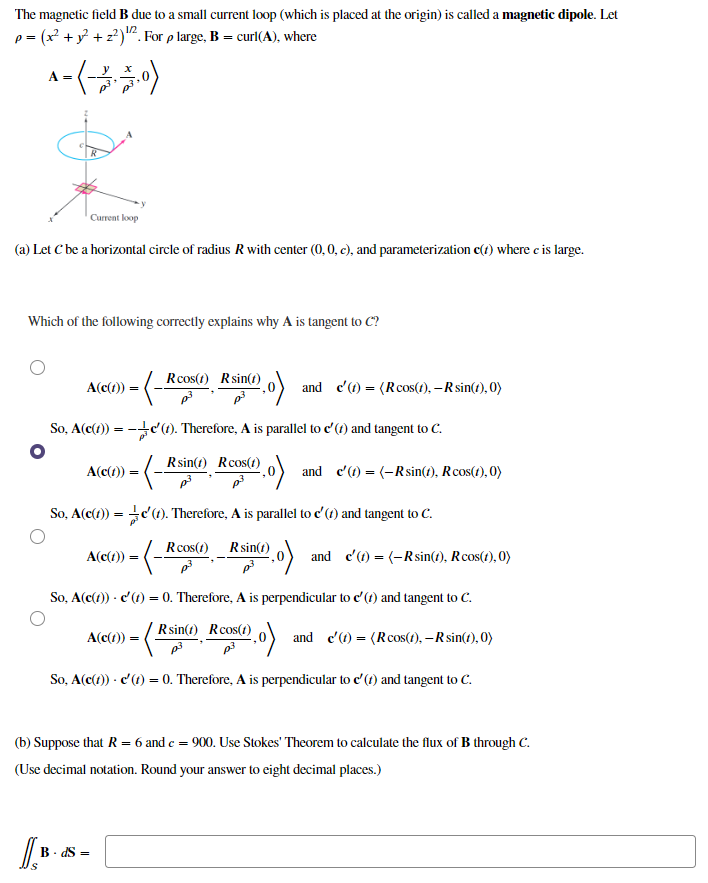
The magnetic field B due to a small current loop (which is placed at the origin) is called a magnetic dipole. Let p = (x + + z?)". For p large, B = curl(A), where A - (-*.*.0) Current loop (a) Let C be a horizontal circle of radius R with center (0, 0, c), and parameterization c() where c is large. Which of the following correctly explains why A is tangent to C? O A(c()) = p3 Roos(1) Rsin(2 0) and c'() = (Rcos(1), -Rsin(1), 0) p3 So, A(c(1)) = -4c'(1). Therefore, A is parallel to c' (() and tangent to C. A(c()) = (_Rsin(0) Rcos()() and c' (1) = (-Rsin(1), Rcos(1), 0) So, A(c(1)) = - c'(1). Therefore, A is parallel to c'(() and tangent to C. O A(C()) = ( Roos(1) Rsin(to p3 p3 0) and c'(1) = (-Rsin(1), Rcos(1), 0) So, A(c() . c' (1) = 0. Therefore, A is perpendicular to c' () and tangent to C. O p3 p3 A(e()) = ( Rsin(), Roos(2.0) and c'() - (Rcos(1), -Rsin(t), 0) So, A(c(1) . c'(1) = 0. Therefore, A is perpendicular to c' (f) and tangent to C. (b) Suppose that R = 6 and c = 900. Use Stokes' Theorem to calculate the flux of B through C. (Use decimal notation. Round your answer to eight decimal places.) / B . as
Step by Step Solution
There are 3 Steps involved in it

Get step-by-step solutions from verified subject matter experts
 Study Help