



Question: The method of the previous problem can be used to derive the general solution of an inhomogeneous equation once we have determined one solution of
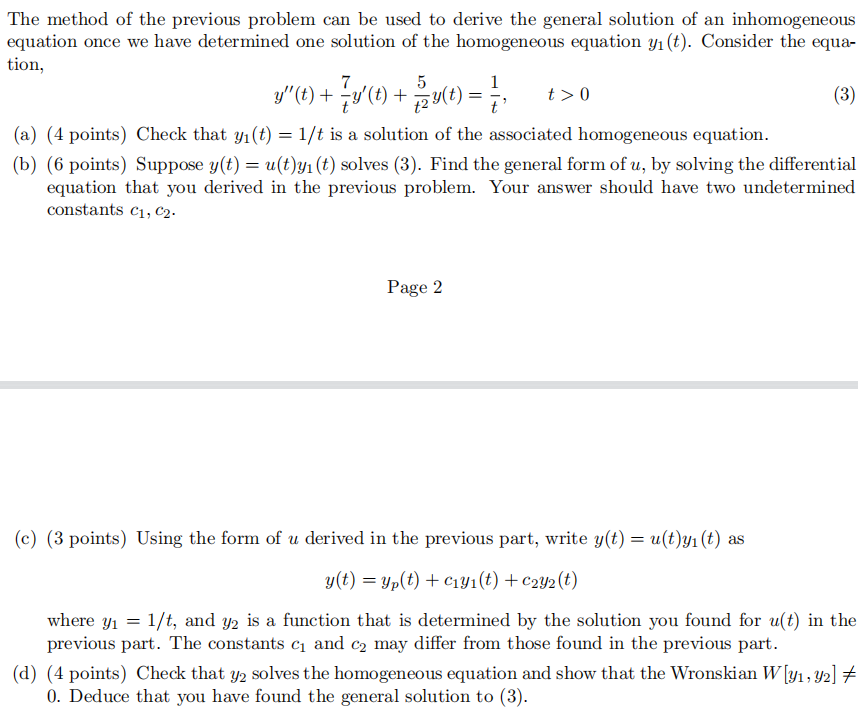
The method of the previous problem can be used to derive the general solution of an inhomogeneous equation once we have determined one solution of the homogeneous equation yl (t). Consider the equa- tion, a 7 r 5 1 if it) + ;y[1)+ t2y{t) = I\" t 3' {3) (a) [4 points) Check that yt) = 1ft is a solution of the associated homogeneous equation. (b) [6 points) Suppose y[t) = u{t)y1[t) solves [3). Find the general form of u, by solving the dierential equation that you derived in the previous problem Your answer should have two undetermined constants [311 I32. Page 2 (c) [3 points) Using the form of is derived in the previous part, write y[t) = u[t)y1[t) as M3) = yp) + clylit) + WWW where y1 = 1ft, and y; is a function that is determined by the solution you found for u[t) in the previous part. The constants c] and c2 may differ from those found in the previous part. (d) [4 points) Check that y; solves the homogeneous equation and show that the Wronslcian W[y1 , ya] 72 U. Deduce that you have found the general solution to [3)
Step by Step Solution
There are 3 Steps involved in it

Get step-by-step solutions from verified subject matter experts