







Question: The Missing Link For Successful Organisation Change Management The topic of organisation change management (OCM) has been gaining momentum lately-particularly due to the wake of
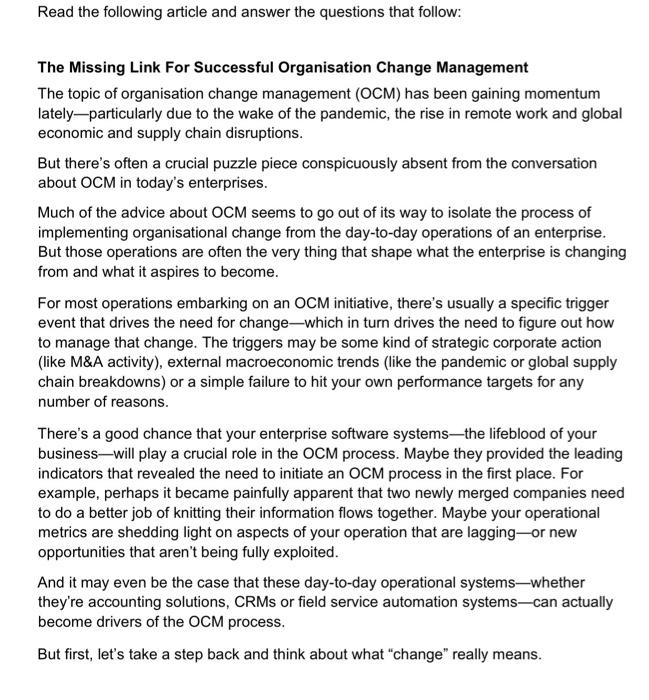
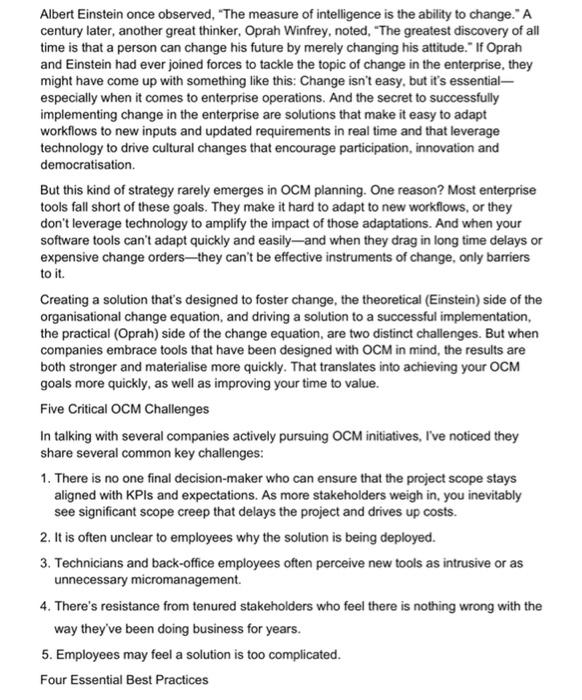
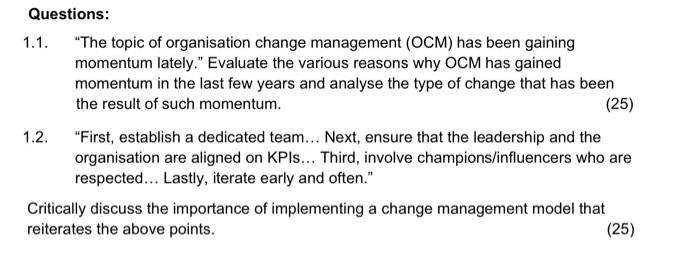
The Missing Link For Successful Organisation Change Management The topic of organisation change management (OCM) has been gaining momentum lately-particularly due to the wake of the pandemic, the rise in remote work and global economic and supply chain disruptions. But there's often a crucial puzzle piece conspicuously absent from the conversation about OCM in today's enterprises. Much of the advice about OCM seems to go out of its way to isolate the process of implementing organisational change from the day-to-day operations of an enterprise. But those operations are often the very thing that shape what the enterprise is changing from and what it aspires to become. For most operations embarking on an OCM initiative, there's usually a specific trigger event that drives the need for change-which in turn drives the need to figure out how to manage that change. The triggers may be some kind of strategic corporate action (like M\&A activity), external macroeconomic trends (like the pandemic or global supply chain breakdowns) or a simple failure to hit your own performance targets for any number of reasons. There's a good chance that your enterprise software systems-the lifeblood of your business-will play a crucial role in the OCM process. Maybe they provided the leading indicators that revealed the need to initiate an OCM process in the first place. For example, perhaps it became painfully apparent that two newly merged companies need to do a better job of knitting their information flows together. Maybe your operational metrics are shedding light on aspects of your operation that are lagging - or new opportunities that aren't being fully exploited. And it may even be the case that these day-to-day operational systems-whether they're accounting solutions, CRMs or field service automation systems-can actually become drivers of the OCM process. But first, let's take a step back and think about what "change" really means. Albert Einstein once observed, "The measure of intelligence is the ability to change." A century later, another great thinker, Oprah Winfrey, noted, "The greatest discovery of all time is that a person can change his future by merely changing his attitude." If Oprah and Einstein had ever joined forces to tackle the topic of change in the enterprise, they might have come up with something like this: Change isn't easy, but it's essentialespecially when it comes to enterprise operations. And the secret to successfully implementing change in the enterprise are solutions that make it easy to adapt workflows to new inputs and updated requirements in real time and that leverage technology to drive cultural changes that encourage participation, innovation and democratisation. But this kind of strategy rarely emerges in OCM planning. One reason? Most enterprise tools fall short of these goals. They make it hard to adapt to new workflows, or they don't leverage technology to amplify the impact of those adaptations. And when your software tools can't adapt quickly and easily-and when they drag in long time delays or expensive change orders-they can't be effective instruments of change, only barriers to it. Creating a solution that's designed to foster change, the theoretical (Einstein) side of the organisational change equation, and driving a solution to a successful implementation, the practical (Oprah) side of the change equation, are two distinct challenges. But when companies embrace tools that have been designed with OCM in mind, the results are both stronger and materialise more quickly. That translates into achieving your OCM goals more quickly, as well as improving your time to value. Five Critical OCM Challenges In talking with several companies actively pursuing OCM initiatives, I've noticed they share several common key challenges: 1. There is no one final decision-maker who can ensure that the project scope stays aligned with KPls and expectations. As more stakeholders weigh in, you inevitably see significant scope creep that delays the project and drives up costs. 2. It is often unclear to employees why the solution is being deployed. 3. Technicians and back-office employees often perceive new tools as intrusive or as unnecessary micromanagement. 4. There's resistance from tenured stakeholders who feel there is nothing wrong with the way they've been doing business for years. 5. Employees may feel a solution is too complicated. Four Essential Best Practices Questions: 1.1. "The topic of organisation change management (OCM) has been gaining momentum lately." Evaluate the various reasons why OCM has gained momentum in the last few years and analyse the type of change that has been the result of such momentum. 1.2. "First, establish a dedicated team... Next, ensure that the leadership and the organisation are aligned on KPIs... Third, involve champions/influencers who are respected... Lastly, iterate early and often." Critically discuss the importance of implementing a change management model that reiterates the above points. The Missing Link For Successful Organisation Change Management The topic of organisation change management (OCM) has been gaining momentum lately-particularly due to the wake of the pandemic, the rise in remote work and global economic and supply chain disruptions. But there's often a crucial puzzle piece conspicuously absent from the conversation about OCM in today's enterprises. Much of the advice about OCM seems to go out of its way to isolate the process of implementing organisational change from the day-to-day operations of an enterprise. But those operations are often the very thing that shape what the enterprise is changing from and what it aspires to become. For most operations embarking on an OCM initiative, there's usually a specific trigger event that drives the need for change-which in turn drives the need to figure out how to manage that change. The triggers may be some kind of strategic corporate action (like M\&A activity), external macroeconomic trends (like the pandemic or global supply chain breakdowns) or a simple failure to hit your own performance targets for any number of reasons. There's a good chance that your enterprise software systems-the lifeblood of your business-will play a crucial role in the OCM process. Maybe they provided the leading indicators that revealed the need to initiate an OCM process in the first place. For example, perhaps it became painfully apparent that two newly merged companies need to do a better job of knitting their information flows together. Maybe your operational metrics are shedding light on aspects of your operation that are lagging - or new opportunities that aren't being fully exploited. And it may even be the case that these day-to-day operational systems-whether they're accounting solutions, CRMs or field service automation systems-can actually become drivers of the OCM process. But first, let's take a step back and think about what "change" really means. Albert Einstein once observed, "The measure of intelligence is the ability to change." A century later, another great thinker, Oprah Winfrey, noted, "The greatest discovery of all time is that a person can change his future by merely changing his attitude." If Oprah and Einstein had ever joined forces to tackle the topic of change in the enterprise, they might have come up with something like this: Change isn't easy, but it's essentialespecially when it comes to enterprise operations. And the secret to successfully implementing change in the enterprise are solutions that make it easy to adapt workflows to new inputs and updated requirements in real time and that leverage technology to drive cultural changes that encourage participation, innovation and democratisation. But this kind of strategy rarely emerges in OCM planning. One reason? Most enterprise tools fall short of these goals. They make it hard to adapt to new workflows, or they don't leverage technology to amplify the impact of those adaptations. And when your software tools can't adapt quickly and easily-and when they drag in long time delays or expensive change orders-they can't be effective instruments of change, only barriers to it. Creating a solution that's designed to foster change, the theoretical (Einstein) side of the organisational change equation, and driving a solution to a successful implementation, the practical (Oprah) side of the change equation, are two distinct challenges. But when companies embrace tools that have been designed with OCM in mind, the results are both stronger and materialise more quickly. That translates into achieving your OCM goals more quickly, as well as improving your time to value. Five Critical OCM Challenges In talking with several companies actively pursuing OCM initiatives, I've noticed they share several common key challenges: 1. There is no one final decision-maker who can ensure that the project scope stays aligned with KPls and expectations. As more stakeholders weigh in, you inevitably see significant scope creep that delays the project and drives up costs. 2. It is often unclear to employees why the solution is being deployed. 3. Technicians and back-office employees often perceive new tools as intrusive or as unnecessary micromanagement. 4. There's resistance from tenured stakeholders who feel there is nothing wrong with the way they've been doing business for years. 5. Employees may feel a solution is too complicated. Four Essential Best Practices Questions: 1.1. "The topic of organisation change management (OCM) has been gaining momentum lately." Evaluate the various reasons why OCM has gained momentum in the last few years and analyse the type of change that has been the result of such momentum. 1.2. "First, establish a dedicated team... Next, ensure that the leadership and the organisation are aligned on KPIs... Third, involve champions/influencers who are respected... Lastly, iterate early and often." Critically discuss the importance of implementing a change management model that reiterates the above points
Step by Step Solution
There are 3 Steps involved in it

Get step-by-step solutions from verified subject matter experts
 Study Help