



Question: The Need for Project Managment Metrics (E) in Project Management Case Studies by Kerzner pages 428-431. A.) Can any KPI be measured? B.) Does exhibit
The Need for Project Managment Metrics (E) in Project Management Case Studies by Kerzner pages 428-431. 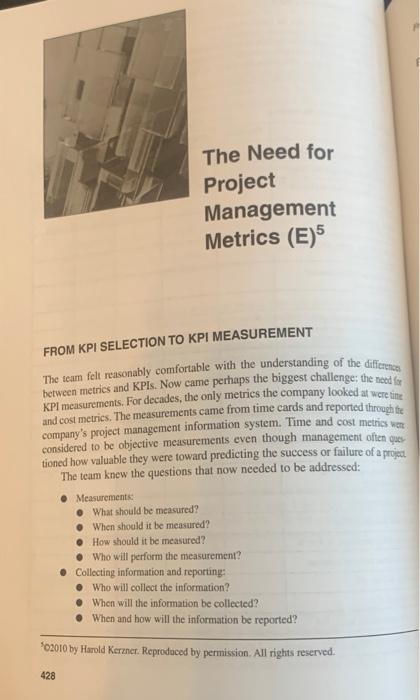
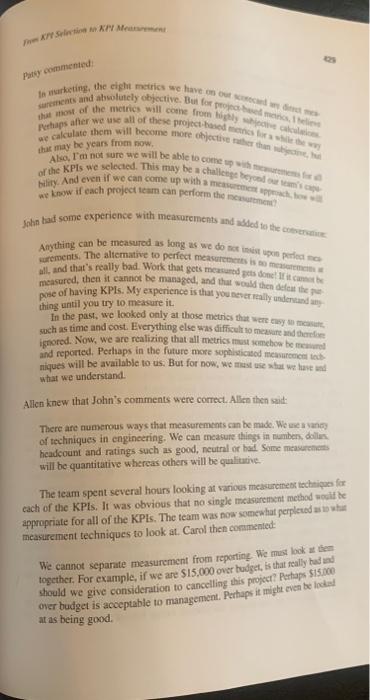
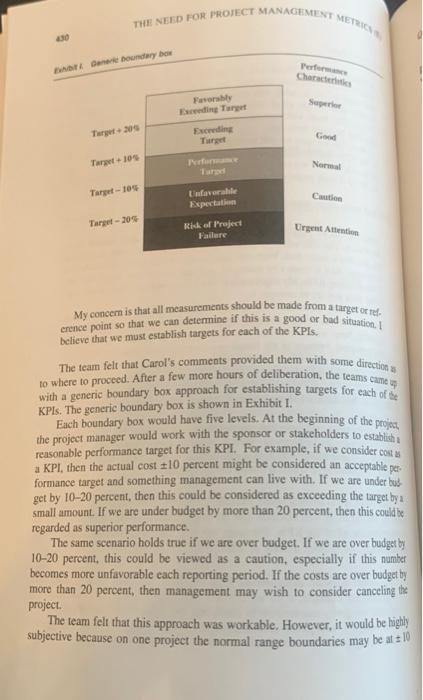
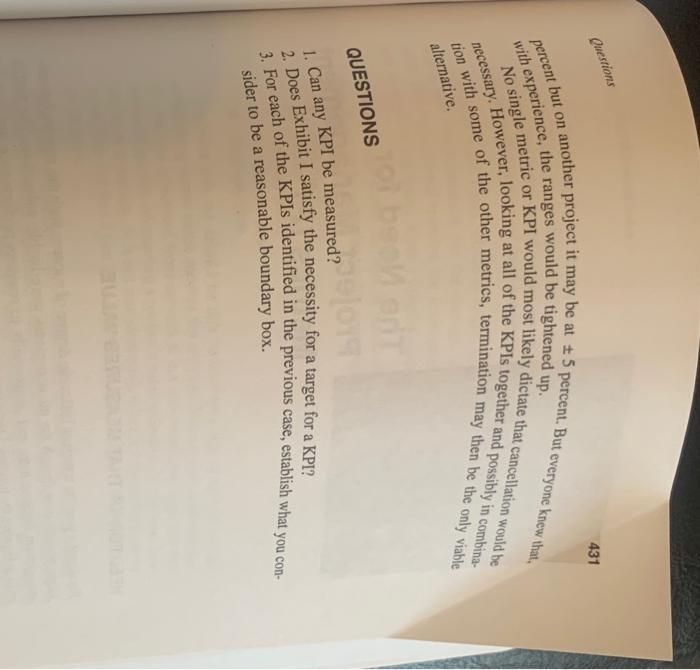
FROM KPI SELECTION TO KPI MEASUREMENT The team felt reasonably comfortable with the understanding of the differtion between metrics and KPIs. Now came perhaps the biggest challenge; the need for KPI measurements. For decades, the only metrics the company looked al were tirte and cost metrics. The measurements came from time cards and reported through te company's project management information system. Time and cost metries vers considered to be objective measurements even though management often qye tioned how valuable they were toward predicting the success or failure of a projat. The team knew the questions that now needed to be addressed: - Measurements: - What should be measured? - When should it be measured? - How should it be measured? - Who will perform the measurement? - Collocting information and reporting: - Who will collect the information? - When will the information be collected? - When and bow will the information be reported? pary comnemied surements and alowlutely objective. But for propact heed manca, I telines of the KPIs we selected. This may be a challetepe beyced our teami' cey. biliry. And even if we can come up with a measeremera appesch, toe of ac koww if each project team can perform the nexturtineme? John had some experience with meaxurements and abled to the coscereave, Anything can be measured as fong as we do not incist upie perler noe all, and that's really bad. Work that gets measurtd pets 'donel If it cameer to measured, then it canniot be managed, and that would then deleat the por pose of having KPls. My experience is that you seser leally undernasd aty. thing until you try to measure it. In the past, we looked only at those metriss that were casy win measere, such as time and cost. Everything else was difficult 10 meesare and thachise ignored. Now, we are realizing that all metriss mast icmehom be measmed and reported. Pectaps in the future more sophtivicated measurences tote. niques will be available to us. But for now, we mitse use xhat we have and what we understand. Allen knew that John's comments were correct. Allen then sit. There are numerous ways that measurements can be made. We ues saney of techniques in engineering. We can tneasure thiegs in numben, delles. headcount and ratings such as good, neutral or had Soine measarchicts will be quantitative whereas others will be qualitite. The team spent several hours looking at varioes measucmest tochipue for each of the KPls, It was obvious that no single measurensent method wostf te appropriate for all of the KPLs. The team was now somchhat perpletod as io whin measurement techniques to look at. Carol then conmented We cannot sepanate measurement from reporting. We must lock at teen together. For example, if we are 515,000 over budget, is that really tai at thould we give consideration to cancelling this project? Putaph 515mo0 over budget is acceptable to managenvent. Perhapt it inight even be lockel at as being good. My concem is that all measurements should be made from a target or ref. erence point so that we can determine if this is a good or bad situation, 1 believe that we must establish targets for each of the KPIs. The team felt that Carol's comments provided them with some direction in to where to proceed. After a few more hours of deliberation, the teams came with a generic boundary box approach for establishing targets for each of the KPIs. The generic boundary box is shown in Exhibit L. Each boundary box would have five levels. At the beginning of the projss, the project manager would work with the sponsor or stakeholders to establiat I reasonable performance target for this KPI. For example, if we consider cost a a KPI, then the actual cost 10 percent might be considered an acceptable per. formance target and something management can live with. If we are undet bos get by 1020 pereent, then this could be considered as exceeding the target by 2 small amount. If we are under budget by more than 20 percent, then this could be regarded as superior performance. The same scenario holds true if we are over budget. If we are over budget ty 10-20 percent, this could be viewed as a caution, especially if this number becomes more unfavorable each reporting period. If the costs are over budget by more than 20 percent, then management may wish to consider canceling to project. The team felt that this approach was workable. However, it would be loghty subjective because on one project the normal range boundaries may be at 10 percent but on another project it may be at 5 percent. But everyone knew that, with experience, the ranges would be tightened up. No single metric or KPI would most likely dictate that cancellation would be necessary. However, looking at all of the KPIs together and possibly in combination with some of the other metrics, termination may then be the only viable alternative. QUESTIONS 1. Can any KPI be measured? 2. Does Exhibit I satisfy the necessity for a target for a KPI? 3. For each of the KPIs identified in the previous case, establish what you consider to be a reasonable boundary box
A.) Can any KPI be measured?
B.) Does exhibit 1 satisfy the necessity for a target for a KPI?
C.) Establish what you consider to be a reasonable boundary box for each of the 7 KPI's.
For each of the following 7 metrics identified as KPI's: (1) Percent of work packages on schedule, (2) percent of work packages on budget, (3) number of cost revisions, (4) number of schedule revisions, (5) schedule performance index, (6) cost performance index, and (7) cost variance (CV).
Step by Step Solution
There are 3 Steps involved in it
1 Expert Approved Answer
Step: 1 Unlock

Question Has Been Solved by an Expert!
Get step-by-step solutions from verified subject matter experts
Step: 2 Unlock
Step: 3 Unlock