







Question: The Newton (Method) Iteration Let Xo be a good estimation of r and let r #x0 + h. Since the true rot isr. andh#r-xo-the number
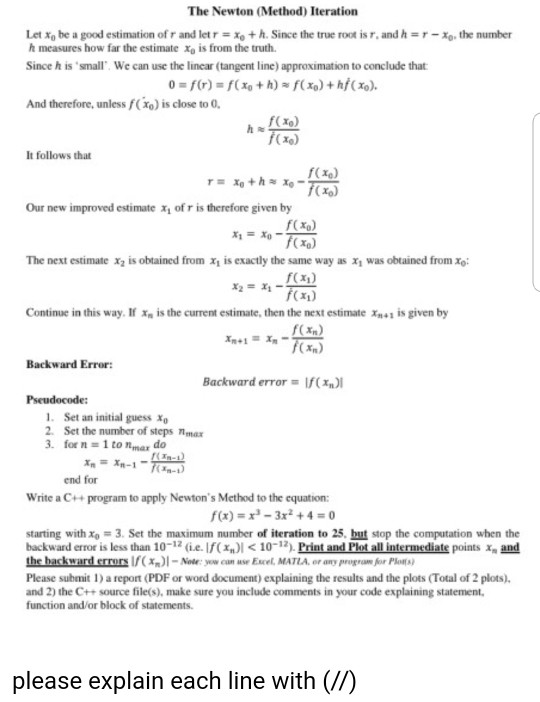
The Newton (Method) Iteration Let Xo be a good estimation of r and let r #x0 + h. Since the true rot isr. andh#r-xo-the number h measures how far the estimate xo is from the truth. Since h is 'small We can use the linear (tangent line) approximation to conclude that And therefore, unless f(o) is close to 0, f(xo) (xe) It follows that (ro Our new improved estimate a of r is therefore given by The next estimate x2 is obtained from x1 is exactly the same way as x was obtained from xo: f(x) Continue in this way. If xn is the current estimate, then the next estimate 1 is given by f(xn) (xn) Backward Error: Backward error f(x) 1. Set an initial guess x 2. Set the number of steps nmax forn 1 to nmax do end for Write a C+program to apply Newton's Method to the equation: f(x) =x-3x2 + 4 = 0 starting with x 3. Set the maximum number of iteration to 25, but stop the computation when the backward error is less than 10-12 (ie. If( xol
Step by Step Solution
There are 3 Steps involved in it

Get step-by-step solutions from verified subject matter experts
 Study Help