







Question: The next question has to do with a bisection process, which is very common in mathematical software. For example, the bisection method for finding a
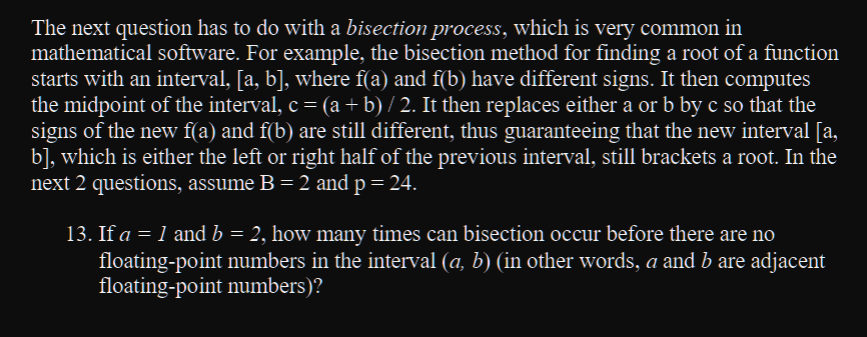
The next question has to do with a bisection process, which is very common in mathematical software. For example, the bisection method for finding a root of a function starts with an interval, [a, b], where f(a) and f(b) have different signs. It then computes the midpoint of the interval, c=(a+b)/2. It then replaces either a or b by c so that the signs of the new f(a) and f(b) are still different, thus guaranteeing that the new interval [a, b], which is either the left or right half of the previous interval, still brackets a root. In the next 2 questions, assume B=2 and p=24. 13. If a=1 and b=2, how many times can bisection occur before there are no floating-point numbers in the interval (a,b) (in other words, a and b are adjacent floating-point numbers)
Step by Step Solution
There are 3 Steps involved in it

Get step-by-step solutions from verified subject matter experts
 Study Help