



Question: The Number Partition problem asks, given a collection of non-negative integers S = {x,...,n} whether or not the integers can be partitioned into two
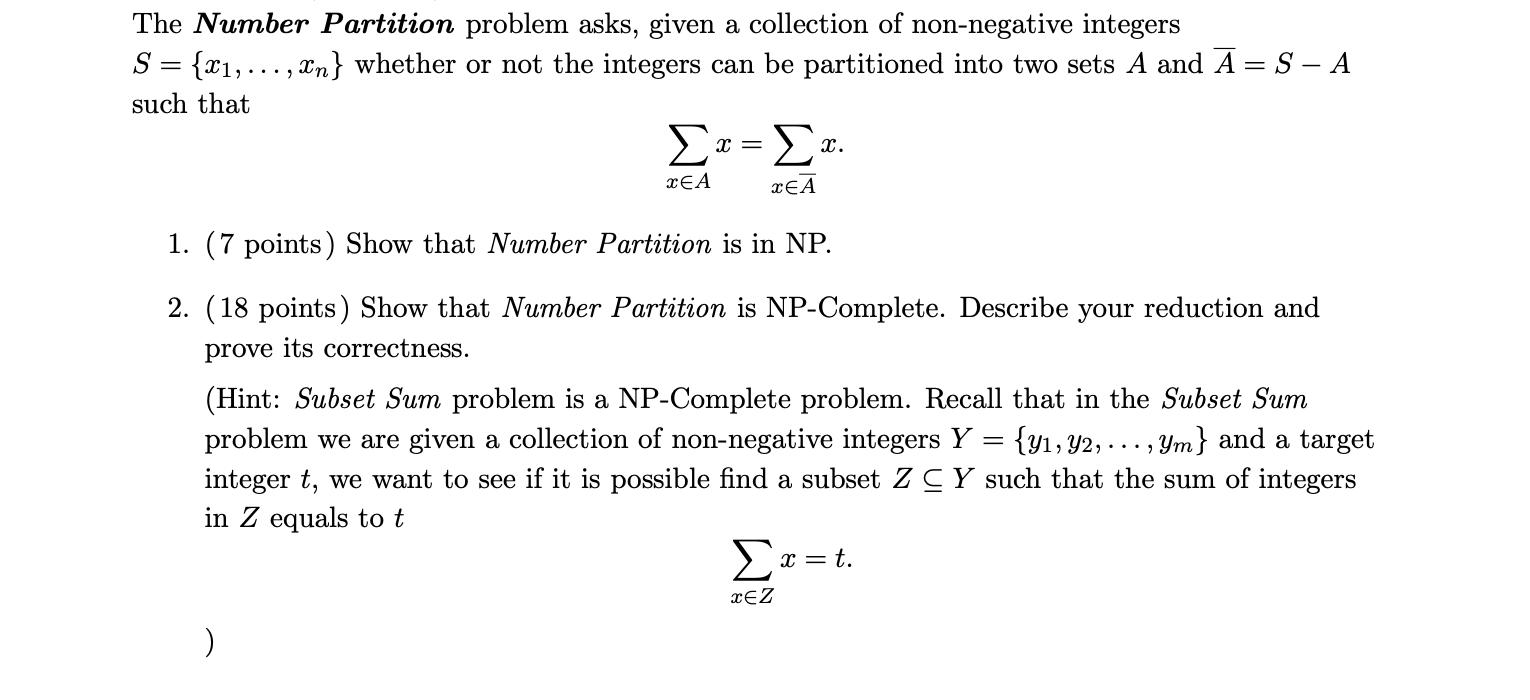
The Number Partition problem asks, given a collection of non-negative integers S = {x,...,n} whether or not the integers can be partitioned into two sets A and A= S-A - such that xEA X = ) TEA X. 1. (7 points) Show that Number Partition is in NP. 2. (18 points) Show that Number Partition is NP-Complete. Describe your reduction and prove its correctness. (Hint: Subset Sum problem is a NP-Complete problem. Recall that in the Subset Sum problem we are given a collection of non-negative integers Y {y, y2,..., Ym} and a target integer t, we want to see if it is possible find a subset ZC Y such that the sum of integers in Z equals to t x x = t. xEZ
Step by Step Solution
3.48 Rating (148 Votes )
There are 3 Steps involved in it
To show that Number Partition is in NP we need to demonstrate that given a solution we can verify it in polynomial time The certificate for the Number Partition problem is a subset A of S such that th... View full answer

Get step-by-step solutions from verified subject matter experts