







Question: The objective of this assignment is to practice and implement binary search tree operations. Problem Specification: Write a generic Java program to create a Binary
The objective of this assignment is to practice and implement binary search tree operations.
Problem Specification:
Write a generic Java program to create a Binary Search Tree. This Binary Search Tree is to store the integer
values. Your program should display a menu of choices to operate the Binary Search Tree data structure.
Please download BSTSample before start. See the sample menu below:
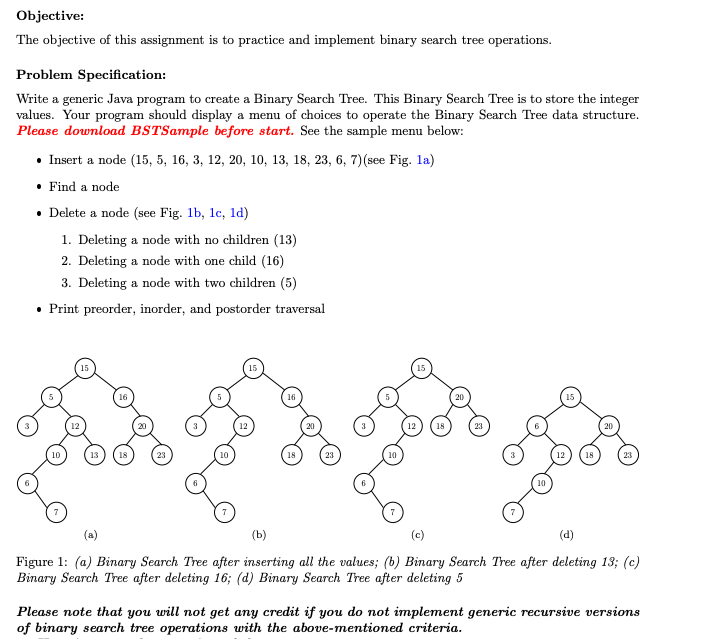
Insert a node see Fig. a
Find a node
Delete a node see Fig. bcd
Deleting a node with no children
Deleting a node with one child
Deleting a node with two children
Print preorder, inorder, and postorder traversal
a
b
c
d
Figure : a Binary Search Tree after inserting all the values; b Binary Search Tree after deleting ; c
Binary Search Tree after deleting ; d Binary Search Tree after deleting
Please note that you will not get any credit if you do not implement generic recursive versions
of binary search tree operations with the abovementioned criteria.
Consider below given classes and complete based on these classes. You are NOT allowed to change the method signatures, but feel free to add extra methods:
public class DriverBST
public static void mainString args
BinarySearchTree bst new BinarySearchTree;
bstinsert;
bstinsert;
Call preorder, inorder, and postorder traversals
bstdelete;
Call preorder, inorder, and postorder traversals
bstdelete;
Call preorder, inorder, and postorder traversals
bstdelete;
Call preorder, inorder, and postorder traversals
end main
public class BinarySearchTree
private TreeNode root;
public BinarySearchTree
root null;
end default constructor
public BinarySearchTreeT rootItem
root new TreeNoderootItem null, null;
end constructor
public void insertT newItem
root insertItemroot newItem;
end insert
public T retrieveT searchKey
return retrieveItemroot searchKey;
end retrieve
public void deleteT searchKey throws TreeException
root deleteItemroot searchKey;
end delete
private TreeNode insertItemTreeNode tNode, T newItem
Implement insertItem here.
The error will go away once you implement and returns an node
end insertItem
private T retrieveItemTreeNode tNode, T searchKey
Implement retrieveItem here
The error will go away once you implement and returns an item
end retrieveItem
private TreeNode deleteItemTreeNode tNode, T searchKey
Implement deleteItem here
The error will go away once you implement and returns a node
end deleteItem
public void setPreorder
preorderroot;
end setPreOrder
public void setInorder
inorderroot;
end setInorder
public void setPostorder
postorderroot;
end setPostorder
private void preorderTreeNode treeNode
implement preorder here
end preorder
private void inorderTreeNode treeNode
implement inorder here
end inorder
private void postorderTreeNode treeNode
implement postorder here
end postorder
end BinarySearchTree
public class TreeException extends RuntimeException
public TreeExceptionString s
supers;
end constructor
end TreeException
public class TreeNode
T item;
TreeNode leftChild;
TreeNode rightChild;
public TreeNodeT newItem
Initializes tree node with item and no children.
item newItem;
leftChild null;
rightChild null;
end constructor
public TreeNodeT newItem, TreeNode left, TreeNode right
Initializes tree node with item and the left and right children references.
item newItem;
leftChild left;
rightChild right;
end constructor
end TreeNode
Step by Step Solution
There are 3 Steps involved in it
1 Expert Approved Answer
Step: 1 Unlock

Question Has Been Solved by an Expert!
Get step-by-step solutions from verified subject matter experts
Step: 2 Unlock
Step: 3 Unlock
 Study Help