







Question: The observation that 10 = 1 mod 9 is the basis for the procedure of 'casting out nines'. The method is as follows. Given
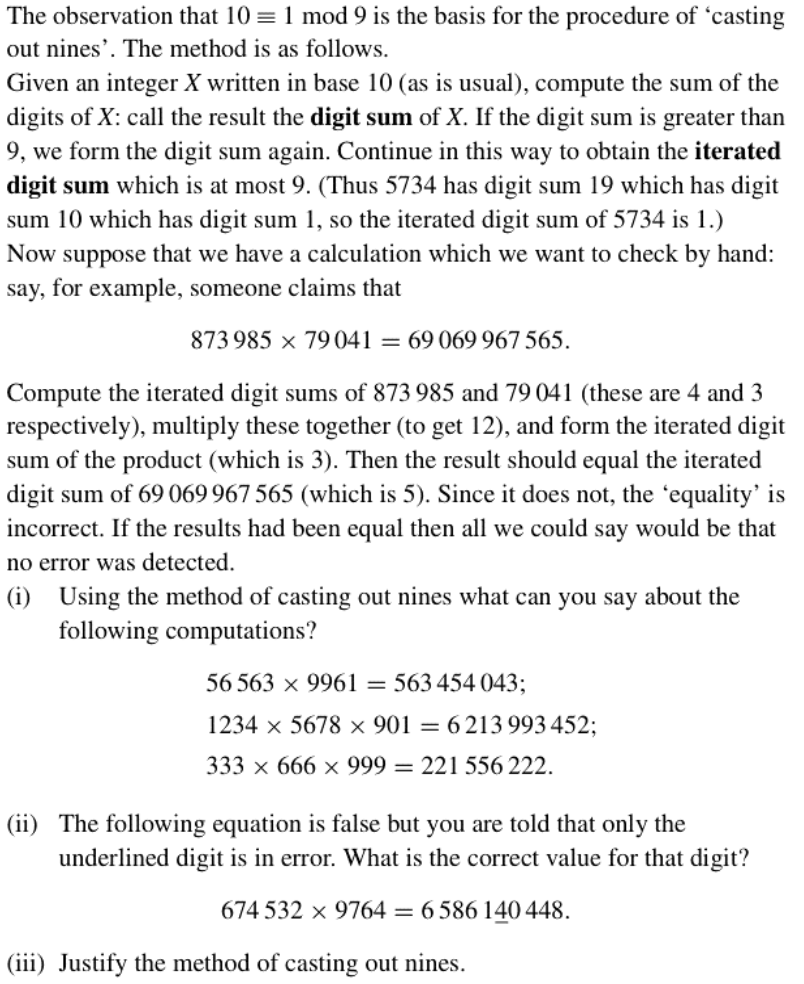
The observation that 10 = 1 mod 9 is the basis for the procedure of 'casting out nines'. The method is as follows. Given an integer X written in base 10 (as is usual), compute the sum of the digits of X: call the result the digit sum of X. If the digit sum is greater than 9, we form the digit sum again. Continue in this way to obtain the iterated digit sum which is at most 9. (Thus 5734 has digit sum 19 which has digit sum 10 which has digit sum 1, so the iterated digit sum of 5734 is 1.) Now suppose that we have a calculation which we want to check by hand: say, for example, someone claims that 873 985 79041 = 69 069 967 565. Compute the iterated digit sums of 873 985 and 79 041 (these are 4 and 3 respectively), multiply these together (to get 12), and form the iterated digit sum of the product (which is 3). Then the result should equal the iterated digit sum of 69 069 967 565 (which is 5). Since it does not, the 'equality' is incorrect. If the results had been equal then all we could say would be that no error was detected. (i) Using the method of casting out nines what can you say about the following computations? 56 563 x 9961 = 563 454 043; 12345678 x 901 = 6213 993 452; 333 666 999 = 221 556 222. (ii) The following equation is false but you are told that only the underlined digit is in error. What is the correct value for that digit? 674 532 x 9764 = 6586 140 448. (iii) Justify the method of casting out nines.
Step by Step Solution
There are 3 Steps involved in it

Get step-by-step solutions from verified subject matter experts
 Study Help