







Question: The OLS models are estimated correctly, please answer all other questions: Use OLS to estimate a model explaining colgpa using hsgpa, actmth, and acteng as
The OLS models are estimated correctly, please answer all other questions:
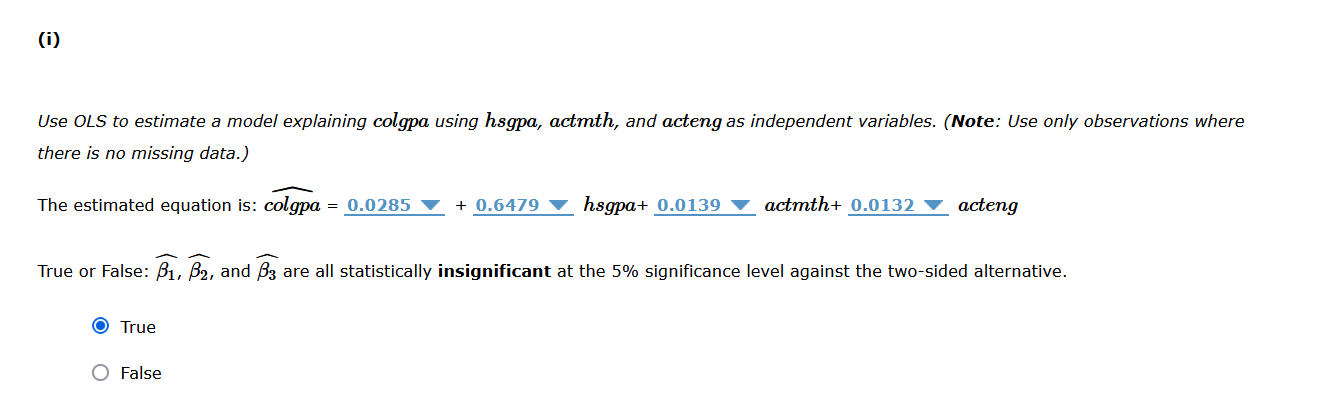
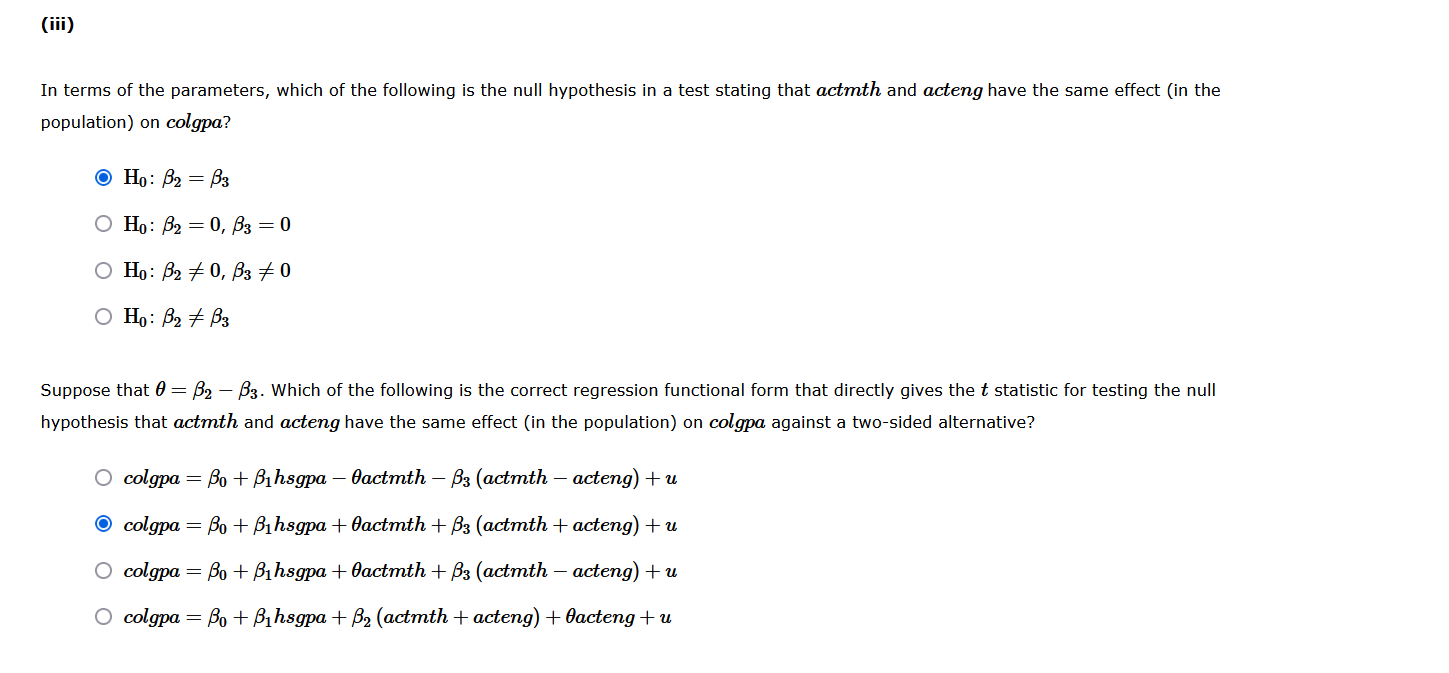
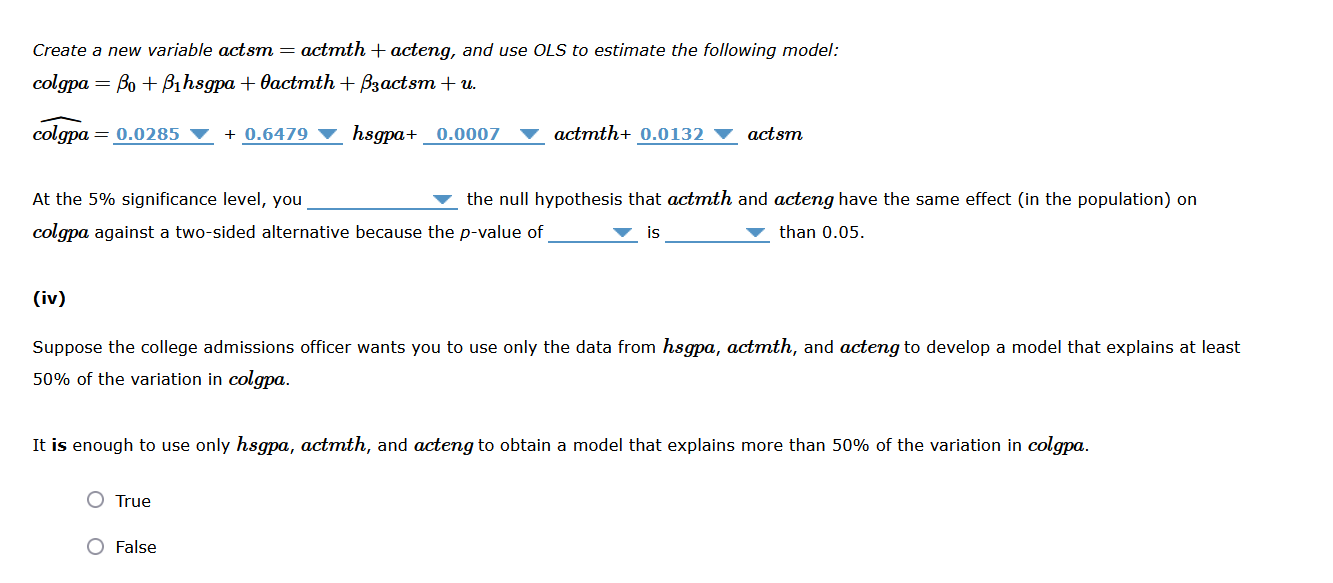
Use OLS to estimate a model explaining colgpa using hsgpa, actmth, and acteng as independent variables. (Note: Use only observations where there is no missing data.) The estimated equation is: colgpa=0.0285+ hsgpa + actmth + acteng True or False: 1,2, and 3 are all statistically insignificant at the 5% significance level against the two-sided alternative. True False In terms of the parameters, which of the following is the null hypothesis in a test stating that actmth and acteng have the same effect (in the population) on colgpa? H0:2=3H0:2=0,3=0H0:2=0,3=0H0:2=3 Suppose that =23. Which of the following is the correct regression functional form that directly gives the t statistic for testing the null hypothesis that actmth and acteng have the same effect (in the population) on colgpa against a two-sided alternative? colgpa=0+1hsgpaactmth3(actmthacteng)+ucolgpa=0+1hsgpa+actmth+3(actmth+acteng)+ucolgpa=0+1hsgpa+actmth+3(actmthacteng)+ucolgpa=0+1hsgpa+2(actmth+acteng)+acteng+u Create a new variable actsm = actmth + acteng, and use OLS to estimate the following model: colgpa=0+1hsgpa+actmth+3actsm+u colgpa=0.0285+0.6479hsgpa+actmth+actsm At the 5% significance level, you the null hypothesis that actmth and acteng have the same effect (in the population) on colgpa against a two-sided alternative because the p-value of is than 0.05. (iv) Suppose the college admissions officer wants you to use only the data from hsgpa, ctmcth, and acteng to develop a model that explains at least 50% of the variation in colgpa. It is enough to use only hsgpa, actmth, and acteng to obtain a model that explains more than 50% of the variation in colgpa. True False Use OLS to estimate a model explaining colgpa using hsgpa, actmth, and acteng as independent variables. (Note: Use only observations where there is no missing data.) The estimated equation is: colgpa=0.0285+ hsgpa + actmth + acteng True or False: 1,2, and 3 are all statistically insignificant at the 5% significance level against the two-sided alternative. True False In terms of the parameters, which of the following is the null hypothesis in a test stating that actmth and acteng have the same effect (in the population) on colgpa? H0:2=3H0:2=0,3=0H0:2=0,3=0H0:2=3 Suppose that =23. Which of the following is the correct regression functional form that directly gives the t statistic for testing the null hypothesis that actmth and acteng have the same effect (in the population) on colgpa against a two-sided alternative? colgpa=0+1hsgpaactmth3(actmthacteng)+ucolgpa=0+1hsgpa+actmth+3(actmth+acteng)+ucolgpa=0+1hsgpa+actmth+3(actmthacteng)+ucolgpa=0+1hsgpa+2(actmth+acteng)+acteng+u Create a new variable actsm = actmth + acteng, and use OLS to estimate the following model: colgpa=0+1hsgpa+actmth+3actsm+u colgpa=0.0285+0.6479hsgpa+actmth+actsm At the 5% significance level, you the null hypothesis that actmth and acteng have the same effect (in the population) on colgpa against a two-sided alternative because the p-value of is than 0.05. (iv) Suppose the college admissions officer wants you to use only the data from hsgpa, ctmcth, and acteng to develop a model that explains at least 50% of the variation in colgpa. It is enough to use only hsgpa, actmth, and acteng to obtain a model that explains more than 50% of the variation in colgpa. True False
Step by Step Solution
There are 3 Steps involved in it

Get step-by-step solutions from verified subject matter experts
 Study Help