







Question: The pictures below will explain the question, use the steps to answer the question. Jump Model V -II & 3 Stage V-III: Synergies from M&As
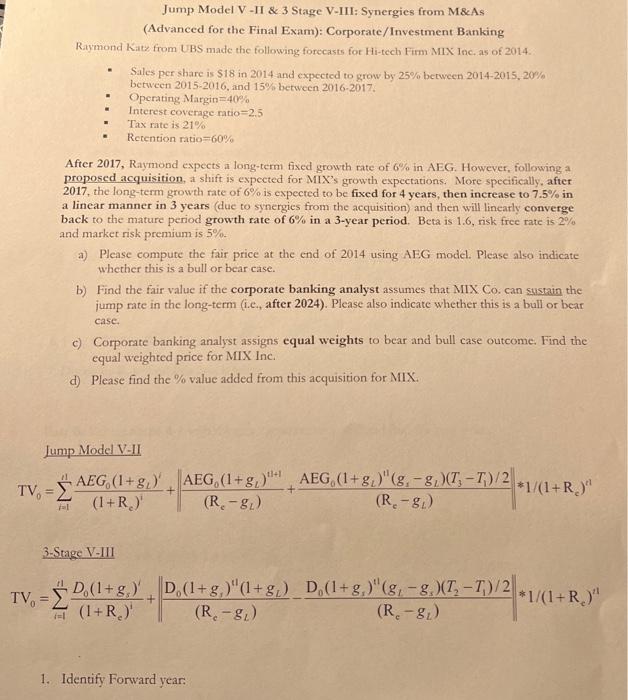
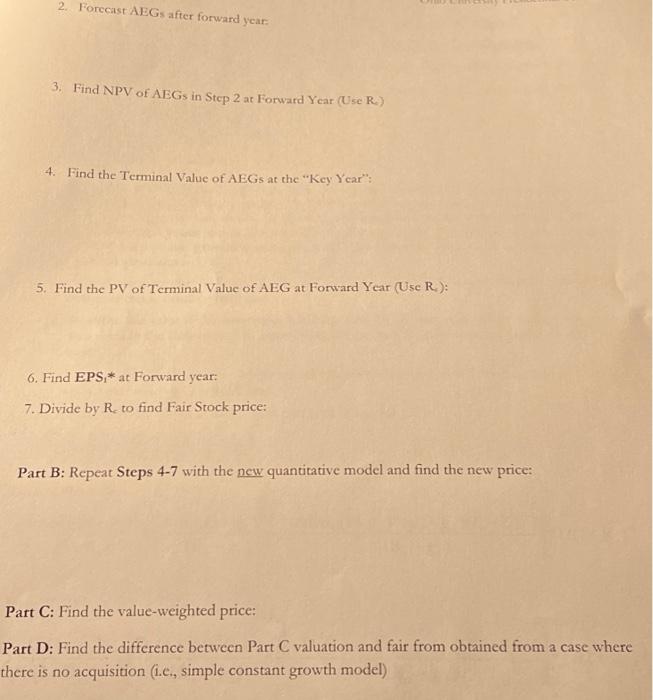
Jump Model V -II \& 3 Stage V-III: Synergies from M\&As (Advanced for the Final Exam): Corporate/Investment Banking Raymond Kate from UBS made the following forecasts for Hi-tech Firm MIX Inc. as of 2014. - Sales per share is $18 in 2014 and expected to grow by 25% between 20142015,20% between 2015-2016, and 15\% between 2016-2017. - Operating Margin =40% - Interest coverage ratio =2.5 - Tax rate is 21% - Retention ratio =60% After 2017, Raymond expects a long-term fixed growth rate of 6% in AEG. However, following a proposed acquisition, a shift is expected for MIX's growth expectations. More specifically, after 2017 , the long-term growth rate of 6% is expected to be fixed for 4 years, then increase to 7.5% in a linear manner in 3 years (due to synergies from the acquisition) and then will linearly converge back to the mature period growth rate of 6% in a 3-year period. Beta is 1.6 , risk free rate is 2% and market risk premium is 5%. a) Please compute the fair price at the end of 2014 using AEG model. Please also indicate whether this is a bull or bear case. b) Find the fair value if the corporate banking analyst assumes that MIX Co. can sustain the jump rate in the long-term (i.e., after 2024). Please also indicate whether this is a bull or bear case. c) Corporate banking analyst assigns equal weights to bear and bull case outcome. Find the equal weighted price for MIX Inc. d) Please find the \% value added from this acquisition for MIX. Lump Model V-II 3-Stage V-III TV0=i=1n(1+Re)iD0(1+gs)i+(RegL)D0(1+gs)t(1+gL)(RegL)D0(1+gs)11(gLgs)(T2T1)/21/(1+Re)t1 1. Identify Forward year: 3. Find NPV of AEG in Step 2 ar Forward Ycar (Use Re) 4. Find the Terminal Value of AEGs at the "Key Ycar": 5. Find the PV of Terminal Value of AEG at Forward Year (Use R2) : 6. Find EPS 1 * at Forward year: 7. Divide by R- to find Fair Stock price: Part B: Repeat Steps 4-7 with the new quantitative model and find the new price: Part C: Find the value-weighted price: Part D: Find the difference between Part C valuation and fair from obtained from a case where there is no acquisition (i.e, simple constant growth model)
Step by Step Solution
There are 3 Steps involved in it

Get step-by-step solutions from verified subject matter experts
 Study Help