







Question: the problems are on the attachments below. the question is complete. fQuestion 3 [93 points) Consider the following decentralized busincle cycle model. The representative household

![representative household makes consumption (0] decisions to maximise lifetime expected utility: ta](https://s3.amazonaws.com/si.experts.images/answers/2024/06/6674fd3b70024_0356674fd3b57cc1.jpg)
the problems are on the attachments below. the question is complete.

![II are prots from rms. As usual, l] d ,6 c: 1.](https://s3.amazonaws.com/si.experts.images/answers/2024/06/6674fd3d0559b_0366674fd3cdd716.jpg)
![following capital production fumction: KHI = KERJ {3} When 5 = i],](https://s3.amazonaws.com/si.experts.images/answers/2024/06/6674fd3e051d2_0376674fd3dd864e.jpg)
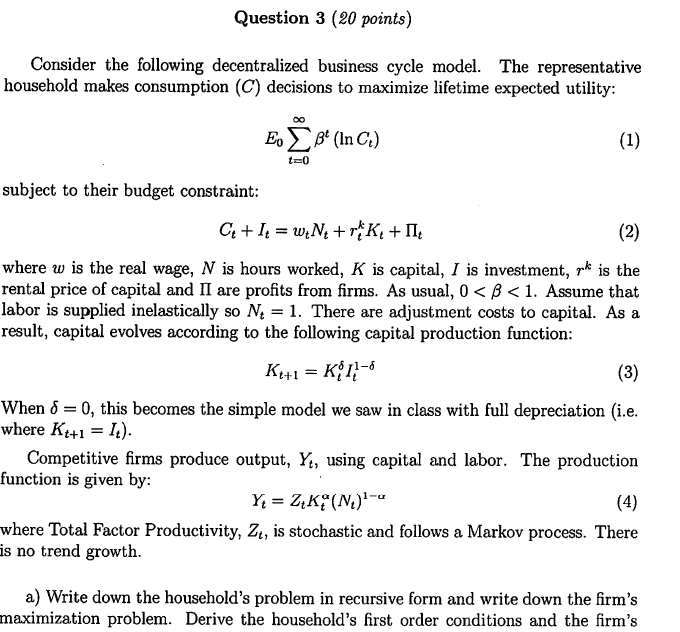
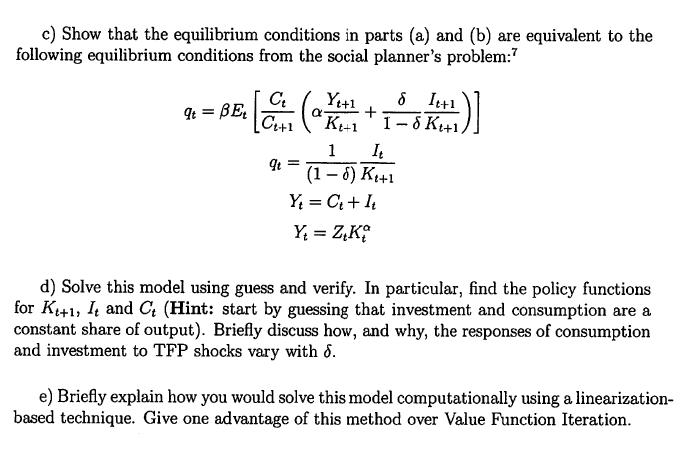
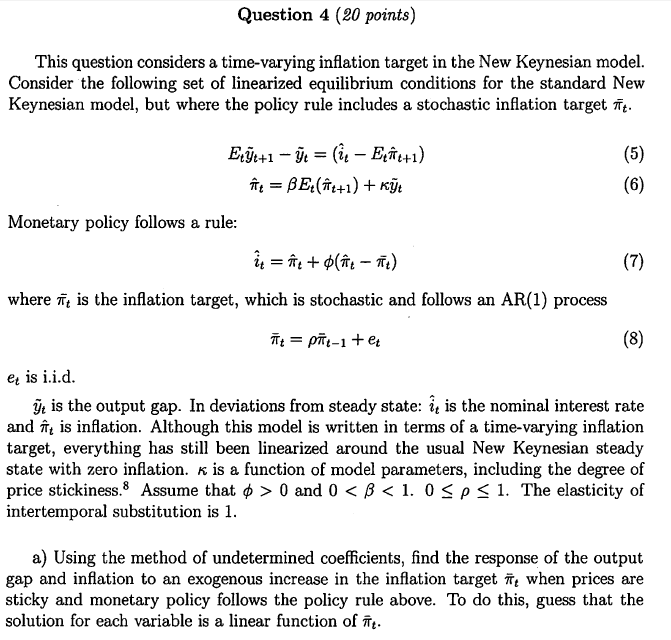
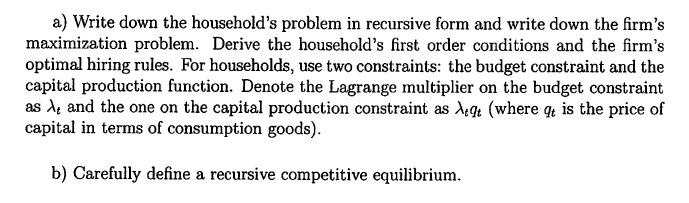
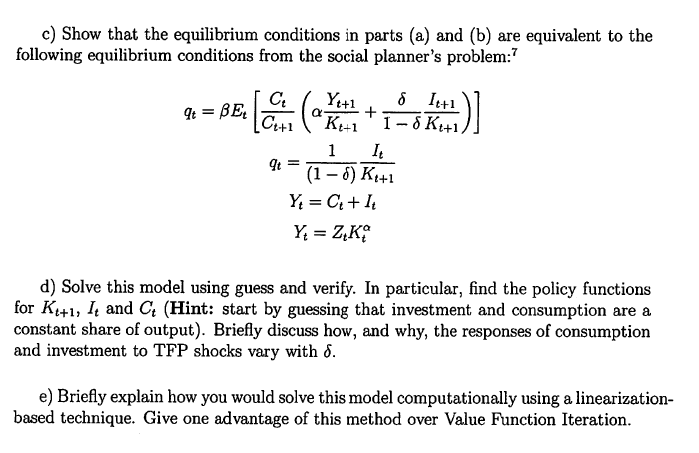
\fQuestion 3 [93 points) Consider the following decentralized busincle cycle model. The representative household makes consumption (0] decisions to maximise lifetime expected utility: ta 3,2,3\" (In 0,} {1} tall subject to their budget constraint: q+c=om+dm+m (3 where to is the real wage, N is hours worked, K is cspitsl, I is investment, 1" is the rental price of capital and II are prots from rms. As usual, l] d ,6 c: 1. Assume that labor is supplied inelasticslly so N, = 1. There are adjustment costs to capital. As s result, capital evolves scoording to the following capital production fumction: KHI = KERJ {3} When 5 = i], this beecnms the simple model we sew in class with full depreciation {i.e. where Kr\" = It]! Competitive rms produce output, 1",, using capital and labor. The production function is given by: H. = Zrt [N1] -.:. {4} where 'Ibtsl Factor Productivity, 2,, is stochastic and follows s Markov process. There is no trend growth. s} Write down the household's problem in recursive form and write down the rm's rneocirnisstion problem. Derive the household's rst order conditions and the rm's a} Write down the household's problem in recursive form and write down the rm's maximization problem. Derive the household's rst order conditions and the rm's optimal hiring rulm. For households, use two constraints: the budget constraint and the capital production function. Denote the Lagrange multiplier on the budget constraint as A; and the one on the capital production constraint as Inc; (where q; is the price of capital in terms of consumption goods). b) {Jarei'ull}r dene a. recursive competitive equilibrium.
Step by Step Solution
There are 3 Steps involved in it

Get step-by-step solutions from verified subject matter experts
 Study Help