Question: The Program Beginning in March of last year, a year-long media-based campaign was aired on radio, TV, and in print in British Columbia. Aimed at
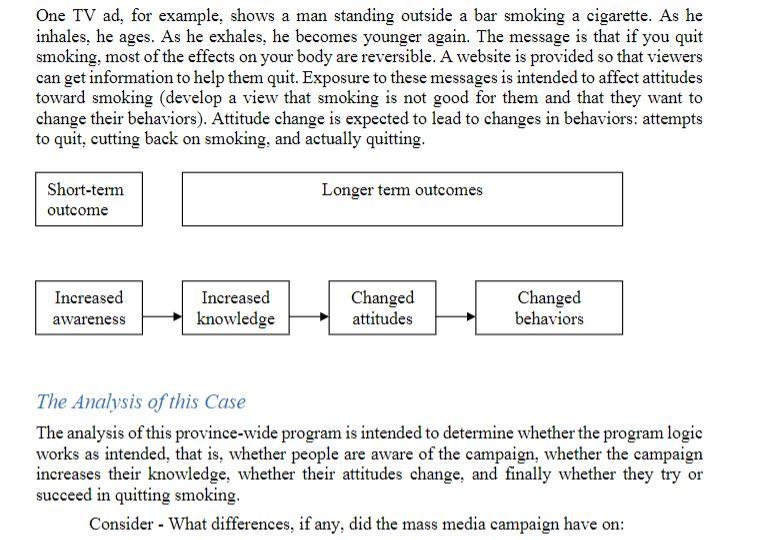
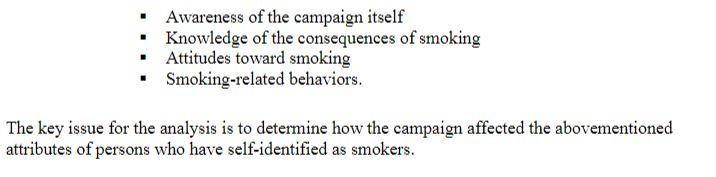
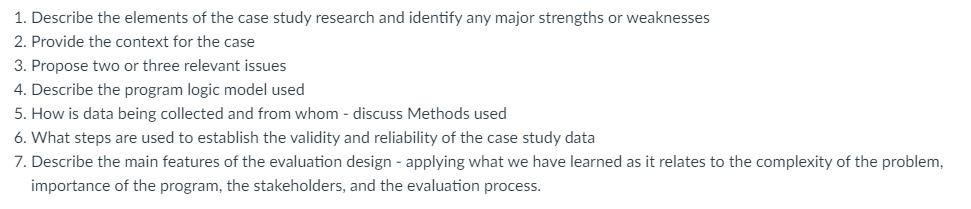
The Program Beginning in March of last year, a year-long media-based campaign was aired on radio, TV, and in print in British Columbia. Aimed at 20- to 30 -year-old persons who are smokers, it is intended to influence them in ways that will lead them to stop smoking. The logic model for the smoking cessation campaign is quite simple and reflects prevailing views about program theory that is relevant to this kind of campaign. Below is a part of that logic model, focusing on outcomes. The components, implementation activities, and outputs are not shown, but they focus on the amounts of media coverage in each of radio, TV, and newspapers. The campaign is intended to last a year and is intended to be implemented in segments. The first segment begins in March and ends in April, the second one is being implemented in July and August, and the third in October and November. As you can see from the logic model, the campaign is intended to initially reach this group of smokers in BC (awareness of the campaign), and once they are aware of the campaign, increase their knowledge of smoking-related issues that might appeal to persons in that age group. One TV ad, for example, shows a man standing outside a bar smoking a cigarette. As he inhales, he ages. As he exhales, he becomes younger again. The message is that if you quit smoking, most of the effects on your body are reversible. A website is provided so that viewers can get information to help them quit. Exposure to these messages is intended to affect attitudes toward smoking (develop a view that smoking is not good for them and that they want to change their behaviors). Attitude change is expected to lead to changes in behaviors: attempts to quit, cutting back on smoking, and actually quitting. \begin{tabular}{|l|l|} \hline Short-term outcome & Longer term outcomes \\ \hline \end{tabular} The Analysis of this Case The analysis of this province-wide program is intended to determine whether the program logic works as intended, that is, whether people are aware of the campaign, whether the campaign increases their knowledge, whether their attitudes change, and finally whether they try or succeed in quitting smoking. Consider - What differences, if any, did the mass media campaign have on: - Awareness of the campaign itself - Knowledge of the consequences of smoking - Attitudes toward smoking - Smoking-related behaviors. The key issue for the analysis is to determine how the campaign affected the abovementioned attributes of persons who have self-identified as smokers. 1. Describe the elements of the case study research and identify any major strengths or weaknesses 2. Provide the context for the case 3. Propose two or three relevant issues 4. Describe the program logic model used 5. How is data being collected and from whom - discuss Methods used 6. What steps are used to establish the validity and reliability of the case study data 7. Describe the main features of the evaluation design - applying what we have learned as it relates to the complexity of the problem, importance of the program, the stakeholders, and the evaluation process. The Program Beginning in March of last year, a year-long media-based campaign was aired on radio, TV, and in print in British Columbia. Aimed at 20- to 30 -year-old persons who are smokers, it is intended to influence them in ways that will lead them to stop smoking. The logic model for the smoking cessation campaign is quite simple and reflects prevailing views about program theory that is relevant to this kind of campaign. Below is a part of that logic model, focusing on outcomes. The components, implementation activities, and outputs are not shown, but they focus on the amounts of media coverage in each of radio, TV, and newspapers. The campaign is intended to last a year and is intended to be implemented in segments. The first segment begins in March and ends in April, the second one is being implemented in July and August, and the third in October and November. As you can see from the logic model, the campaign is intended to initially reach this group of smokers in BC (awareness of the campaign), and once they are aware of the campaign, increase their knowledge of smoking-related issues that might appeal to persons in that age group. One TV ad, for example, shows a man standing outside a bar smoking a cigarette. As he inhales, he ages. As he exhales, he becomes younger again. The message is that if you quit smoking, most of the effects on your body are reversible. A website is provided so that viewers can get information to help them quit. Exposure to these messages is intended to affect attitudes toward smoking (develop a view that smoking is not good for them and that they want to change their behaviors). Attitude change is expected to lead to changes in behaviors: attempts to quit, cutting back on smoking, and actually quitting. \begin{tabular}{|l|l|} \hline Short-term outcome & Longer term outcomes \\ \hline \end{tabular} The Analysis of this Case The analysis of this province-wide program is intended to determine whether the program logic works as intended, that is, whether people are aware of the campaign, whether the campaign increases their knowledge, whether their attitudes change, and finally whether they try or succeed in quitting smoking. Consider - What differences, if any, did the mass media campaign have on: - Awareness of the campaign itself - Knowledge of the consequences of smoking - Attitudes toward smoking - Smoking-related behaviors. The key issue for the analysis is to determine how the campaign affected the abovementioned attributes of persons who have self-identified as smokers. 1. Describe the elements of the case study research and identify any major strengths or weaknesses 2. Provide the context for the case 3. Propose two or three relevant issues 4. Describe the program logic model used 5. How is data being collected and from whom - discuss Methods used 6. What steps are used to establish the validity and reliability of the case study data 7. Describe the main features of the evaluation design - applying what we have learned as it relates to the complexity of the problem, importance of the program, the stakeholders, and the evaluation process









 Study Help