



Question: The Q has two requirements please answer them with details Required information [The following information applies to the questions displayed below] Patel and Sons Inc.
The Q has two requirements please answer them with details 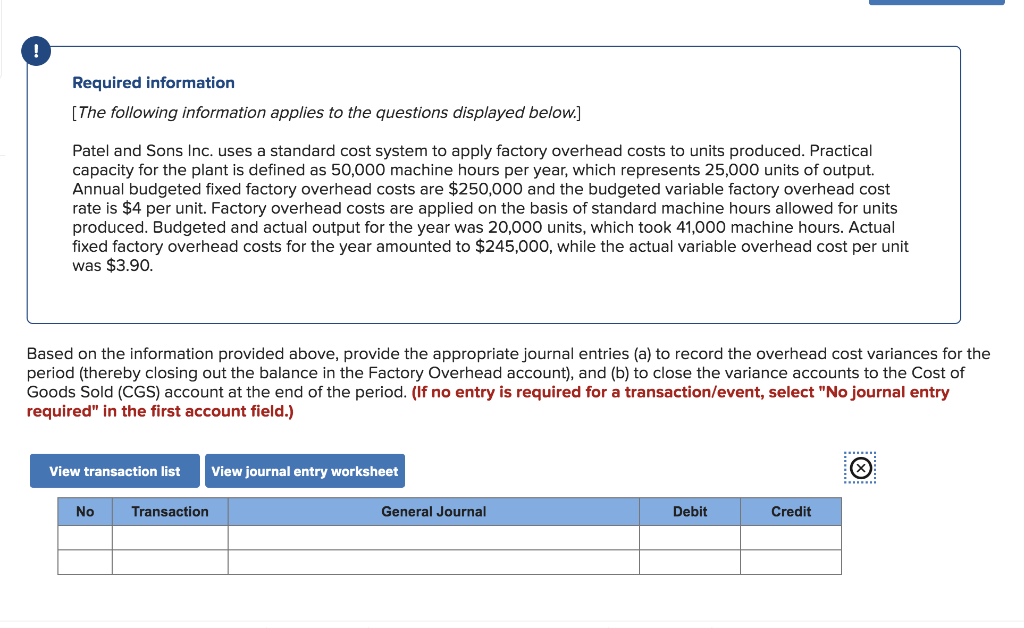
![[The following information applies to the questions displayed below] Patel and Sons](https://dsd5zvtm8ll6.cloudfront.net/si.experts.images/questions/2024/09/66e5fb1a1d4cf_05766e5fb1998a58.jpg)
Required information [The following information applies to the questions displayed below] Patel and Sons Inc. uses a standard cost system to apply factory overhead costs to units produced. Practical capacity for the plant is defined as 50,000 machine hours per year, which represents 25,000 units of output. Annual budgeted fixed factory overhead costs are $250,000 and the budgeted variable factory overhead cost rate is $4 per unit. Factory overhead costs are applied on the basis of standard machine hours allowed for units produced. Budgeted and actual output for the year was 20,000 units, which took 41,000 machine hours. Actual fixed factory overhead costs for the year amounted to $245,000, while the actual variable overhead cost per unit was $3.90. Based on the information provided above, provide the appropriate journal entries (a) to record the overhead cost variances for the period (thereby closing out the balance in the Factory Overhead account), and (b) to close the variance accounts to the Cost of Goods Sold (CGS) account at the end of the period. (If no entry is required for a transaction/event,slect "No journal entry required" in the first account field.) View transaction list View journal entry worksheet General Journal Debit No Transaction Credit Based on the information provided above, provide the correct summary journal entries for actual and applied factory overhead costs (both variable and fixed) for the year. Assume that the company uses a single account, Factory Overhead, to record both actual and applied factory overhead. Also, assume that the only variable overhead cost was electricity and that actual fixed overhead consisted of depreciation of $150,000 and supervisory salaries of $95,000. Finally, assume that both electricity expense and the supervisory salaries expense have been incurred but not yet paid (i.e., both are current liabilities). (If no entry is required for a transaction/event, select "No journal entry required" in the first account field.) View transaction list Import a new list Record the actual overhead costs. A B Record the overhead costs applied to production Required information [The following information applies to the questions displayed below] Patel and Sons Inc. uses a standard cost system to apply factory overhead costs to units produced. Practical capacity for the plant is defined as 50,000 machine hours per year, which represents 25,000 units of output. Annual budgeted fixed factory overhead costs are $250,000 and the budgeted variable factory overhead cost rate is $4 per unit. Factory overhead costs are applied on the basis of standard machine hours allowed for units produced. Budgeted and actual output for the year was 20,000 units, which took 41,000 machine hours. Actual fixed factory overhead costs for the year amounted to $245,000, while the actual variable overhead cost per unit was $3.90. Based on the information provided above, provide the appropriate journal entries (a) to record the overhead cost variances for the period (thereby closing out the balance in the Factory Overhead account), and (b) to close the variance accounts to the Cost of Goods Sold (CGS) account at the end of the period. (If no entry is required for a transaction/event,slect "No journal entry required" in the first account field.) View transaction list View journal entry worksheet General Journal Debit No Transaction Credit Based on the information provided above, provide the correct summary journal entries for actual and applied factory overhead costs (both variable and fixed) for the year. Assume that the company uses a single account, Factory Overhead, to record both actual and applied factory overhead. Also, assume that the only variable overhead cost was electricity and that actual fixed overhead consisted of depreciation of $150,000 and supervisory salaries of $95,000. Finally, assume that both electricity expense and the supervisory salaries expense have been incurred but not yet paid (i.e., both are current liabilities). (If no entry is required for a transaction/event, select "No journal entry required" in the first account field.) View transaction list Import a new list Record the actual overhead costs. A B Record the overhead costs applied to production
Step by Step Solution
There are 3 Steps involved in it

Get step-by-step solutions from verified subject matter experts