







Question: The quality-control manager at a compact fluorescent light bulb (CFL) factory needs to determine whether the mean life of a large shipment of CFLs is
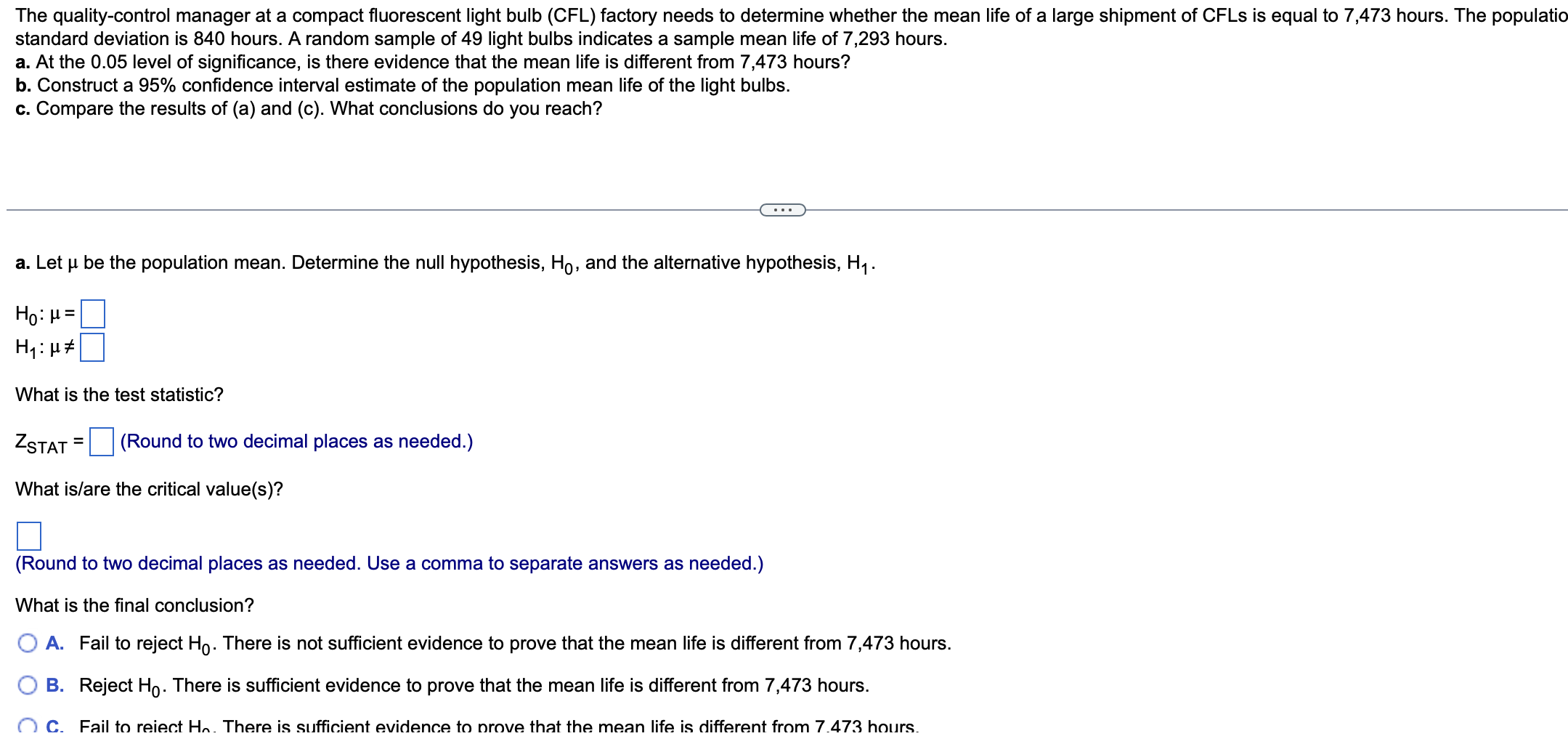
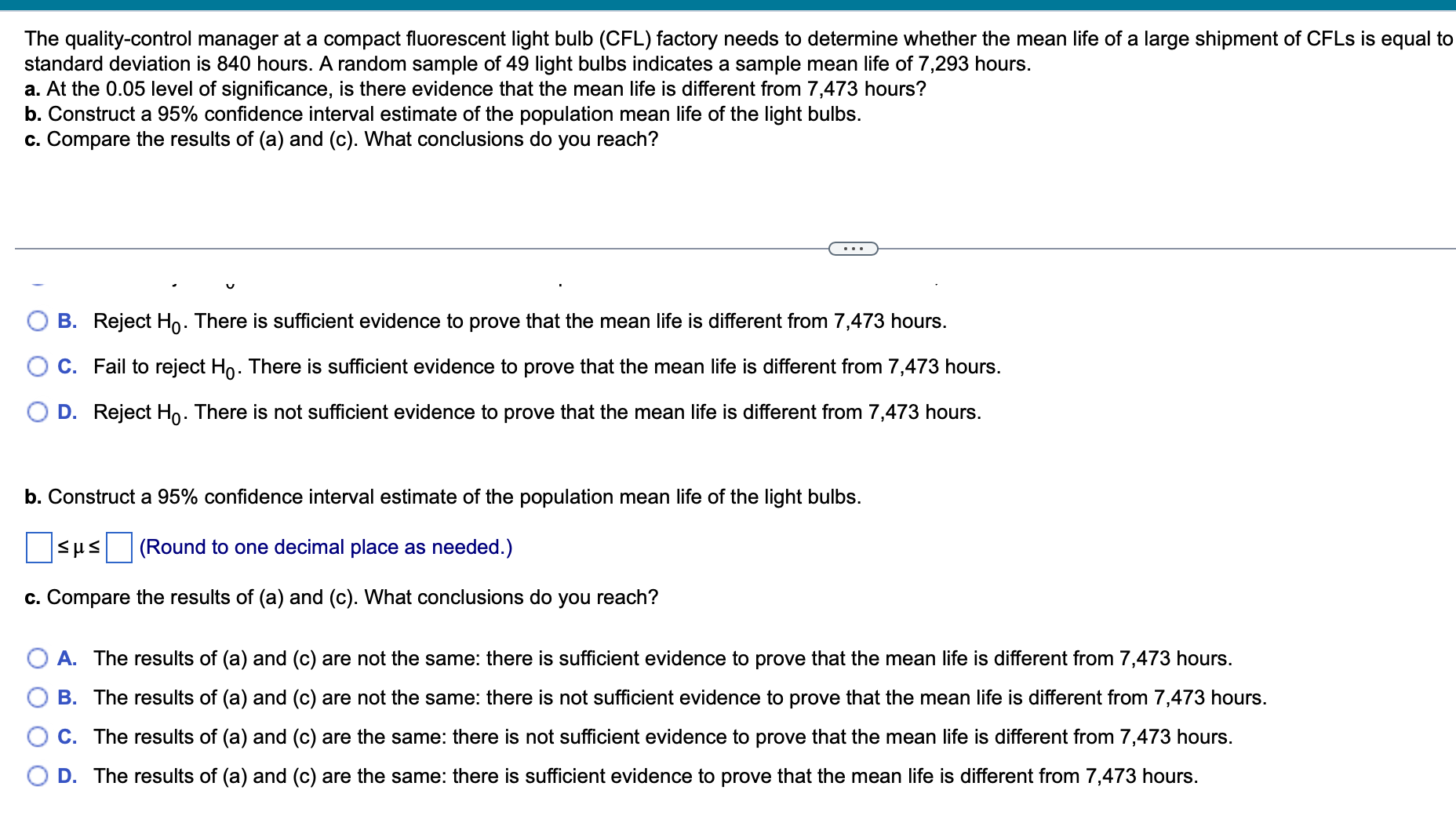
The quality-control manager at a compact fluorescent light bulb (CFL) factory needs to determine whether the mean life of a large shipment of CFLs is equal to 7,473 hours. The population standard deviation is 840 hours. A random sample of 49 light bulbs indicates a sample mean life of 7,293 hours. a. At the 0.05 level of significance, is there evidence that the mean life is different from 7,473 hours? b. Construct a 95% confidence interval estimate of the population mean life of the light bulbs. c. Compare the results of (a) and (c). What conclusions do you reach? a. Let u be the population mean. Determine the null hypothesis, Ho, and the alternative hypothesis, H1 . HO: H= What is the test statistic? ZSTAT = (Round to two decimal places as needed.) What is/are the critical value(s)? (Round to two decimal places as needed. Use a comma to separate answers as needed.) What is the final conclusion? O A. Fail to reject Ho. There is not sufficient evidence to prove that the mean life is different from 7,473 hours. O B. Reject Ho. There is sufficient evidence to prove that the mean life is different from 7,473 hours. C. Fail to reject Ha. There is sufficient evidence to prove that the mean life is different from 7 473 hours.The quality-control manager at a compact fluorescent light bulb (CFL) factory needs to determine whether the mean life of a large shipment of CFLs is equal to standard deviation is 840 hours. A random sample of 49 light bulbs indicates a sample mean life of 7,293 hours. a. At the 0.05 level of significance, is there evidence that the mean life is different from 7,473 hours? b. Construct a 95% confidence interval estimate of the population mean life of the light bulbs. c. Compare the results of (a) and (c). What conclusions do you reach? . . . O B. Reject Ho. There is sufficient evidence to prove that the mean life is different from 7,473 hours. O C. Fail to reject Ho. There is sufficient evidence to prove that the mean life is different from 7,473 hours. O D. Reject Ho. There is not sufficient evidence to prove that the mean life is different from 7,473 hours. b. Construct a 95% confidence interval estimate of the population mean life of the light bulbs. Sus (Round to one decimal place as needed.) c. Compare the results of (a) and (c). What conclusions do you reach? O A. The results of (a) and (c) are not the same: there is sufficient evidence to prove that the mean life is different from 7,473 hours. O B. The results of (a) and (c) are not the same: there is not sufficient evidence to prove that the mean life is different from 7,473 hours. O C. The results of (a) and (c) are the same: there is not sufficient evidence to prove that the mean life is different from 7,473 hours. O D. The results of (a) and (c) are the same: there is sufficient evidence to prove that the mean life is different from 7,473 hours
Step by Step Solution
There are 3 Steps involved in it

Get step-by-step solutions from verified subject matter experts
 Study Help