



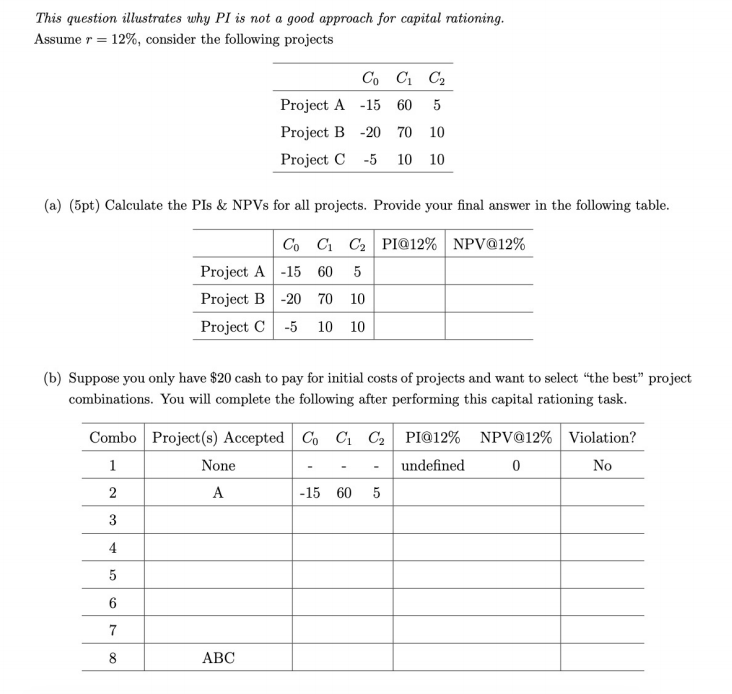
Question: the question is described This question illustrates why PI is not a good approach for capital rationing. Assume r = 12%, consider the following projects
the question is described
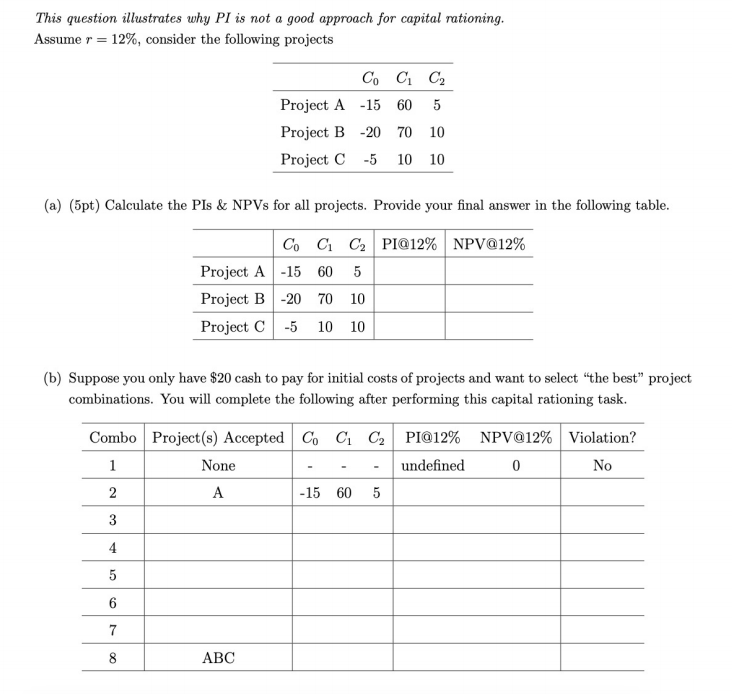
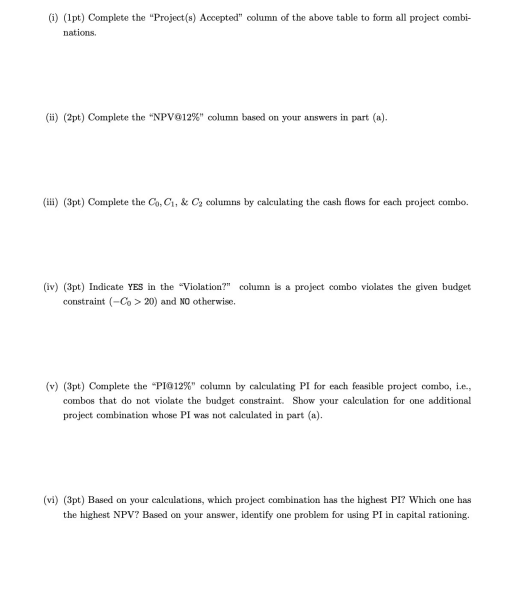
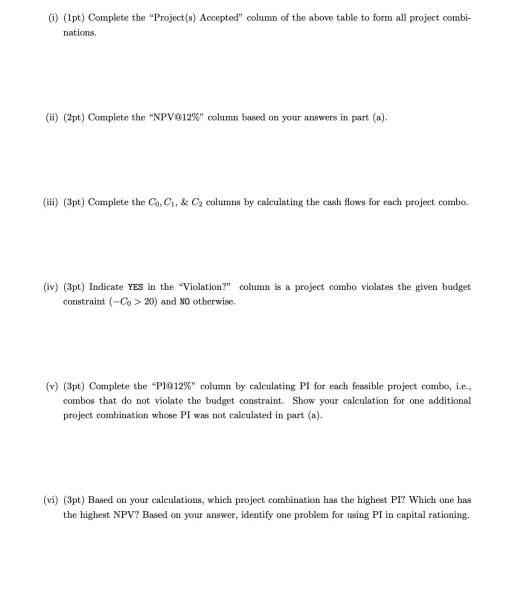
This question illustrates why PI is not a good approach for capital rationing. Assume r = 12%, consider the following projects Co CI C2 Project A -15 60 5 Project B -20 70 10 Project C -5 10 10 (a) (5pt) Calculate the PIs & NPVs for all projects. Provide your final answer in the following table. Co C C2 PI@12% NPV@12% Project A -15 60 5 Project B -20 70 10 Project C -5 10 10 (b) Suppose you only have $20 cash to pay for initial costs of projects and want to select "the best" project combinations. You will complete the following after performing this capital rationing task. Combo Project(s) Accepted Co CI C2 PI@12% NPV@12% Violation? 1 None undefined 0 No 2 A -15 60 5 3 4 5 6 7 8 ABC(i) (1pt) Complete the "Project(s) Accepted" column of the above table to form all project combi- nations. (ii) (2pt) Complete the "NPV@12%%" column based on your answers in part (a). (iii) (3pt) Complete the Co. Ci, & Co columns by calculating the cash flows for each project combo. (iv) (3pt) Indicate YES in the "Violation?" column is a project combo violates the given budget constraint (-Co > 20) and NO otherwise. (v) (3pt) Complete the "PIO12%%" column by calculating PI for each feasible project combo, i.e., combos that do not violate the budget constraint. Show your calculation for one additional project combination whose PI was not calculated in part (a). (vi) (3pt) Based on your calculations, which project combination has the highest PI? Which one has the highest NPV7 Based on your answer, identify one problem for using PI in capital rationing
Step by Step Solution
There are 3 Steps involved in it

Get step-by-step solutions from verified subject matter experts