







Question: The question is for a Causal Inference class. There is no additional information provided. Consider an experiment with / units. Each unit : in the
The question is for a Causal Inference class. There is no additional information provided.
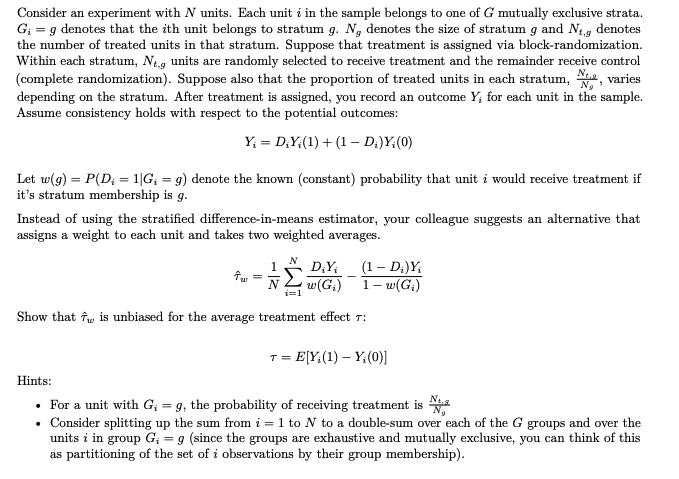
Consider an experiment with / units. Each unit : in the sample belongs to one of G mutually exclusive strata. G; = g denotes that the ith unit belongs to stratum g. N, denotes the size of stratum g and My denotes the number of treated units in that stratum. Suppose that treatment is assigned via block-randomization. Within each stratum, Neg units are randomly selected to receive treatment and the remainder receive control (complete randomization). Suppose also that the proportion of treated units in each stratum, N., 1 Ate, varies depending on the stratum. After treatment is assigned, you record an outcome Y, for each unit in the sample. Assume consistency holds with respect to the potential outcomes: Y = DY(1)+ (1 - D.)Y(0) Let w(g) = P(D. = 1/G, = g) denote the known (constant) probability that unit i would receive treatment if it's stratum membership is g. Instead of using the stratified difference-in-means estimator, your colleague suggests an alternative that assigns a weight to each unit and takes two weighted averages. N DY N (1 - D.)Y 1= 1 w(G.) 1 - w(G.) Show that +, is unbiased for the average treatment effect T: T= E[Y(1) - Y(0)] Hints: . For a unit with G, = g, the probability of receiving treatment is . Consider splitting up the sum from i = 1 to N to a double-sum over each of the G groups and over the units i in group G, =g (since the groups are exhaustive and mutually exclusive, you can think of this as partitioning of the set of i observations by their group membership)
Step by Step Solution
There are 3 Steps involved in it

Get step-by-step solutions from verified subject matter experts
 Study Help