







Question: The question is in the image. 5. (5 marks) Consider the following version of the innitely repeated Cournot duopoly problem. In the stage game, the
The question is in the image.
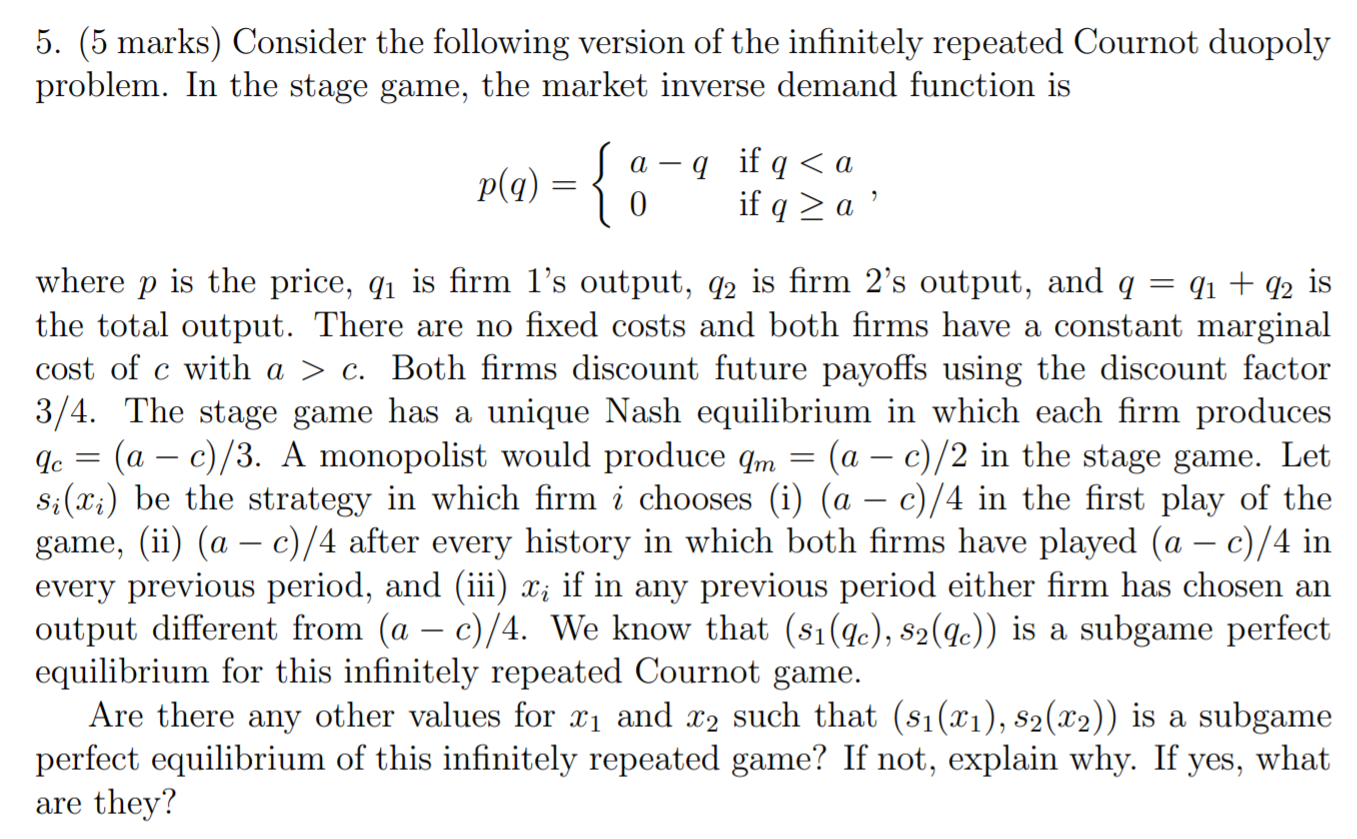
5. (5 marks) Consider the following version of the innitely repeated Cournot duopoly problem. In the stage game, the market inverse demand function is _ aq ifq c. Both rms discount future payoffs using the discount factor 3/4. The stage game has a unique Nash equilibrium in which each rm produces qc = (a. c) / 3. A monopolist would produce qm = (a c) / 2 in the stage game. Let 3,03,) be the strategy in which rm i chooses (i) (a c)/4 in the rst play of the game, (ii) (a c) / 4 after every history in which both rms have played (a c) / 4 in every previous period, and (iii) 3:,- if in any previous period either rm has chosen an output different from (a c)/4. We know that (51(qc), 52(qc)) is a subgame perfect equilibrium for this innitely repeated Cournot game. Are there any other values for :31 and .182 such that (51(m1),52(m2)) is a subgame perfect equilibrium of this innitely repeated game? If not, explain why. If yes, what are they
Step by Step Solution
There are 3 Steps involved in it

Get step-by-step solutions from verified subject matter experts
 Study Help