







Question: The question> Let's start by defining f:R[1,[ according to f(x)=65sin(x)+4, and g:RR according to g(x)=4x3. In this assignment we will study the composite function h
The question>
Let's start by defining f:R[1,[ according to f(x)=65sin(x)+4, and g:RR according to g(x)=4x3. In this assignment we will study the composite function h of f and g, which satisfies h(x)=f(g(x)) for all x in its definition set.
a) Give the expression for h(x).
b) Calculate h(3), h(4) and h(5). Your answer should not contain any sine or cosine function and should not be in decimal form.
c) Print the definition set and target set for h.
d) Determine the set of values for h.
e) Is h an injective function? If yes, provide a proof; if no, give a counterexample.
f) Is h a surjective function? If yes, provide a proof; if no, give a counterexample. Your solution must be well written and your conclusions clearly formulated. Explain reasoning using both text and mathematical symbols. Only calculations are not accepted. All theorems in the course literature may be used without proof.
my answers>
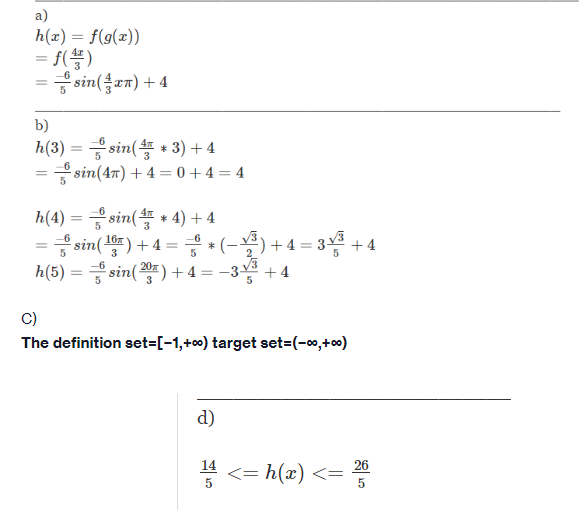
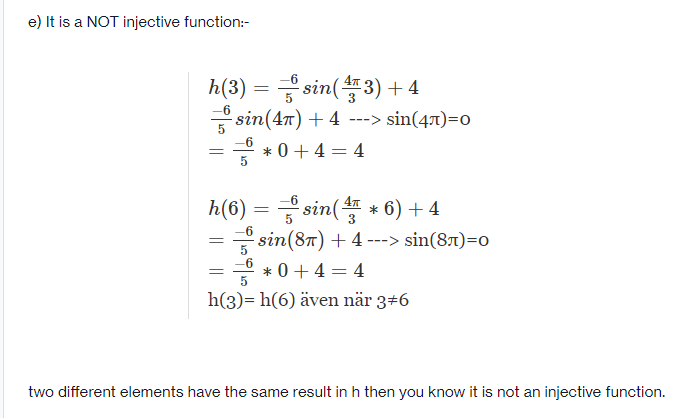
a) h(x) = f(g(x)) = f(@) = - sin(#xx) +4 b) ) = 3 sin(* *3) +4 = - sin(47) + 4 = 0+4=4 h(4) = - sin(4: * 4) + 4 " sin( 197) +4 = s * (-W) +4=343 5 +4 h(5) = " sin(207 ) +4 = -34 +4 C) The definition set=[-1,+co) target set=(-co,+co) d) 14 sin(47)=0 = *0+4 =4 h(6) = -~ sin( * 6) + 4 = sin (87) + 4---> sin(8)=0 = * 0+4 =4 h(3)= h(6) aven nar 3+6 two different elements have the same result in h then you know it is not an injective function
Step by Step Solution
There are 3 Steps involved in it

Get step-by-step solutions from verified subject matter experts
 Study Help