







Question: the question(g),(h) Discrete Maths 1. In this exercise, we work through the RSA encryption algorithm as done in lectures, using the same notation. The numbers
 the question(g),(h)
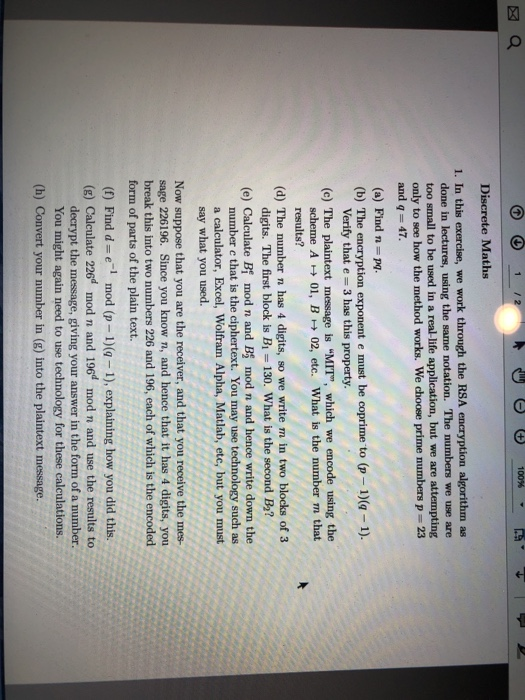
Discrete Maths 1. In this exercise, we work through the RSA encryption algorithm as done in lectures, using the same notation. The numbers we use are too small to be used in a real-life application, but we are attempting only to see how the method works, we choose prime numbers p 23 and q 47. (a) Find n-p. (b) The encryption exponent e must be coprime to (p-1)(a -1). Verify that e 3 has this property. (c) The plaintext message is "MIT, which we encode using the Scheme A-+ 01, B 02, etc. what is the number m that results? (d) The number n has 4 digits, so we write m in two blocks of 3 digits. The first block is Bi 130. What is the second B2? (e) Calculate Bi mod n and B5 mod n and hence write down the number e that is the ciphertext. You may use technology such as a calculator, Excel, Wolfram Alpha, Matlab, etc, but you must say what you used. Now suppose that you are the receiver, and that you receive the mes- sage 226196. Since you know n, and hence that it has 4 digits, you break this into two numbers 226 and 196, each of which is the encoded form of parts of the plain text. (f) Find d = e-1 mod (p-1)(1-1), explaining how you did this. (g) Calculate 226 mod n and 196 mod n and use the results to decrypt the message, giving your answer in the form of a number You might again need to use technology for these calculations. (h) Convert your number in (g) into the plaintext message
Step by Step Solution
There are 3 Steps involved in it

Get step-by-step solutions from verified subject matter experts
 Study Help