







Question: In this problem you will perform generalized linear regression on a dataset D={(x(1),y(1)),,(x(m),y(m))} of m examples/instances, each corresponding to an input-output pair (x,y), using the
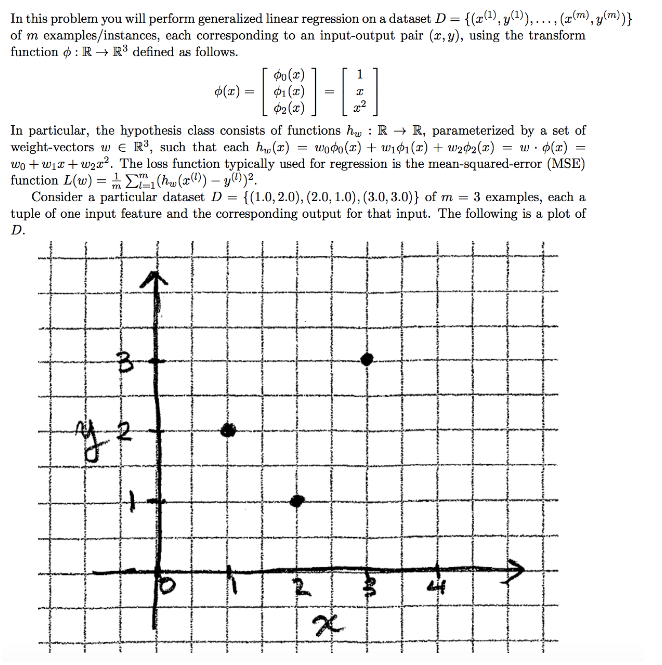
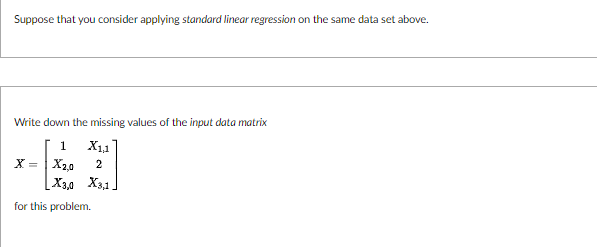
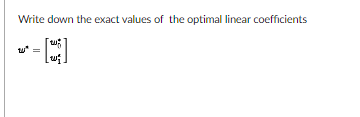
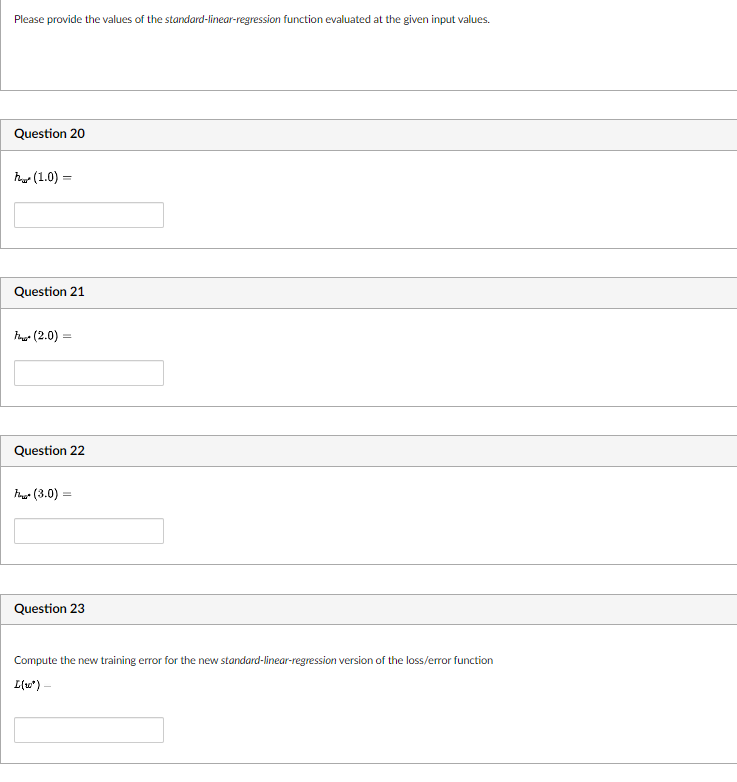
In this problem you will perform generalized linear regression on a dataset D={(x(1),y(1)),,(x(m),y(m))} of m examples/instances, each corresponding to an input-output pair (x,y), using the transform function :RR3 defined as follows. (x)=0(x)1(x)2(x)=1xx2 In particular, the hypothesis class consists of functions hw:RR, parameterized by a set of weight-vectors wR3, such that each hw(x)=w00(x)+w11(x)+w22(x)=w(x)= w0+w1x+w2x2. The loss function typically used for regression is the mean-squared-error (MSE) function L(w)=m1l=1m(hw(x(l))y(l))2. Consider a particular dataset D={(1.0,2.0),(2.0,1.0),(3.0,3.0)} of m=3 examples, each a tuple of one input feature and the corresponding output for that input. The following is a plot of Suppose that you consider applying standard linear regression on the same data set above. Write down the missing values of the input data matrix X=1X2,0X3,0X1,12X3,1 for this problem. Write down the exact values of the optimal linear coefficients w=[w0w1] Please provide the values of the standard-linear-regression function evaluated at the given input values. Question 20 h(1.0)= Question 21 hw(2.0)= Question 22 hw(3.0)= Question 23 Compute the new training error for the new standard-linear-regression version of the loss/error function L(w)=
Step by Step Solution
There are 3 Steps involved in it

Get step-by-step solutions from verified subject matter experts
 Study Help