







Question: The queueing model is described in the second picture. 2.1 Consider the queueing model (Example 3 of Section 2.1). For which values of p, is
The queueing model is described in the second picture. 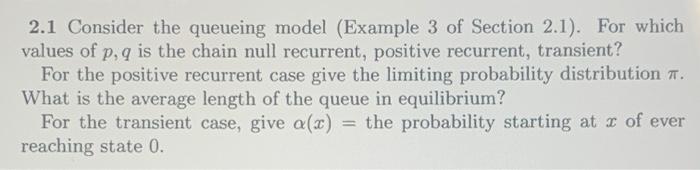
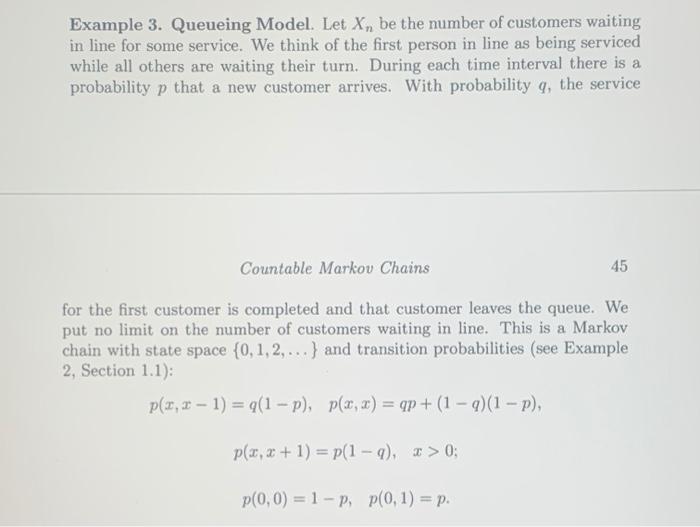
2.1 Consider the queueing model (Example 3 of Section 2.1). For which values of p, is the chain null recurrent, positive recurrent, transient? For the positive recurrent case give the limiting probability distribution . What is the average length of the queue in equilibrium? For the transient case, give a(x) = the probability starting at x of ever reaching state 0. Example 3. Queueing Model. Let X, be the number of customers waiting in line for some service. We think of the first person in line as being serviced while all others are waiting their turn. During each time interval there is a probability p that a new customer arrives. With probability 9, the service Countable Markov Chains 45 for the first customer is completed and that customer leaves the queue. We put no limit on the number of customers waiting in line. This is a Markov chain with state space {0, 1, 2,...} and transition probabilities (see Example 2, Section 1.1): p(7,2 - 1) = 9(1 - p), p(x,x) = qp + (1 - 9)(1-p), p(x,x + 1) = p(1-0), 3 > 0; p(0,0) = 1-P. (0, 1) = p. 2.1 Consider the queueing model (Example 3 of Section 2.1). For which values of p, is the chain null recurrent, positive recurrent, transient? For the positive recurrent case give the limiting probability distribution . What is the average length of the queue in equilibrium? For the transient case, give a(x) = the probability starting at x of ever reaching state 0. Example 3. Queueing Model. Let X, be the number of customers waiting in line for some service. We think of the first person in line as being serviced while all others are waiting their turn. During each time interval there is a probability p that a new customer arrives. With probability 9, the service Countable Markov Chains 45 for the first customer is completed and that customer leaves the queue. We put no limit on the number of customers waiting in line. This is a Markov chain with state space {0, 1, 2,...} and transition probabilities (see Example 2, Section 1.1): p(7,2 - 1) = 9(1 - p), p(x,x) = qp + (1 - 9)(1-p), p(x,x + 1) = p(1-0), 3 > 0; p(0,0) = 1-P. (0, 1) = p Step by Step Solution
There are 3 Steps involved in it
1 Expert Approved Answer
Step: 1 Unlock

Question Has Been Solved by an Expert!
Get step-by-step solutions from verified subject matter experts
Step: 2 Unlock
Step: 3 Unlock
 Study Help