







Question: The region shown below is bounded by the curvey = Volume = Answer the following based on the graph given above. a. Consider a
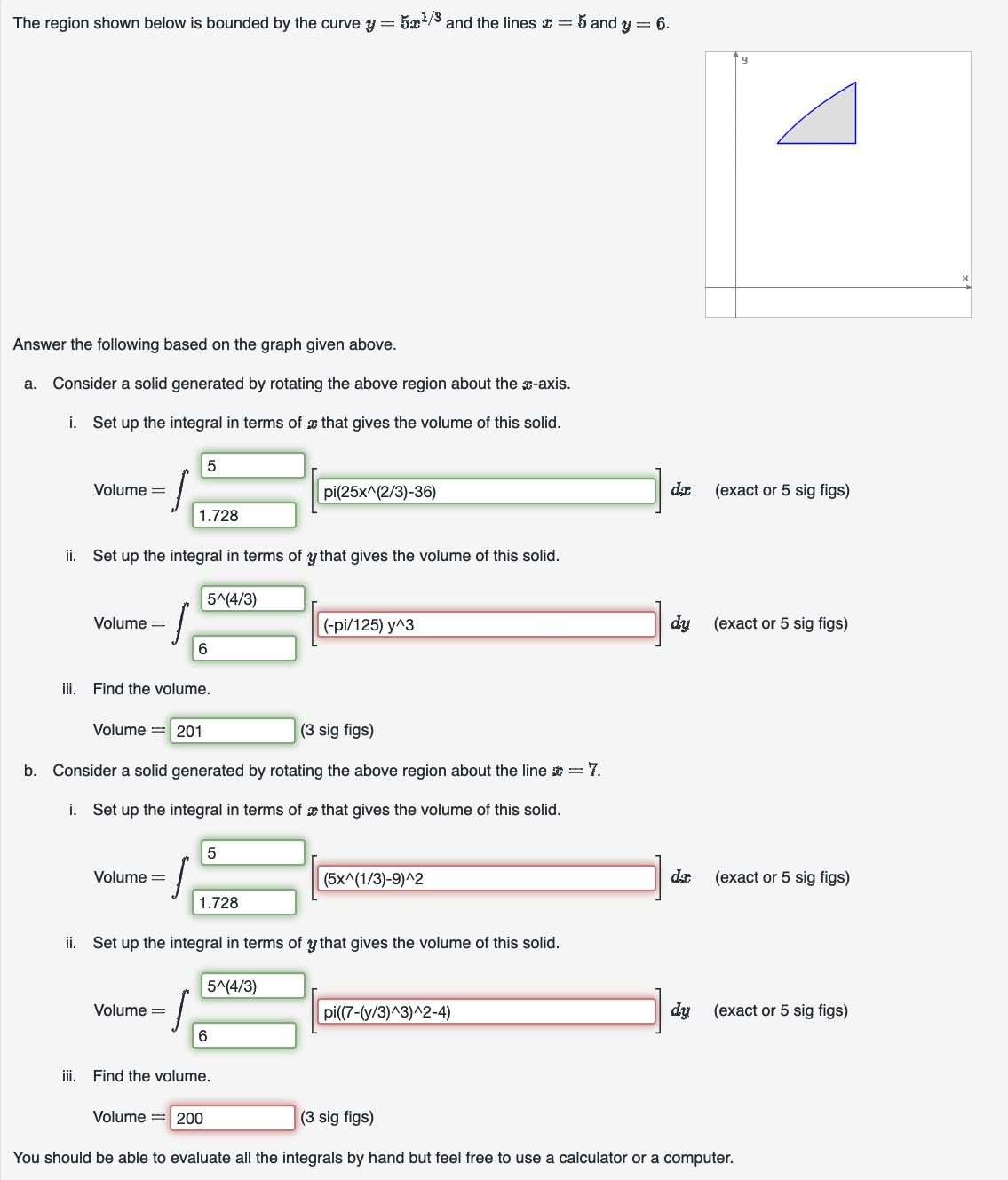
The region shown below is bounded by the curvey = Volume = Answer the following based on the graph given above. a. Consider a solid generated by rotating the above region about the x-axis. i. Set up the integral in terms of that gives the volume of this solid. Volume= 1.728 5 ii. Set up the integral in terms of y that gives the volume of this solid. 5^(4/3) iii. Find the volume. Volume = 201 Volume= 6 Volume = (3 sig figs) b. Consider a solid generated by rotating the above region about the line = 7. i. Set up the integral in terms of that gives the volume of this solid. 5 1.728 5x1/3 6 pi(25x^(2/3)-36) iii. Find the volume. Volume = 200 and the lines * = 5 and y = 6. (-pi/125) y^3 ii. Set up the integral in terms of y that gives the volume of this solid. 5^(4/3) (5x^(1/3)-9)^2 pi((7-(y/3)^3)^2-4) da (exact or 5 sig figs) dy (exact or 5 sig figs) da (exact or 5 sig figs) dy (exact or 5 sig figs) (3 sig figs) You should be able to evaluate all the integrals by hand but feel free to use a calculator or a computer. The region shown below is bounded by the curvey = Volume = Answer the following based on the graph given above. a. Consider a solid generated by rotating the above region about the x-axis. i. Set up the integral in terms of that gives the volume of this solid. Volume= 1.728 5 ii. Set up the integral in terms of y that gives the volume of this solid. 5^(4/3) iii. Find the volume. Volume = 201 Volume= 6 Volume = (3 sig figs) b. Consider a solid generated by rotating the above region about the line = 7. i. Set up the integral in terms of that gives the volume of this solid. 5 1.728 5x1/3 6 pi(25x^(2/3)-36) iii. Find the volume. Volume = 200 and the lines * = 5 and y = 6. (-pi/125) y^3 ii. Set up the integral in terms of y that gives the volume of this solid. 5^(4/3) (5x^(1/3)-9)^2 pi((7-(y/3)^3)^2-4) da (exact or 5 sig figs) dy (exact or 5 sig figs) da (exact or 5 sig figs) dy (exact or 5 sig figs) (3 sig figs) You should be able to evaluate all the integrals by hand but feel free to use a calculator or a computer.
Step by Step Solution
3.44 Rating (147 Votes )
There are 3 Steps involved in it

Get step-by-step solutions from verified subject matter experts
 Study Help