Question: The response Less than a day after publishing her post. Weitz has received a barrage of both supportive and critical metges Tve gotten some really
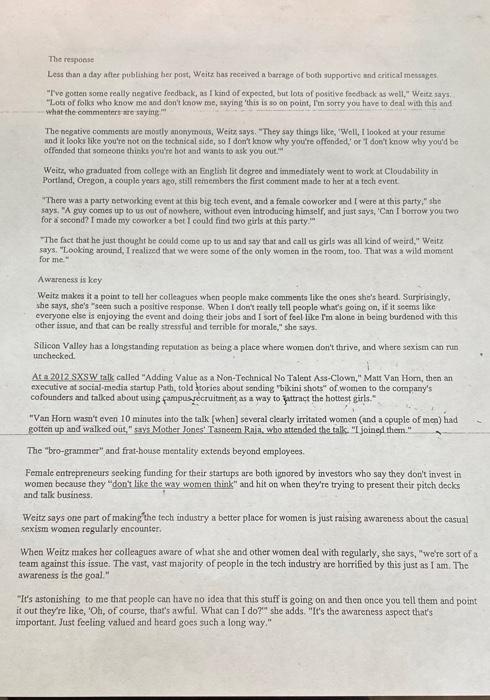
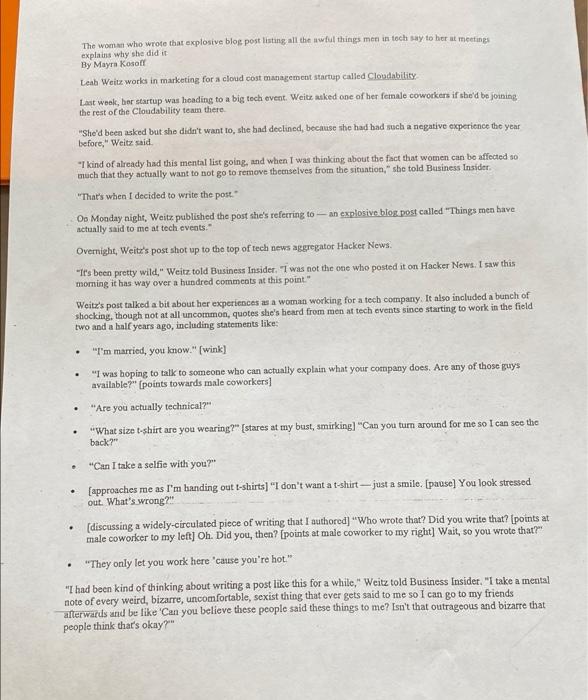
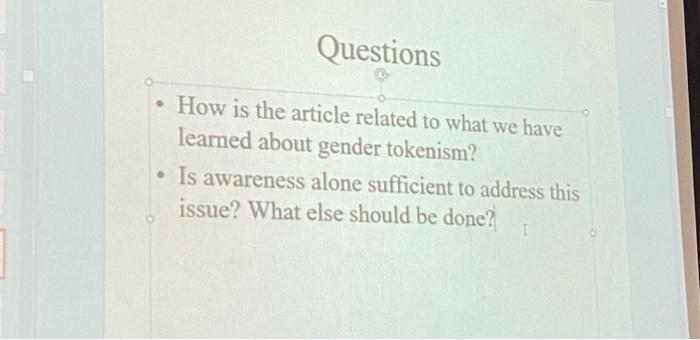
The response Less than a day after publishing her post. Weitz has received a barrage of both supportive and critical metges "Tve gotten some really negative feedback, as I kind of expected, but lots of positive feedback as woll." Weitz says "Lots of folies who know me and don't know me, saying this is so on point, l'on sorty you have to deal with this and what the commenters are saying The negative comments are mostly anonymous, Weitz says. "They say things like, 'Well, I looked at your resume and it looks like you're not on the technical side, so I don't know why you're offended,' or I don't know why you'd be offended that someone thinks you're hot and wants to ask you out. Weitz, who graduated from college with an English lit degree and immediately went to work at Cloudability in Portland, Oregon, a couple years ago, still remembers the first comment made to her nt a tech event. "There was a party networking event at this big toch event, and a female coworker and I were at this party," the for a second? I made my coworkera bet I could find two girls at this party says. "A guy comes up to us out of nowhero, without even introducing himself, and just says, 'Can I borrow you two The fact that he just thought he could come up to us and say that and call us girls was all kind of weird." Weitz says. "Looking around, I realized that we were some of the only women in the room, too. That was a wild moment for me Awareness is key Weitz makes it a point to tell her colleagues when people make comments like the ones she's heard. Surprisingly, she says, she's "seen such a positive response. When I don't really tell people what's going on, if it seems like everyone else is enjoying the event and doing their jobs and I sort of feel like I'm alone in being burdened with this other issue, and that can be really stressful and terrible for morale," she says. Silicon Valley has a longstanding reputation as being a place where women don't thrive, and where sexism can run unchecked. At a 2012 SXSW talk called "Adding Value as a Non-Technical No Talent Ass-Clown." Mall Van Horn, then an executive at social media startup Path, told Stories about sending 'bikini shots" of women to the company's cofounders and talked about using anapus secruitment as a way to attract the hottest girls." "Van Horn wasn't even 10 minutes into the talk (when) several clearly irritated women and a couple of men) had gotten up and walked out," says Mother Jones' Tasneem Raja, who attended the talk. "I joined them." The "bro-grammer" and frat-house mentality extends beyond employees Female entrepreneurs seeking funding for their startups are both ignored by investors who say they don't invest in women because they don't like the way women think" and hit on when they're trying to present their pitch decks and talk business Weitz says one part of making the tech industry a better place for women is just raising awareness about the casual sexism women regularly encounter. When Weitz makes her colleagues aware of what she and other women deal with regularly, she says, "we're sort of a team against this issue. The vast, vast majority of people in the tech industry are horrified by this just as I am. The awareness is the goal." "It's astonishing to me that people can have no idea that this stuff is going on and then once you tell them and point it out they're like, 'Oh, of course, that's awful. What can I do?" she adds. "It's the awareness aspect that's important. Just feeling valued and heard goes such a long way." The woman who wrote that explosive blog post listing all the awful things men in toch way to her a meetings explains why she did it By Mayra Kosor a Leah Weitz works in marketing for a cloud cost management startup called Cloudability Last wool, her startup was heading to a big toch event. Weitz asked one of her female coworkers if she'd be joining the rest of the Cloudability toam there "She'd been asked but she didn't want to, she bad declined, because she had had such a negative experience the year before." Weitz said "I kind of already had this mental list going, and when I was thinking about the fact that women can be affected so much that they actually want to not go to remove themselves from the situntion," she told Business Insider "That's when I decided to write the post. On Monday night, Weitz published the post she's referring to an explosive blog post called "Things men have actually said to me at toch events." Overnight, Weite's post shot up to the top of tech news aggregator Hacker News. "It's been pretty wild." Weitz told Business Insider. "I was not the one who posted it on Hacker News. I saw this morning it has way over a hundred comments at this point." Weite's post talked a bit about her experiences as a woman working for a tech company. It also included a bunch of shocking, though not at all uncommon, quotes she's beard from men at tech events since starting to work in the field two and a half years ago, including statements like: . "I'm married, you know." (wink] "I was hoping to talk to someone who can actually explain what your company does. Are any of those guys available? (points towards male coworkers . "Are you actually technical? . "What size t-shirt are you wearing?" (stares at my bust, smirking) "Can you turn around for me so I can see the back? "Can I take a selfie with you?" {approaches me as I'm banding out t-shirts] "I don't want a t-shirt -- just a smile. (pause] You look stressed out. What's wrong?" [discussing a widely-circulated piece of writing that I authored] "Who wrote that? Did you write that? (points at male coworker to my left] Oh. Did you, then? (points at male coworker to my right] Wait, so you wrote that?" "They only let you work here 'cause you're hot." "I had been kind of thinking about writing a post like this for a while, " Weitz told Business Insider. "I take a mental note of every weird, bizarre, uncomfortable, sexist thing that ever gets said to me so I can go to my friends afterwards and be like 'Can you believe these people said these things to me? Isn't that outrageous and bizarre that people think that's okay?" Questions How is the article related to what we have learned about gender tokenism? Is awareness alone sufficient to address this issue? What else should be done









 Study Help