



Question: The search problem is set up as follows. . The set of states S-{U, V, W, X, Y, Z} corresponds to a set of locations
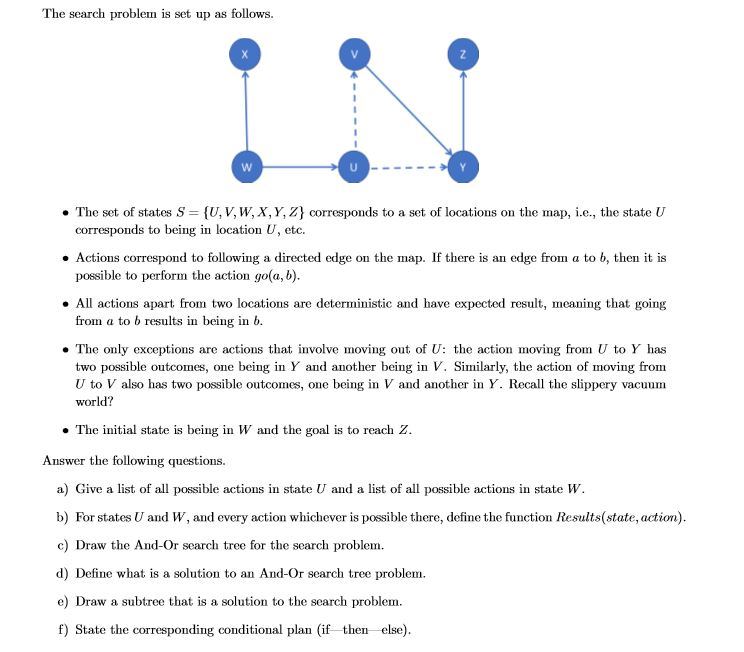
The search problem is set up as follows. . The set of states S-{U, V, W, X, Y, Z} corresponds to a set of locations on the muap, ie, the state U corresponds to being in location U, etc. Actions correspond to following a directed edge on the map. If there is an edge from a to b, then it is possible to perform the action go(a, b) All actions apart from two locations are deterministic and have expected result, leaning that going from a to b results in being in b. The only exceptions are actions that involve moving out of U: the action moving from U to Y has two possible outcomes, one being in Y and another being in V. Similarly, the action of moving from world? U to V also has two possible outcomes, one being in V and another in Y. Recall the slippery vacuum . The initial state is being in W and the goal is to reach Z Answer the following questions. a) Give a list of all possible actions in state U and a list of all possible actions in state W b) For states U and W, and every action whichever is possible there, define the function Results(state, action) c) Draw the And-Or search tree for the search problem. d) Define what is a solution to an And-Or search tree problem. e) Draw a subtree that is a solution to the search problem f) State the corresponding conditional plan (if then else)
Step by Step Solution
There are 3 Steps involved in it

Get step-by-step solutions from verified subject matter experts