







Question: The second order decomposition reaction 2 A ( g ) B ( g ) + C ( g ) is carried out in a 2
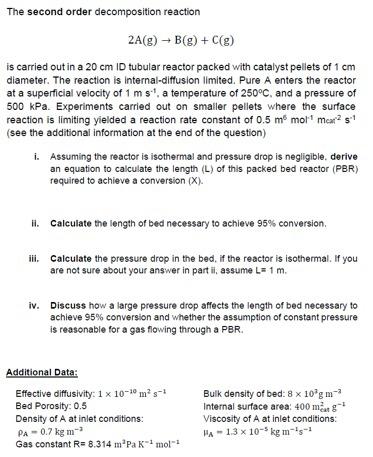
The second order decomposition reaction
is carried out in a ID tubular reactor packed with catalyst pellets of diameter. The reaction is internaldiffusion limited Pure A enters the reactor at a superficial velocity of a temperature of and a pressure of kPa. Experiments carried out on smaller pellets where the surface reaction is limiting yielded a reaction rate constant of see the additional information at the end of the question
i Assuming the reactor is isothermal and pressure drop is negligible, derive an equation to calculate the length L of this packed bed reactor PBR required to achieve a conversion X
ii Calculate the length of bed necessary to achieve conversion.
iii. Calculate the pressure drop in the bed, if the reactor is isothermal. If you are not sure about your answer in part ii assume
iv Discuss how a large pressure drop affects the length of bed necessary to achieve conversion and whether the assumption of constant pressure is reasonable for a gas flowing through a PBR
Additional Data:
Effective diffusivity:
Bed Porosity:
Density of at inlet conditions:
Gas constant
Bulk density of bed: Internal surface area: Viscosity of at inlet conditions:
Step by Step Solution
There are 3 Steps involved in it
1 Expert Approved Answer
Step: 1 Unlock

Question Has Been Solved by an Expert!
Get step-by-step solutions from verified subject matter experts
Step: 2 Unlock
Step: 3 Unlock
 Study Help