







Question: The Set Cover problem is defined thus: Given a universal set U and a set of subsets s-: {si, S2, . . . , Sm}
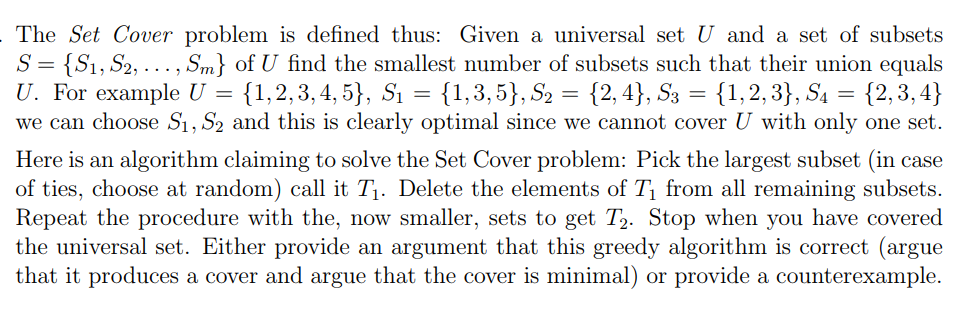
The Set Cover problem is defined thus: Given a universal set U and a set of subsets s-: {si, S2, . . . , Sm} of? find the smallest number of subsets such that their union equals U. For example U= {1.2, 3, 4, 5), Si-(1,3, 5),S= {2.4),S3_ {1.2.3}, S4=(2, 3, 4} we can choose S?, S2 and this is clearly optimal since we cannot cover U with only one set. Here is an algorithm claiming to solve the Set Cover problem: Pick the largest subset (in case of ties, choose at random) call it T1. Delete the elements of Ti from all remaining subsets Repeat the procedure with the, now smaller, sets to get T2. Stop when you have covered the universal set. Either provide an argument that this greedy algorithm is correct (argue that it produces a cover and argue that the cover is minimal) or provide a counterexample
Step by Step Solution
There are 3 Steps involved in it

Get step-by-step solutions from verified subject matter experts
 Study Help