







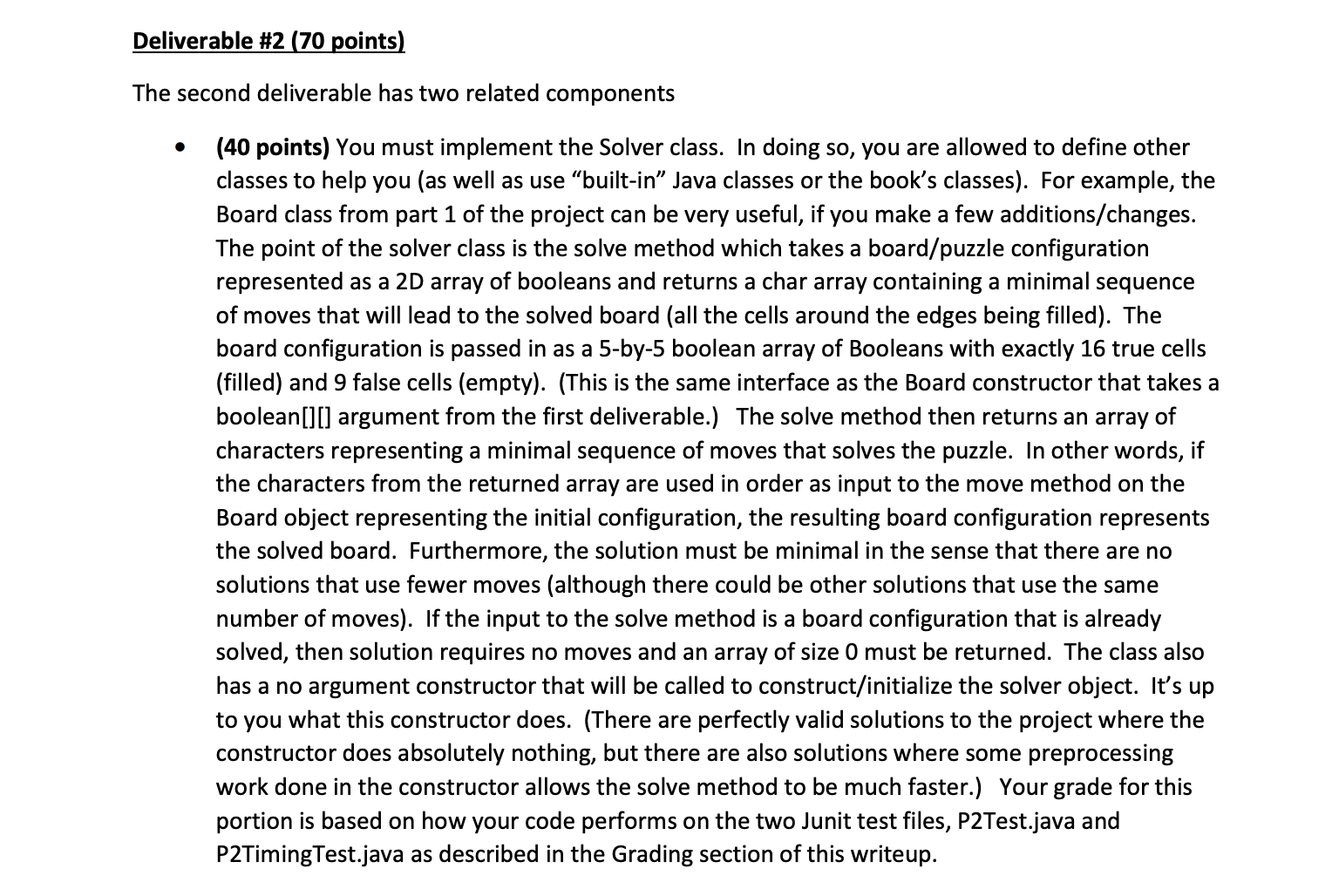
Question: The Solver class should be implemented to solve the puzzle game. You can define other classes as needed. The Solver class should have a constructor
- The Solver class should be implemented to solve the puzzle game. You can define other classes as needed.
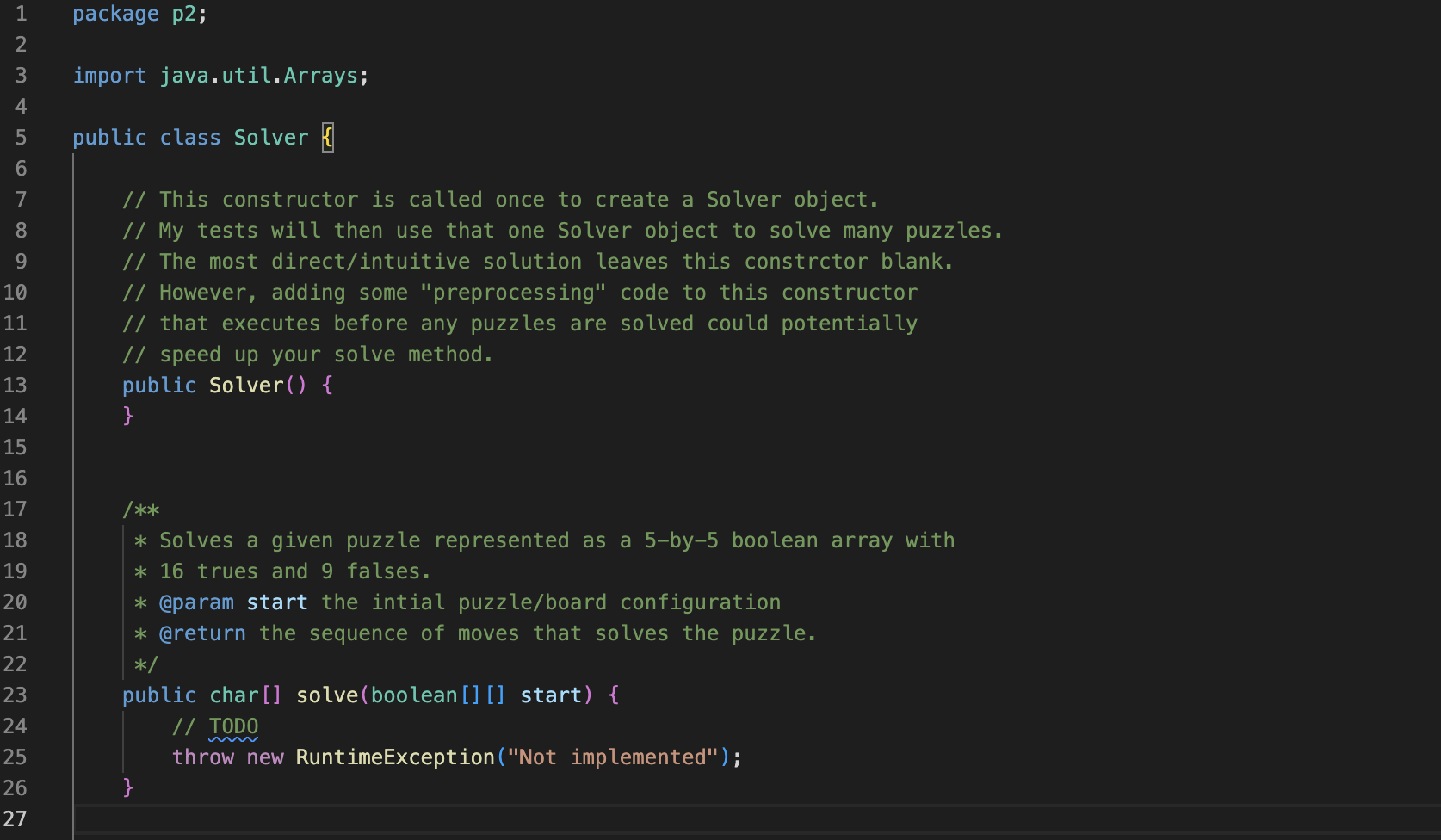
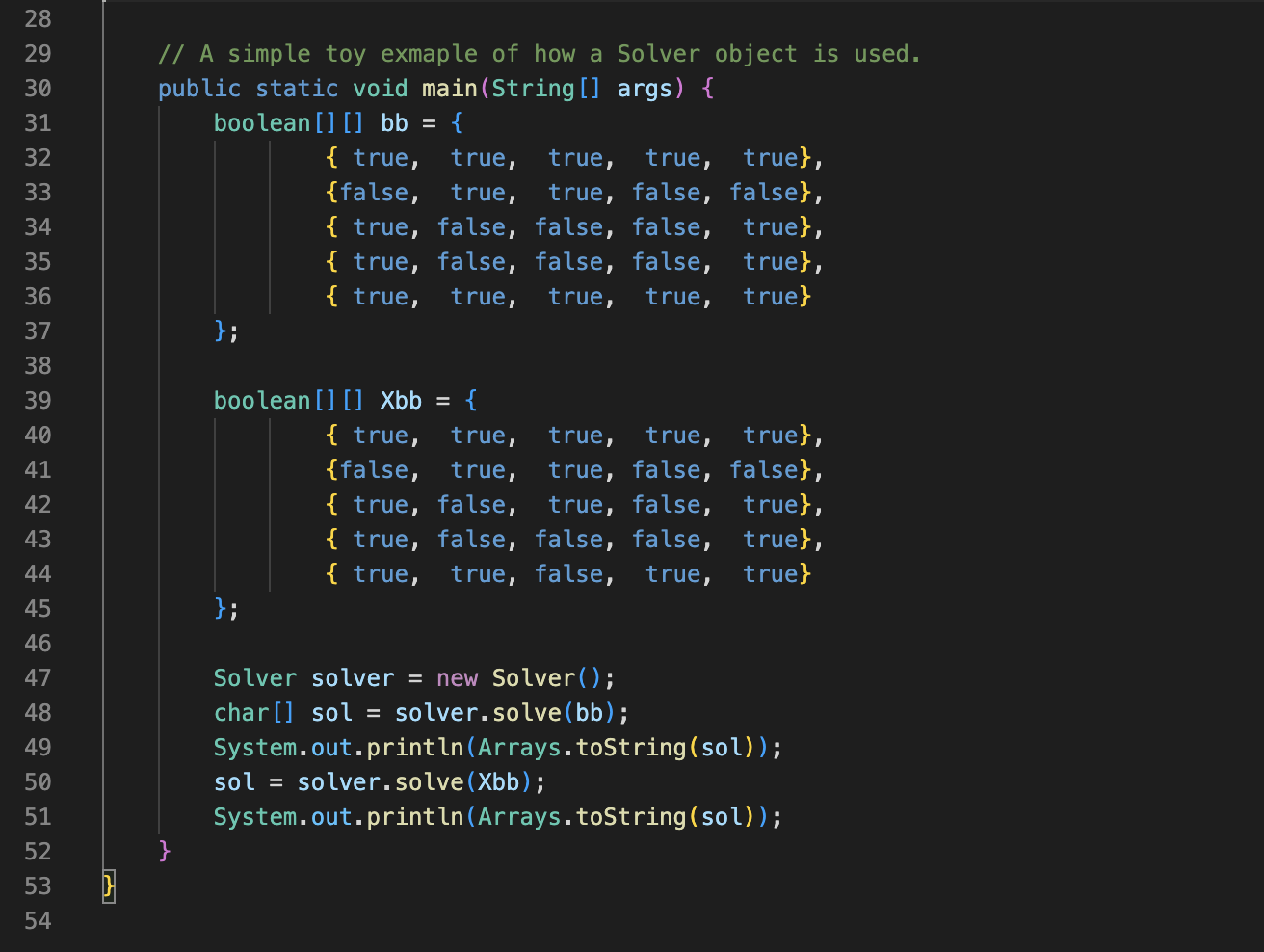
- The Solver class should have a constructor and a solve method that takes a 5x5 boolean array as input.
- The solve method should return a char array representing a minimal sequence of moves to solve the puzzle.
- The solve method should implement the logic to solve the puzzle based on the given rules.
Test Cases:
- The provided test cases in the P2Test class can help you ensure that your Solver class is working correctly.
- The test cases cover different configurations of the puzzle and check if the solve method returns the expected results.
- You can run the test cases in the P2Test class to verify the correctness of your implementation.
Preprocessing in Constructor:
- The prompt suggests that you can add preprocessing code to the constructor of the Solver class to potentially speed up the solve method.
- Consider if there are any calculations or data structures that you can initialize in the constructor to optimize the solve method's performance.
Timing Test:
- The P2TestTiming class provides a timing test to evaluate the efficiency of your implementation.
- It measures the time taken to solve a set of predefined puzzle configurations.
- You can run the timing test to check the performance of your solve method.
Based on the provided code and instructions, you need to implement the Solver class, write the necessary logic in the solve method, and ensure that it passes the provided test cases.
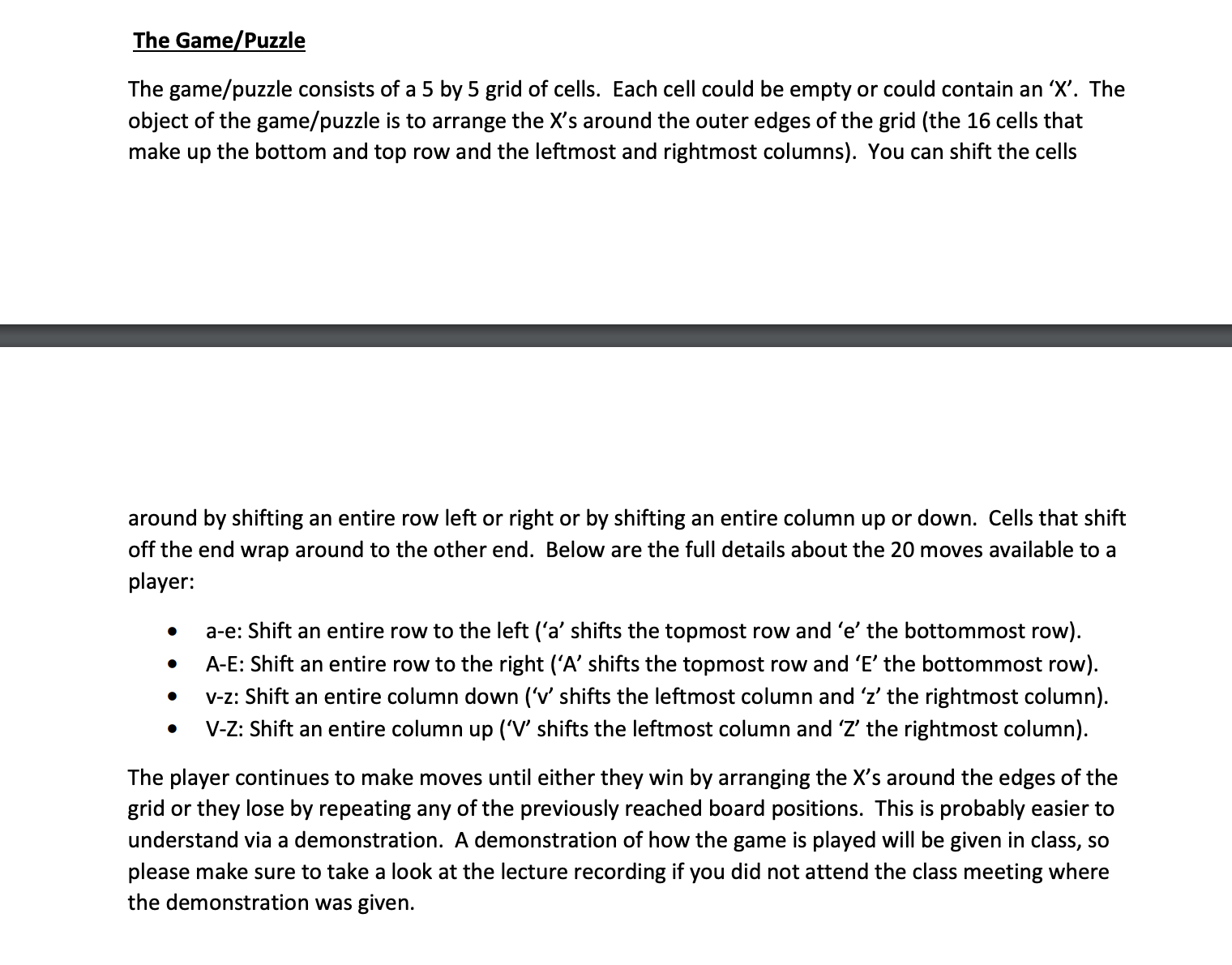
The Game/Puzzle The game/puzzle consists of a 5 by 5 grid of cells. Each cell could be empty or could contain an 'X'. The object of the game/puzzle is to arrange the X's around the outer edges of the grid (the 16 cells that make up the bottom and top row and the leftmost and rightmost columns). You can shift the cells around by shifting an entire row left or right or by shifting an entire column up or down. Cells that shift off the end wrap around to the other end. Below are the full details about the 20 moves available to a player: a-e: Shift an entire row to the left ('a' shifts the topmost row and 'e' the bottommost row). A-E: Shift an entire row to the right ('A' shifts the topmost row and 'E' the bottommost row). v-z: Shift an entire column down ('V' shifts the leftmost column and 'z' the rightmost column). V-Z: Shift an entire column up ('V' shifts the leftmost column and Z' the rightmost column). The player continues to make moves until either they win by arranging the X's around the edges of the grid or they lose by repeating any of the previously reached board positions. This is probably easier to understand via a demonstration. A demonstration of how the game is played will be given in class, so please make sure to take a look at the lecture recording if you did not attend the class meeting where the demonstration was given.
Step by Step Solution
3.43 Rating (153 Votes )
There are 3 Steps involved in it
To solve the puzzle game efficiently we can use a breadthfirst search BFS algorithm to explore all possible states of the puzzle starting from the ini... View full answer

Get step-by-step solutions from verified subject matter experts
 Study Help