







Question: The state evolution model allows us to model the relationship between the object state at the tth measurement and its state at the (t+1)th
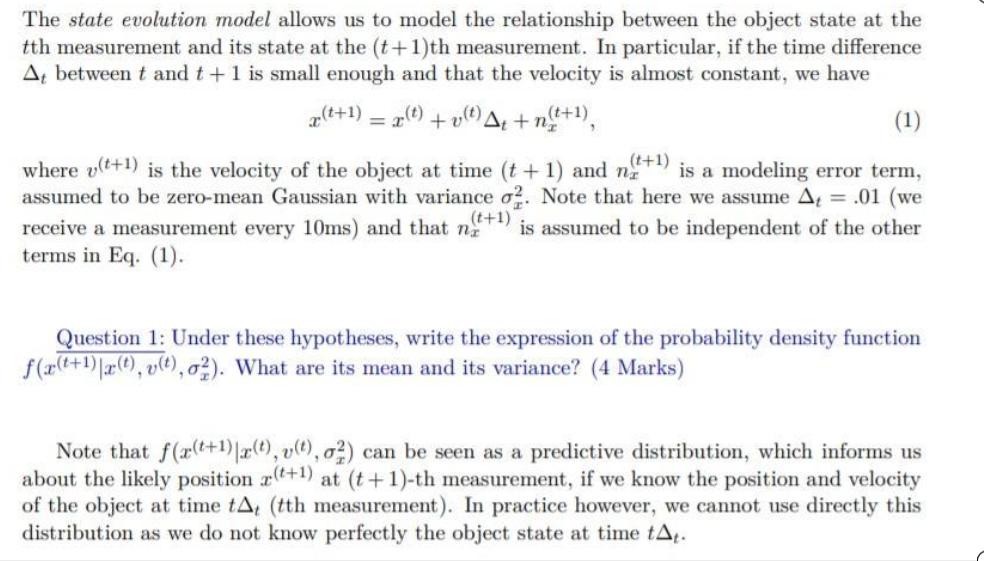
The state evolution model allows us to model the relationship between the object state at the tth measurement and its state at the (t+1)th measurement. In particular, if the time difference At between t and t + 1 is small enough and that the velocity is almost constant, we have 2(t+1) = x(t) +v(t) At + n(t+), (1) (t+1) where (t+1) is the velocity of the object at time (t+1) and n is a modeling error term, assumed to be zero-mean Gaussian with variance o2. Note that here we assume A = .01 (we (t+1) receive a measurement every 10ms) and that na is assumed to be independent of the other terms in Eq. (1). Question 1: Under these hypotheses, write the expression of the probability density function f(x(t+1) r(t), v(t), o). What are its mean and its variance? (4 Marks) Note that f(x(+1) r(t), y(t), 2) can be seen as a predictive distribution, which informs us about the likely position z(+1) at (t+1)-th measurement, if we know the position and velocity of the object at time tA, (tth measurement). In practice however, we cannot use directly this distribution as we do not know perfectly the object state at time tAt.
Step by Step Solution
3.43 Rating (166 Votes )
There are 3 Steps involved in it
olution Given data The expression of the probability den isty function fxx 1 ... View full answer

Get step-by-step solutions from verified subject matter experts
 Study Help