







Question: The Steps in Executing a Program 3 1. CPU receives signal from input device specifying input string is ready. 2. The operating system copies input
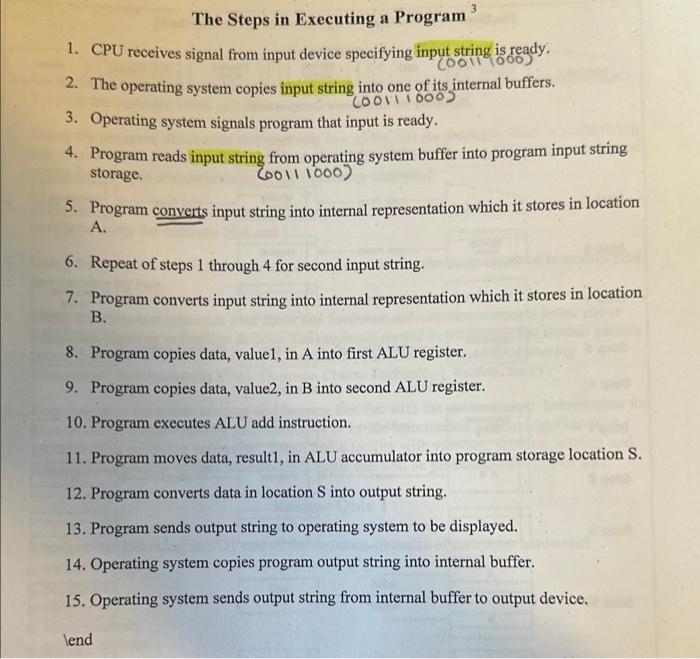

The Steps in Executing a Program 3 1. CPU receives signal from input device specifying input string is ready. 2. The operating system copies input string into one of its internal buffers. (00111000) 3. Operating system signals program that input is ready. 4. Program reads input string from operating system buffer into program input string storage. 60111000 ) 5. Program converts input string into internal representation which it stores in location A. 6. Repeat of steps 1 through 4 for second input string. 7. Program converts input string into internal representation which it stores in location B. 8. Program copies data, value1, in A into first ALU register. 9. Program copies data, value2, in B into second ALU register. 10. Program executes ALU add instruction. 11. Program moves data, result1, in ALU accumulator into program storage location S. 12. Program converts data in location S into output string. 13. Program sends output string to operating system to be displayed. 14. Operating system copies program output string into internal buffer. 15. Operating system sends output string from internal buffer to output device. Using a word processor such as WordPad or Word, modify the general description shown in the text to describe the walkthrough for a specific example. In this example, use 6 and 9 respectively instead of two arbitrary numbers in this figure
Step by Step Solution
There are 3 Steps involved in it

Get step-by-step solutions from verified subject matter experts
 Study Help