







Question: The syntax of the Excel function that returns the number of periods for an investment based on a periodic, constant payments at a certain rate
The syntax of the Excel function that returns the number of periods for an investment based on a periodic, constant payments at a certain rate of interest is:
A. NPER (rate, pmt, pv, [fv], [type])
B. NPV(rate, value1, [value2]...)
C. TIMEVALUE (time_text)
D. LOOKUP(look_value, lookup_vector, [result_vector])
Which of the arguments in the function to solve for number of periods are relevant and required?
Check all that apply.
-value1
-fv
-pmt
-look_value
-pv
Suppose you get a job offer from one of your dream companies and they are paying you within the range you would want your salary to be. Lets take this amount to be $45,000 per year. You are confident that working in this company would help you grow and charter a career path that you would like to pursue. You are curious to know that if your salary increases at the rate of 9.0% per year, how many years would it take to double your salary?
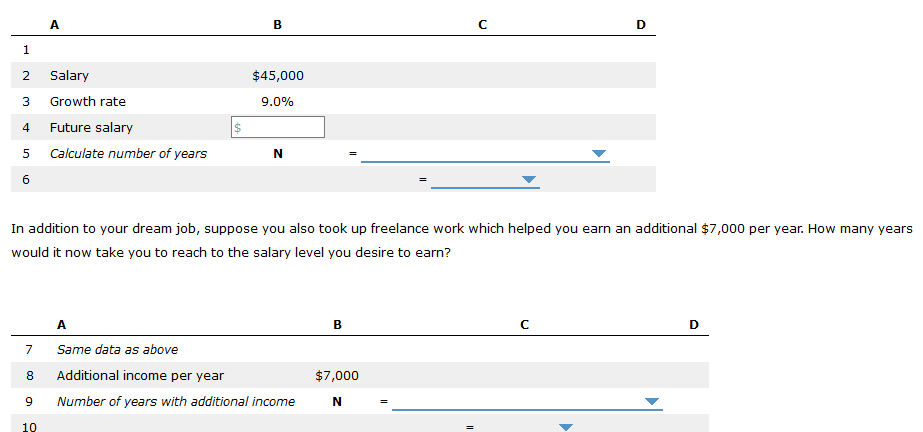
$45,000 9.0% 2 3 4 5 Salary Growth rate Future salary Calculate number of years N 6 In addition to your dream job, suppose you also took up freelance work which helped you earn an additional $7,000 per year. How many years would it now take you to reach to the salary level you desire to earn? 7 8 9 Same data as above Additional income per year Number of years with additional income $7,000 N = 19
Step by Step Solution
There are 3 Steps involved in it

Get step-by-step solutions from verified subject matter experts
 Study Help