







Question: The table shows results from polygraph (lie detector) experiments conducted by researchers on 58 subjects. In each case it was known if the subjected
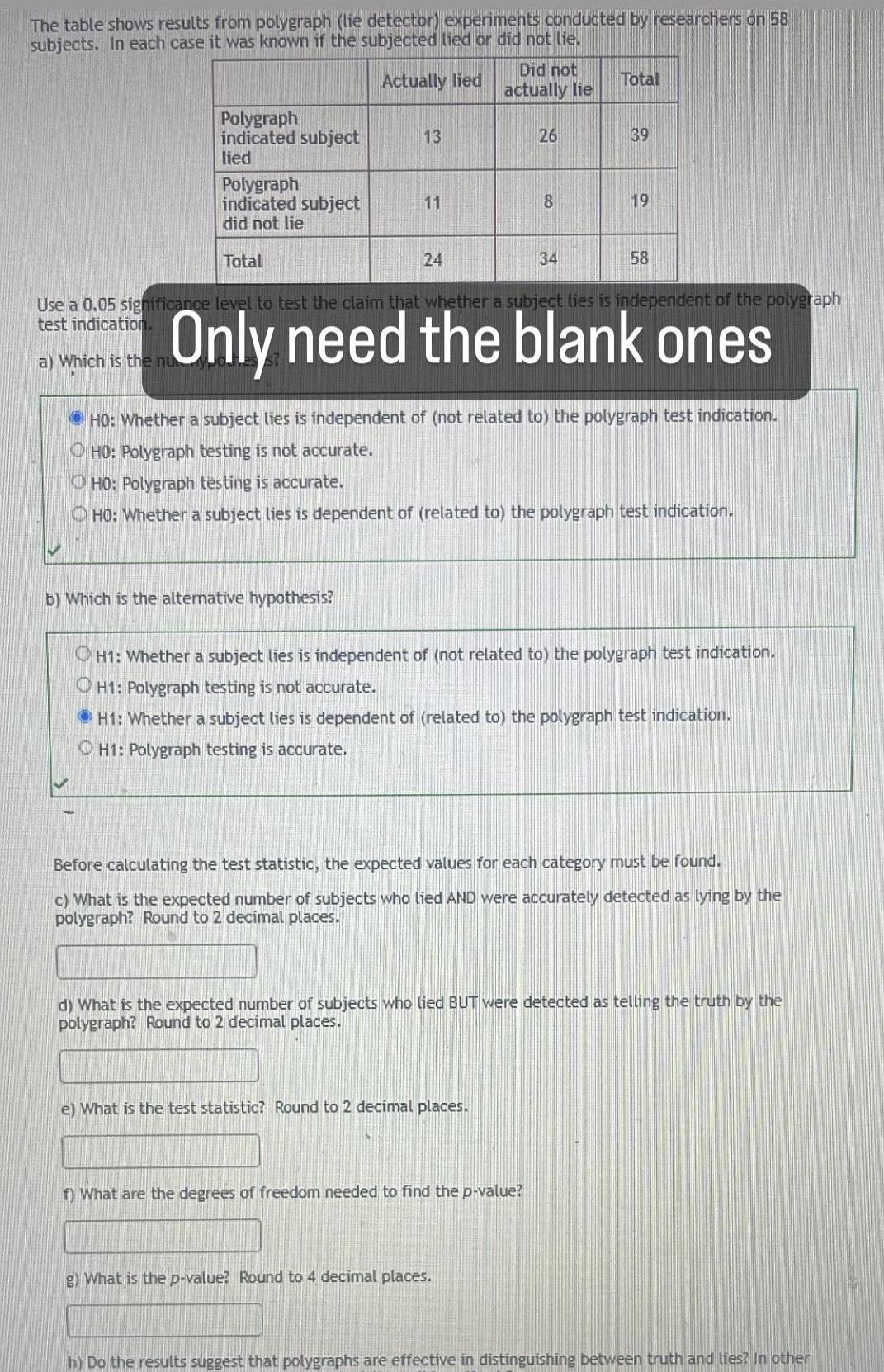
The table shows results from polygraph (lie detector) experiments conducted by researchers on 58 subjects. In each case it was known if the subjected lied or did not lie. Actually lied Did not actually lie Total Polygraph indicated subject 13 26 39 lied Polygraph indicated subject did not lie 11 8 00 19 999 Total 24 34 58 Use a 0.05 significance level to test the claim that whether a subject lies is independent of the polygraph test indication. a) Which is the nu Only need the blank ones HO: Whether a subject lies is independent of (not related to) the polygraph test indication. OHO: Polygraph testing is not accurate. HO: Polygraph testing is accurate. HO: Whether a subject lies is dependent of (related to) the polygraph test indication. b) Which is the alternative hypothesis? OH1: Whether a subject lies is independent of (not related to) the polygraph test indication. H1: Polygraph testing is not accurate. H1: Whether a subject lies is dependent of (related to) the polygraph test indication. OH1: Polygraph testing is accurate. Before calculating the test statistic, the expected values for each category must be found. c) What is the expected number of subjects who lied AND were accurately detected as lying by the polygraph? Round to 2 decimal places. d) What is the expected number of subjects who lied BUT were detected as telling the truth by the polygraph? Round to 2 decimal places. e) What is the test statistic? Round to 2 decimal places. f) What are the degrees of freedom needed to find the p-value? g) What is the p-value? Round to 4 decimal places. h) Do the results suggest that polygraphs are effective in distinguishing between truth and lies? In other
Step by Step Solution
There are 3 Steps involved in it

Get step-by-step solutions from verified subject matter experts
 Study Help