







Question: The text must be read to help answer the prompt. Please assist me on finding different potential risks that an organization DOES NOT forsee. PROMPT.
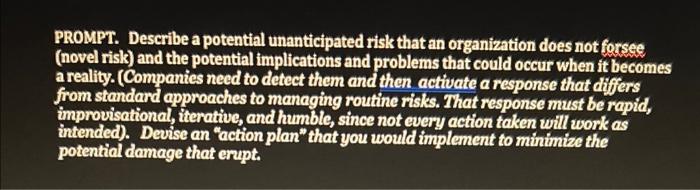
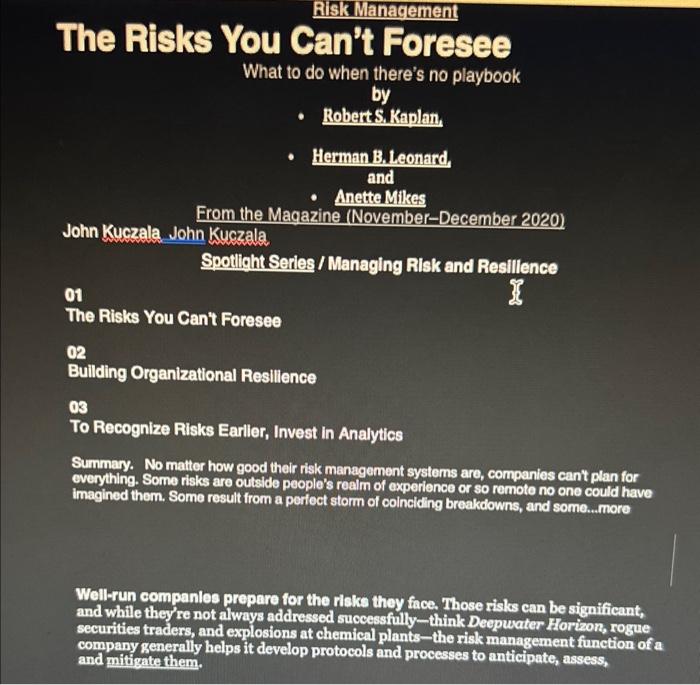
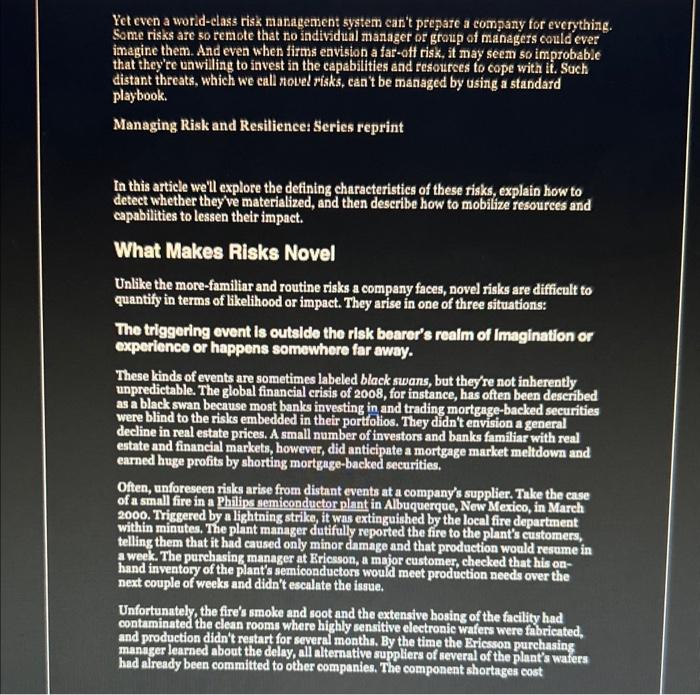
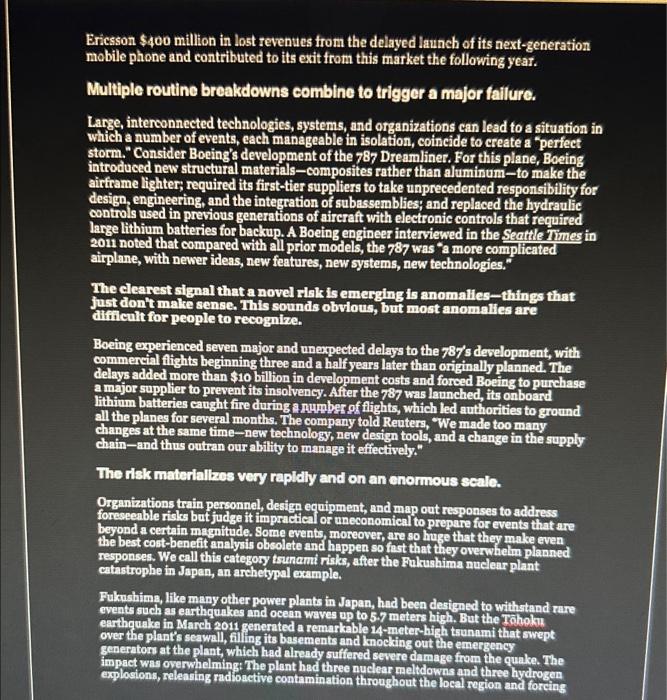
PROMPT. Describe a potential unanticipated risk that an organization does not forsee (novel risk) and the potential implications and problems that could occur when it becomes a reality. (Companies need to detect them and then activate a response that differs from standard approaches to managing routine risks. That response must be rapid, improvisational, iterative, and humble, since not every action taken will work as intended). Devise an "action plan" that you would implement to mnimize the potential damage that erupt. Well-run companles prepare for the risks they face. Those risks can be significant, and while they're not always addressed suocessfully-think Deepuater Eorizon, rogue securities traders, and explosions at chemical plants-the risk management function of a company generally helps it develop protocols and processes to anticipate, assess, and mitigate them. Yet cven a worid-class risk management system can't prepare a company for everything. Some risks are so remote that no individual manager or group of managers could ever imagine them. And even when firms envision a far-att risk, it may seem so improbable that they're unwilling to invest in the capabilities and resourees to cope with it. Such distant threats, which we call novel risks, can't be managed by using a standard playbook. Managing Risk and Resilience: Series reprint In this article well explore the defining characteristics of these risks, explain how to detect whether theyve materialized, and then describe how to mobilize resources and eapabilities to lessen their impact. What Makes Risks Novel Unlike the more-familiar and routine risks a company faces, novel risks are difficult to quantify in terms of likelihood or impact. They arise in one of three situations: The triggering event is outside the risk bearer's realm of Imagination or experience or happens somewhore far away. These kinds of events are sometimes labeled black swans, but theyre not inherently unpredictable. The global financial crisis of 2008 , for instance, has often been deseribed as a black swan because most banks investing in and trading mortgage-backed securities were blind to the risks embedded in their portiolios. They didn't eavision a general decline in real estate prices. A small number of investors and banks familiar with real estate and financial markets, however, did anticipate a mortgage market meltdown and earned huge profits by shorting mortgage-backed securities. Often, unforeseen risks arise from distant events at a company's supplier. Take the case of a small fire in a Philips semicondretor plant in Albuquerque, New Mexico, in March 2000. Triggered by a lightaing strike, it was extinguished by the local fire department within minutes. The plant manager dutifully reported the fire to the plant's customers, telling them that it had caused only minor damage and that production would resume in a week. The purchasing manager at Eriosson, a major customer, checked that his onnext couple of weeks and didn't escalate the issue. Unfortunately, the fire's smoke and soot and the extensive hosing of the facility had contaminated the clean rooms where highly sensitive clectronic wafers were fabricated, and production didn't restart for several montha, By the time the Ericsson purchasing manager learned about the delay, all altemative suppliers of neveral of the plant's wafers had already been committed to other companies. The component shortages cost Ericsson \$400 million in lost revenues from the delayed launch of its next-generation mobile phone and contributed to its exit from this market the following year. Multiple routine breakdowns combine to trigger a major failure. Large, intereonnected technologies, systems, and organizations can lead to a situation in which a number of events, each manageable in isolation, coincide to create a "perfect storm," Consider Boeing's development of the 787 Dreamliner. For this plane, Boeing introduced new struetural materials-composites rather than aluminum-to make the airframe lighter; required its first-tier suppliers to take unprecedented responsibility for design, engineering, and the integration of subassemblies; and replaced the hydraulic controls used in previous generations of aireraft with electronic controls that required large lithium batteries for backup. A Boeing engineer interviewed in the Seattle Times in 2011 noted that compared with all prior models, the 787 was "a more complicated airplane, with newer ideas, new features, new systems, new technologies." The clearest sigal that a novel risk is emerging is anomalies - things that just don't make sense. This sounds obvlous, but most anomalies are aifincult for people to recognize. Boeing experienced seven major and unexpected delays to the 787 s development, with commercial flights beginning three and a half years later than originally planned. The delays added more than $10 billion in development costs and foreed Boeing to purchase a major supplier to prevent its insolvency. After the 787 was launched, its onboard lithium batteries eaught fire during a number of flights, which led authorities to ground all the planes for several months. The company told Reuters, "We made too many changes at the same time-new technology, new design tools, and a change in the supply chain-and thus outran our ability to manage it effectively." The risk materialkes very rapldly and on an enormous seale. Organizations train personnel, design equipment, and map out responses to address foreseenble risks but judge it impractica or or uneconomical to prepare for events that are beyond a certain magnitude. Some events, moreover, are so huge that they make even the best cost-benefit analysis obsolete and happen so fast that they overwhelm planned responses. We call this category tsunami risks, after the Fukushima nuclear plant catastrophe in Japan, an archetypal example. Fuknshima, like many other power plants in Japan, had been designed to withstand rare events such as earthquakes and ocean waves op to 5.7 meters high. But the Tohoku earthquake in March 2011 generated a remarkable 14-meter-high tsunami that swept over the plants seawall, filling its basements and knocking out the emergency generators at the plant, which had already suffered severe damage from the quake. The impact was overwhelming The plant had three nuclear meltdowns and three hydrogen explosions, releasing radioactive contamination throughout the local region and forcing After the meeting the two companies agreed that "Philips and Nokia would operate as one company regarding those components, according to an interview the troubleshooter gave the Wall Street Journal. In effect, Nokia could now use Philips as its captive supplier for the two scarce chips. The relationship allowed Nokia to maintain production of existing phones, launch its next generation of phones on time, and benefit when Ericsson exited the mobile phone market. Digitize event reporting. Digital technology can be a powerful tool in the search for anomalies, as the experiences of the Swiss electricity utility Swissgrid illustrate. Through a user-friendly mobile app, RiskTalls, Syiscerid's employees can quickly report safety violations, maintenance problems, and imminent equipment failures. A rotating group of risk, safety, and quality managers monitor the app's messages in a central control room, applying data analytics to connect the dots between these small and unrelated reports and identify potential novel risks, A control room manager who believes that a low-probability novel risk might materialize can analyze it more deeply to determine whether to implement a nonroutine response. In effect, members of the team serve as the company's chief worry officers, empowered to think deeply about and respond quickly to novel risks. Recognizing a novel risk requires people to suppress their instincts, question thelr assumptions, and think deeply about the situation. In addition to encouraging employee reports, companies can look outside their organizations for information about novel risks, Svirssovid has joined forces with the Swiss army, the Swiss national police force, and several other federal and state agencies and corporations to develop a real-time national crisis-management platform that can be accessed by all parties involved. Bach entity uses the platform to report any issue it learns about, such as a forest fire, an accident triggering a massive trafific jam, or unusual spow conditions or avalanches in the Aps. Risk managers at Swissen. connected to the platform, get early visiblity into external situations that could potenterrupt the reliable flow of electricity to customers. Imegine what if. Companies can also identify potential novel risks indirectly-by looking at what has happened in other industries and countries and then asking themselves, "What if that happens here?" At Swisgrid the senior risk officer keeps an eye out for unsettling developments like the Swissair bankruptcy and the high-profile cyberattack on the shipping ginat Maersk Following any such event, he schedules an extraordinary-risk workshop attended by senior managers and risk officers from every business unit and by external subjectmatter experts. After deliberation, the group creates an aetion plin that can be deployed should something similar oecur in Swisegtidis supply chain. This systematic process helps the company spot potential novel risks and transform them into managed ones. As Swissqid's CEO. Yves Zumugald, has noted, "Our business, with individual risks and intricate connections spread across all our units, is too complex for any one individual to tathom. Yet we cannot wait for problems to show up and then solve them like firefighters. IThe systems we have put in place lenable us to solve a lot of problems proactively. "Those now include many risks that would be complete surprises to most other companies. Responding to Novel Risks For all a company's efforts to anticipate what-ifs, novel risks will still emerge, and companies will not have a script or a playbook for managing them "right of boom, or atter disaster has struck. Also, nothing in the backgrounds of operating or risk managers will help them respond quickly and appropriately. In this situation a company needs to makre decisions that are (a) good enough, (b) taken soon enough to make a difference, (c) communicated well enough to be understood, and (d) carried out well enough to be effective until a better option emerges. A company has two options for right-of-boom responses: Deploy a critleal-incldentomanagement team. This standard approach to a novel risk-creating a central team to oversee the response-works well when an event has widespread impact but doesn't need a complete, immediate solution. The team should consist of employees from different functions and levels of the company, external people with relevant expertise, and representatives of stakeholders and partners. For a novel event such as the Covid-19 epidemic, for example, a company's critical-incident team would need people with medical, public health, and public policy expertise, which the firm might not have in-honse. For managing the consequences of delays in large-scale product development-for instance, for a new aireraft-the team should work closely with its suppliers. Over time, as the situation changes and new information emerges, the membership of the team may change. AI communicntions should be brutnlly honest about the sltuation, hghlight clearly what the orgmination doesn't yet know, and provlde a ratlonal basis for hope. The team deciphers the situation, identifies the most important issues, and establishes priorities among the firm's multiple, and sometimes competing, constituencies and interests. It can delegate specific questions, such as how to access and preserve cash and how to manage key components in the supply chain, to other individuals or subgroups. to examine, but the team must maintain regponsibility for coordinating all aspects of the response. The team usually meets at least daily and more often if the event is evolving rapidly, It maneges communication within the firm and coaches the CEO on exdernal ommunications. All communications should be brutally honest about the reality of the situation, highlight clearly what the organization doesn't yet know, provide a rational basis for hope, and empathize with all stakeholders affected by the event. The discussion dynamics are important. A critical-incident team brings together diverse individuals who may have never met before and might be reluctant to speak candidly among people they don't know, especially those higher up in the organization. The aim is to encourage inquiry, not advocacy, which is why meetings must be psychologically safe gatherines where everyone can offer untested ideas and disagree. What is right is far more important than who is right. That's partly why someone other than the team's leader should facilitate meetings. By listening rather than speaking, the leader reduces the likelihood that subordinates will defer to their perception of the chief decisionmaker's opinion. Manage the crisis at the loeal levol. Some novel risks don't allow for the luxury of a critical-incident team. Time is of the essence, and details about the situation are difficult to communicate to company headquarters far from where the threat has emerged. In those situations, responses must be delegated to personnel closest to the event. Manacino Rlsk and ReAllianea In a lengthy, costly process, the company replaced its American guides with local guides in each country, who had considerable knowledge of their tegions and strong local ountacts. It empowered the new guides to problem-solve and implement a response to aay novel situation that arose during a trip. The company believed that the guides had the best information about challenges that might come up; the best knowledge, connections, and resources to develop creative responses; the best understanding of the tour group's preferences regarding responses; and the ability to put the chosen solution quickly into effect. The company's headquarters assisted them by performing tasks best handled by a central staff (such as rescheduling flights and rebooking hotel reservations). The travel company's decentralized approach of authorizing operations people to also serve as risk managers departs from established risk management standards. But for a distant novel-risk event requiring an immediate response, centralized risk managers would have limited information about the event, be unaware of local options and preferences, and have little to no ability to rapidly implement a response. The ODDA Loop The OODA loop-observe, orient, decide, act-was devised by a Korean War-era fighter pilot, Colonel John ... The initial decisions by either a centralized team or a local employee will be speculative, given how little information will be available in an uncertain, dynamic environment. Being perfectly exshctly gorrect cannot be a performance standard. Any response may, in hindsight, have been suboptimal. But the company has no alternative other than to make a quick, "probably approximately correct" decision, learn from it, acquire new information, and act again and again to stay ahead of events. (For more on how to do this, see the sidebar "Ihe OODA Loop.? Bisks come in many forms and flavors. Companies can manage the ones they know about and anticipate. But novel risks-those that emerge completely out of the blue-will arise either from complex combinations of seeminsly routine events or from unprecedentedly massive events. Companies need to detect them and then activate a response that differs from standard approaches to managing routine risks. That response must be rapid, improvisational, iterative, and humble, since not every action taken will work as intended. A version of this aticle appeared in the November-December 2020 lssue of Harvard Business Review. Read more on Rilk management or related topics Crisls management and Declalon making and problem solving - Pobert S. Keplnn is a senior fellow and the Marvin Bower Professor of Leadership Development, Bmeritus, at Harverd Business School. His recent HBR articles include: Incm riue Grovthr Profitoble Strateries for Trekting Pouerty. and Inequality (with George Serfigim and Bduardo Tugendhat), Hom to Ray for Hectif care: The Case for Eundled Paymenta (with Michael B. Portep)
Step by Step Solution
There are 3 Steps involved in it

Get step-by-step solutions from verified subject matter experts
 Study Help