







Question: The The net present value (NPV) method estimates how much a potential project will contribute to and it is the best selection criterion. The the
 The
The
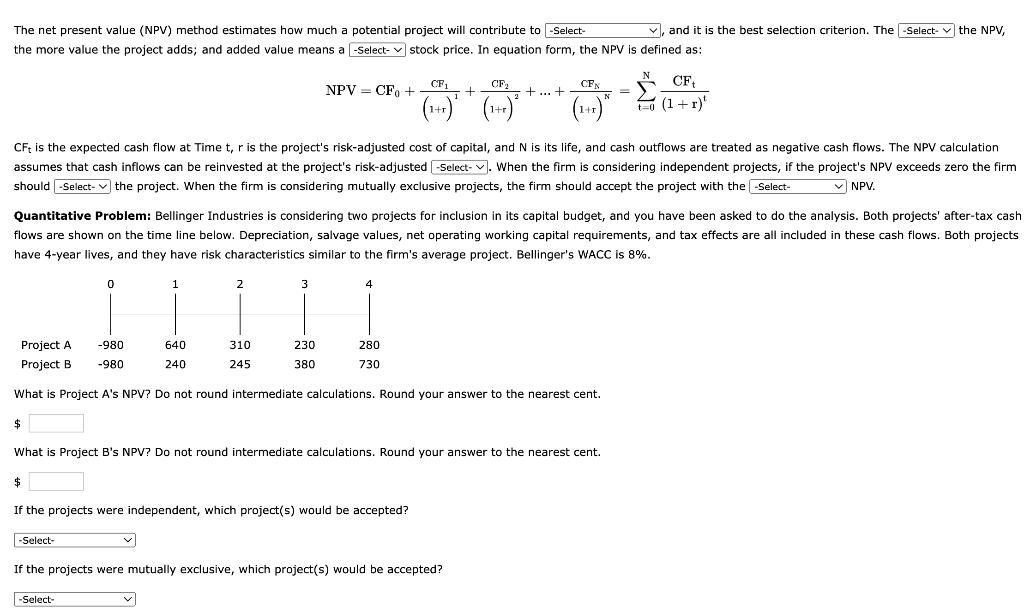
The net present value (NPV) method estimates how much a potential project will contribute to and it is the best selection criterion. The the NPV, the more value the project adds; and added value means a stock price. In equation form, the NPV is defined as: NPV=CF0+(1+r)1CF1+(1+r)2CF2++(1+r)NCFK=t=0N(1+r)tCFt CFt is the expected cash flow at Time t,r is the project's risk-adjusted cost of capital, and N is its life, and cash outflows are theated as negative the cas should the project. When the firm is considering mutually exclusive projects, the firm should accept the project with the NPV. Quantitative Problem: Bellinger Industries is considering two projects for inclusion in its capital budget, and you have been asked to do the analysis. Both projects' after-tax cash flows are shown on the time line below. Depreciation, salvage values, net operating working capital requirements, and tax effects are all included in these cash flows. have 4-year lives, and they have risk characteristics similar to the firm's average project. Bellinger's WACC is 8%. What is Project A's NPV? Do not round intermediate calculations. Round your answer to the nearest cent. $ What is Project B's NPV? Do not round intermediate calculations. Round your answer to the nearest cent. $ If the projects were independent, which project(s) would be accepted? If the projects were mutually exclusive, which project(s) would be accepted
Step by Step Solution
There are 3 Steps involved in it

Get step-by-step solutions from verified subject matter experts
 Study Help